
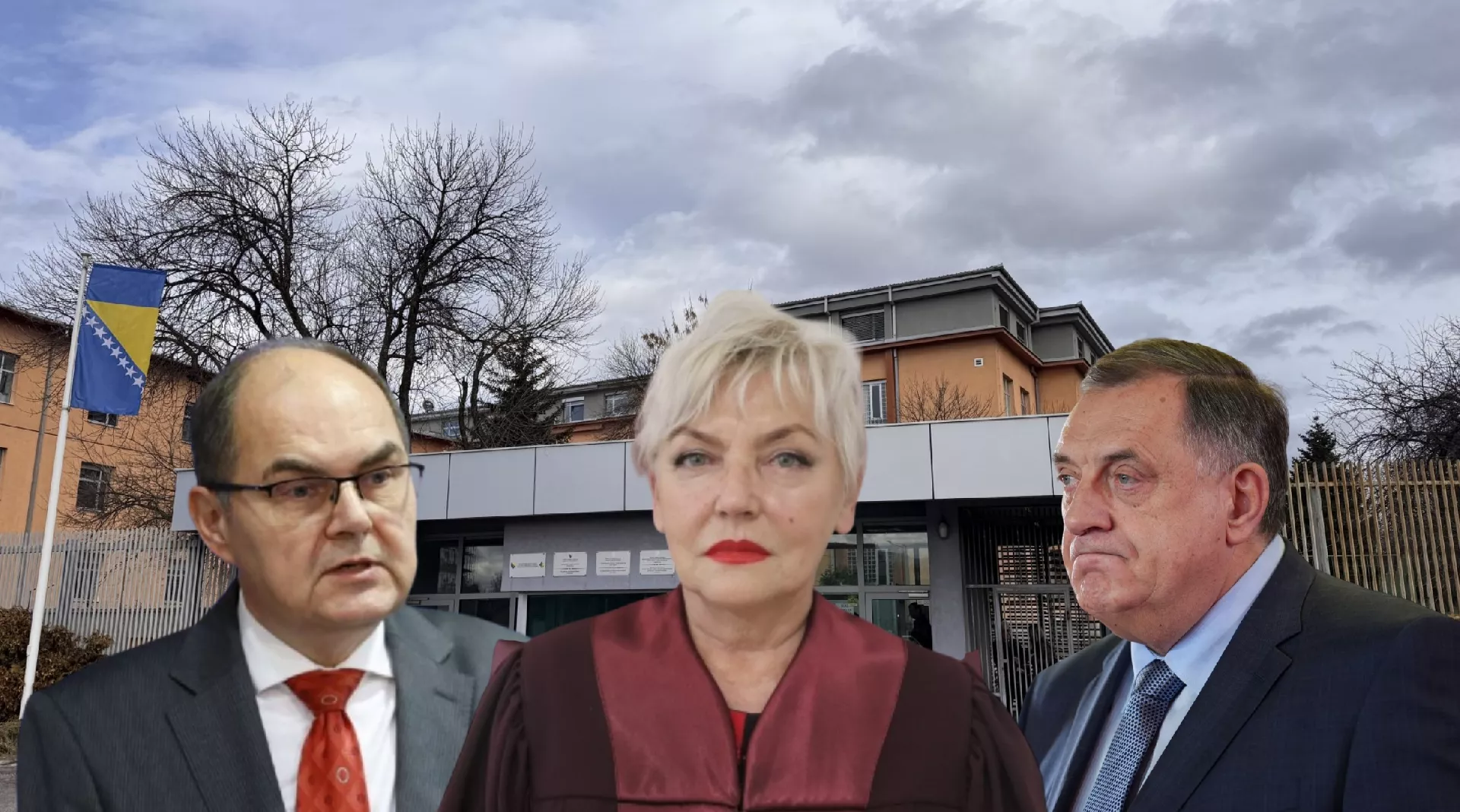
For NAP, written by: Sifet Kukuruz, legal expert
After the Court of BiH issued a verdict against Milorad Dodik, sentencing him to one year in prison and imposing a security measure prohibiting him from performing the duties of the President of Republika Srpska for six years, and after the Court of BiH publicly clarified that the legal consequences of the verdict take effect automatically, i.e., by force of law, and that after the verdict becomes final, the convicted Milorad Dodik cannot hold the position of SNSD president, citizens thought that the rule of law had finally been ensured in BiH and that a legal state had been established.
However, a painful awakening followed very quickly.
After the verdict was rendered, or more precisely, after it became final and enforceable, the real problems began. The enforcement phase of the verdict showed that the rule of law is still an unattainable ideal in BiH. There can be no doubt that court verdicts are one of the indicators of the rule of law, but the true test for the rule of law is the enforcement of verdicts. Verdicts that are not enforced are not only worthless, they are even harmful as such.
The question arises on its own: how is it possible for a final and enforceable verdict to exist, and yet not be enforced, or be partially enforced? As is known, Milorad Dodik acknowledged the verdict of the Court of BiH by paying a fine of KM 36,500 for the imposed prison sentence. The payment of this sum confirms that part of the verdict has been executed, and part has not, and it remains to be seen if it will be executed at all.
In the context of the above, the question arises: is it legally possible to partially enforce a verdict, and does partial enforcement of a verdict actually represent its negation? Does the current situation mean that the verdict is only what the perpetrator of the crime accepts and agrees to, or is the verdict what the Court of BiH has ruled? Given that the Court of BiH has publicly clarified that the final and enforceable verdict also applies to Milorad Dodik's inability to hold the position of SNSD president, the question arises: where is the problem, or more precisely, who is the problem and for whom or what reason is the final and enforceable verdict of the Court of BiH not being enforced? Who, and on what grounds, has the right to agree to or consent to the non-enforcement of a verdict, contrary to the law?
Regardless of the numerous spins, awkward justifications, and attempts to relativize the problem, the fact remains that cannot be obscured or hidden by anything: a final and enforceable verdict exists, it was rendered by the Court of BiH in the name of the state of Bosnia and Herzegovina, and that verdict has not been enforced to this day. That is the reality, and everything else is an excuse. And the non-enforcement of a verdict is not, and must not become, a political issue; it is the commission of a criminal offense. The Criminal Code of BiH is clear on this matter: whoever fails to enforce a final court decision that they were obligated to enforce is criminally liable. Therefore, it is completely logical and lawful to file a criminal complaint with the BiH Prosecutor's Office for the non-enforcement of a final and enforceable court verdict. Under such circumstances, when it is completely clear that a criminal offense has been committed by not enforcing a final and enforceable court verdict, the complaint is not pressure, not an attack, and not politicization; it is the correct application of the law.
And the BiH Prosecutor's Office is a state body that protects and enforces the decisions of the state of BiH and has the jurisdiction, meaning the responsibility, to conduct investigations, prosecute, and bring to justice perpetrators of criminal offenses over which the Court of Bosnia and Herzegovina has jurisdiction. In this specific case, it is precisely the Court of BiH that has finally ruled that a criminal offense has been committed. In this regard, the non-enforcement of the final and enforceable verdict for the criminal offense constitutes a new criminal offense. The BiH Prosecutor's Office is aware of this, and also has the mechanisms to prosecute perpetrators of criminal offenses. The only question is why the Prosecutor's Office lacks the will to perform its duties? If the BiH Prosecutor's Office does not have the will to do its job, then there are institutions and entities that are obligated to request it from the Prosecutor's Office, and in case of an ignorant attitude, to hold the Prosecutor's Office itself responsible for committing a criminal offense, because the Criminal Code of BiH stipulates that, in addition to not enforcing a court verdict, anyone who prevents or otherwise hinders its enforcement also commits a criminal offense.
Filing a complaint is respecting the law in a state that claims to be legal, and not filing a complaint or not using the mechanisms that can ensure the enforcement of a verdict is also a violation of the law. The BiH Prosecutor's Office has no right to act as if the problem does not exist; it is obligated to process the complaint, verify its validity, and inform the complainant about it. Anything else would mean not only complicity in institutional blockage but also complicity in the commission of a criminal offense.
The official position of the Prosecutor's Office would provide a clear answer to the key question or dilemma that has been artificially imposed on the public for months: is the verdict of the Court of BiH unclear, or is it intentionally not being enforced due to the political context and the OHR's decision to suspend funding for SNSD? There is no third option.
No less important fact to point out is that the Court of BiH is responsible for the enforcement of the final and enforceable verdict it has rendered. The Court cannot stop at rendering a verdict. Just as the verdict binds the person to whom it applies, it also binds the Court that rendered it. If the verdict is not voluntarily enforced, the Court of BiH, according to the law, is obliged to take measures for its forced enforcement. If the Court does not ensure the enforcement of the verdict, then it should not render it either, because without enforcement, the verdict is not just a "dead letter on paper"; it is simultaneously an open attack on the rule of law. Such a "dead letter on paper" can lead the state of BiH to its death.
Judge Sena Uzunović of the Court of BiH, in her letter to the BiH Central Election Commission (CEC), publicly pointed out that the verdict she rendered is clear, thereby confirming that the problem is not with the verdict. Therefore, if the problem is not with the verdict, the question must be asked: what or who is the problem then? However, in addition to clarifying the legal consequences of the verdict, the presiding judge Sena Uzunović should clarify why she sent the verdict to the BiH CEC and not to the registry court in Banja Luka, which is the only one that can execute the deletion of Milorad Dodik from the register of political organizations as a person authorized to represent SNSD. Also, Sena Uzunović owes an answer to the question of whether she officially requested information from the competent registry court on whether the legal consequences of the verdict have been implemented and, if not, for what reasons this has not been done.
If a verdict exists and is clear, and no one is enforcing it, then the problem is not with the law but with the constitutional loyalty and courage of BiH institutions to enforce their own decisions. If institutional silence continues and if all available legal mechanisms are not used, then it is clear that the system's institutions are heading down Milorad Dodik's path, not the path of the rule of law. In that case, it is no longer about a single verdict at all; it is about whether the law applies to everyone in Bosnia and Herzegovina, or only to those who have political protection. In this specific case, the essential question is to determine what kind of protection it is and whose protection it is: is it the protection of domestic institutions only, or does it also involve international institutions formally embodied in the OHR? Is the convicted Milorad Dodik, in addition to domestic institutions, also protected by Christian Schmidt, who made the decision to suspend funding for SNSD and the Alliance of Independent Social Democrats? Schmidt himself should and must answer this question, if he finds time from his almost daily meetings in Croatia with proponents of a third entity. The institutions of the BiH system must publicly, clearly, and loudly ask him: Is he, with his decision, protecting Milorad Dodik and nullifying the rule of law in BiH, or is he merely feigning a conflict with Dodik while, behind the scenes, making some new arrangement with him?
Given that there is a final and enforceable verdict of the Court of BiH which has not been challenged, overturned, or suspended, it must be insisted on an answer as to why the competent institutions are not ensuring its enforcement? Non-enforcement of a verdict is not a technical problem, not a procedural error, and not a legal dilemma. It is an open violation of the law. The only question is who is participating in this: the one who refuses to enforce the verdict but is obliged to take action for its enforcement; the Court of BiH, which refuses to initiate mechanisms for its forced enforcement despite it being a legal obligation and has not submitted the verdict to the registry court in Banja Luka; the BiH Prosecutor's Office, which does not want to initiate proceedings to determine the commission of a new criminal offense, which consists of the non-enforcement of a final and enforceable court verdict; the BiH CEC, which did not want to use legal remedies against the decision of the Basic Court in Banja Luka; the Disciplinary Prosecutor's Office, which, based on publicly available information that are notorious facts, does not want to initiate proceedings to determine responsibility for the non-enforcement of the court verdict; the registry court in Banja Luka, which has not deleted Milorad Dodik from the court register despite the clarification from the Court of BiH regarding the legal consequences of the court verdict; or the OHR, which does not want to resolve the artificial dilemmas regarding the financing of SNSD.
It is particularly hypocritical to hide behind the alleged "unclarity of the verdict." The verdict has already been clarified, as have the consequences it produces, and by the Court that rendered it. If it is clear to the media and the public, it must be clear to the institutions as well. Therefore, the real question is: why is the Court of BiH, for whom the consequences produced by the verdict are completely clear and who is aware that the verdict has not been enforced, not initiating legal mechanisms for its forced enforcement? The Court of BiH has no right to withdraw after rendering a verdict; it is legally responsible for its enforcement. If this is not happening, then the verdict becomes a "dead letter on paper," and the Court of BiH becomes its executor.
The argument that there is an OHR Decision on suspending the financing of SNSD is not, and cannot be, a legal argument. It is a political alibi. If an international decision suspends the enforcement of a domestic final and enforceable verdict, let the OHR state it clearly and take responsibility for such a position. If not, then it is institutional cowardice.
Even if Christian Schmidt's decision implied that SNSD should not be financed with public funds, it would not affect the enforcement of the Court of BiH's verdict in any way, because the verdict has gone through the appeal process, its legal basis has been confirmed, and it has become final and enforceable. The OHR does not annul or change final and enforceable court verdicts. On the contrary, the OHR has always taken actions to ensure that court verdicts are respected and enforced. Therefore, the enforceability of the verdict of the Court of BiH can no longer be prevented by anything, legally, except by cowardice or unlawful conduct of domestic institutions.
For now, it is not entirely clear who among the aforementioned institutions is responsible for the violation of the law, but that cannot and will not change the fact that the non-enforcement of the verdict of the Court of BiH is a criminal offense. And anyone who relativizes this, consciously or unconsciously, participates in the destruction of the legal order of BiH.
In a legal state, at this moment, criminal proceedings would be conducted, not discussions about this. If the aforementioned institutions remain silent, then it is not a lapse, but a conscious decision to violate or consent to the violation of the law.
Komentari (0)
Prijavite se za komentiranje
PrijavaJos nema komentara. Budite prvi!
Minuta
Sve →Iz drugih kategorija

High Representative Not Elected: Germans, French and British Sabotaged Americans, New Attempt at End of June

ČOVIĆ WITHOUT MERCY: How Those Who Brought Ademović to Office Created a Political Hell for Him



Sunny Saturday, quite warm



Tragedy in Albanian resort: Two minors drown












