
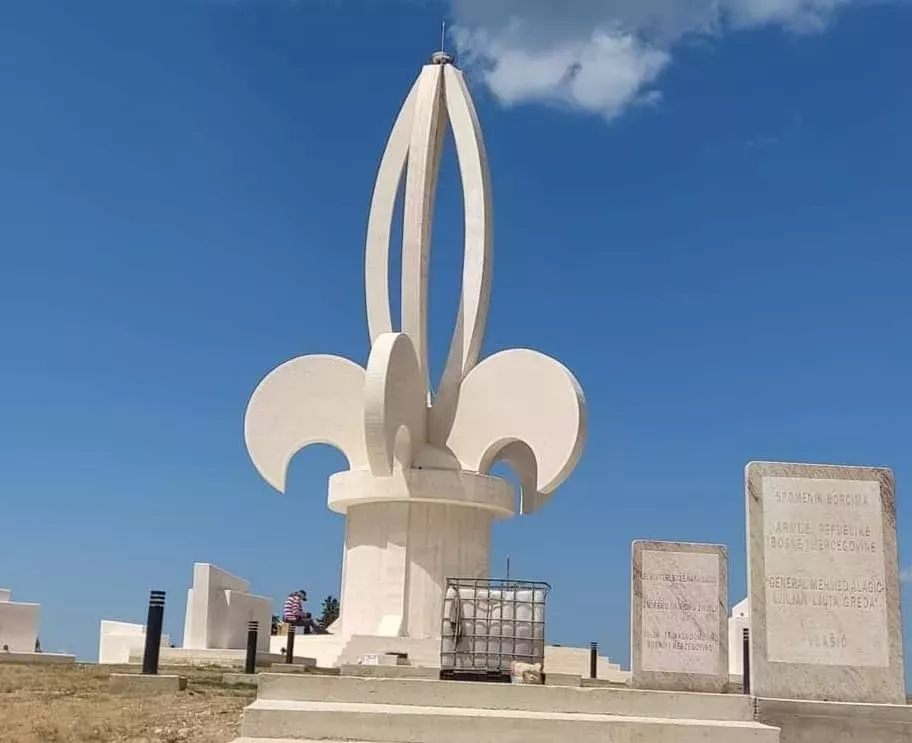
For NAP writes Sifet Kukuruz
The erection of a monument to General of the Army of the Republic of Bosnia and Herzegovina Mehmed Alagić certainly does not represent the celebration, relativization or denial of crimes committed during the war by certain members of the ARBiH, but challenging the erection of such a monument and equating General Mehmed Alagić with finally convicted war criminals, without any doubt, represents an attempt to relativize the truth about the war in BiH.
And disrespect for court verdicts which have finally established that the war in BiH was an international armed conflict, i.e., aggression of neighboring states against the RBiH.
The criticisms voiced, with the argument that in this way victims and their families are insulted and that the citizens of BiH deserve better, represent a subtle undermining of the true and legal truth based both on the final verdicts of the International Criminal Tribunal for the former Yugoslavia and on the verdict of the UN International Court of Justice for the genocide committed against Bosniaks in BiH.
To truly be able to speak about respecting victims and their families and strengthening trust in BiH, it is necessary first to work on accepting the legal facts that have been established and verified by the final court verdicts of the aforementioned courts.
Also, it is necessary to accept and respect the basic legal postulate that no one is a criminal until crimes are prosecuted and finally proven in court, and their commission is individualized and attributed to the perpetrator or to the person responsible for their commission under one of the legally prescribed grounds.
Without prior acceptance of judicially established facts and without respect for fundamental legal postulates, it is impossible to speak about respecting victims and their families.
Furthermore, one cannot speak about respecting victims, their families and establishing trust, as long as judicially proven crimes and crimes that are not judicially proven and individualized are equated. Respect and trust can hardly exist if finally convicted war criminals and persons who are accused, but not convicted of war crimes, are treated the same.
Attributing a crime and responsibility for that crime to someone without a prior court proceeding is manipulation of the truth, and such an attitude towards reality cannot represent a basis for establishing trust and showing respect for the victims of crime and their families, who have the right to a legal, not a political truth. It is precisely such an approach that could deprive the victim of the truth about the crime and its perpetrator.
Basing the process of respecting victims and their families on political views, and not on final court verdicts, represents not only ignoring, distorting and denying the past as it is described in court verdicts, but also disrespect for victims and their families.
The condemnations of the erection of the monument to General Mehmed Alagić represent, above all, an attempt to put on the same level individual crimes and great-state hegemonic projects that resulted in a joint criminal enterprise (JCE) and genocide against Bosniaks in BiH. And it should be recalled that both the joint criminal enterprise and genocide were a direct expression of great-state projects whose main goal was the destruction of the state of BiH and its citizens.
Of course, the greatest injustice towards surviving victims of crime and their families can be caused by criticism of unproven and unconvicted individual war crimes and simultaneous indifference, or even favoritism towards convicted criminal projects and their results.
It should be recalled that the entities and the so-called constituent peoples in BiH are a direct consequence of the unlawful use of force and as such are the result of the great-state hegemonic aspirations of neighboring states towards BiH.
Their existence after numerous verdicts establishing the legal nature of the war in BiH and after the verdict for the crime of genocide committed in BiH represents a true monument to crime, disrespect for victims and their families.
Instead of removing those monuments to crime, today the state of BiH and its citizens, through the hypocritical policy of the international community, are brought into an extremely humiliating position and forced to bow to those monuments every day.
That is why it is difficult to believe in the good intentions of representatives of the international community who condemn the erection of a monument to General of the Army of the Republic of Bosnia and Herzegovina Mehmed Alagić, who defended the state of BiH from a double, judicially proven, aggression.
Such criticisms, even if the legal presumption of innocence of the accused were ignored, which is impossible, can hardly be credible as long as the results of criminal projects are accepted and supported and everything is done on the political level to ensure that the results of those projects determine the future of the citizens and peoples of BiH. Sifet Kukuruz
And the citizens of BiH certainly deserve better.
Because of its role in the aggression and the genocide committed, the international community has lost the moral right to speak about respecting victims and their families. Such a right is permanently lost, especially in the context of the fact that the international community still imposes on surviving victims of crime and their families, as the only possible political-legal framework for living, nothing more or less than the result of the crime.
Such an attitude, in itself, raises the question of whether the international community shows respect for the crime or for the victims and their families?
Of course, individual crimes must not be denied or justified by anyone, but one must not agree with the approach that puts individual crimes and criminal projects on the same level, that equates those who attacked and destroyed the state of BiH and those who defended it, and especially that treats convicted war criminals and those to whom war crimes have not been attributed in finally concluded court proceedings the same.
In the interest of truth, justice and respect for surviving victims and their families, it should be said that the fight against evil is most harmed by an approach that combines the incompatible and equates cause and effect.
Such an approach, in itself, is unjust and overlooks the fact that individual crimes would not have occurred at all had there been no criminal projects. Also, one must never forget the fact that individual crimes would not have occurred, at least not to the extent they were committed, had the international community respected its international legal obligations. Given that these obligations were grossly ignored, the international community was and still is an accomplice in the crime, given that it still supports the results of the crime.
And the citizens of BiH deserve better than such an approach.
Komentari (0)
Prijavite se za komentiranje
PrijavaJos nema komentara. Budite prvi!
Minuta
Sve →Iz drugih kategorija

High Representative Not Elected: Germans, French and British Sabotaged Americans, New Attempt at End of June

ČOVIĆ WITHOUT MERCY: How Those Who Brought Ademović to Office Created a Political Hell for Him



Sunny Saturday, quite warm



Tragedy in Albanian resort: Two minors drown












