
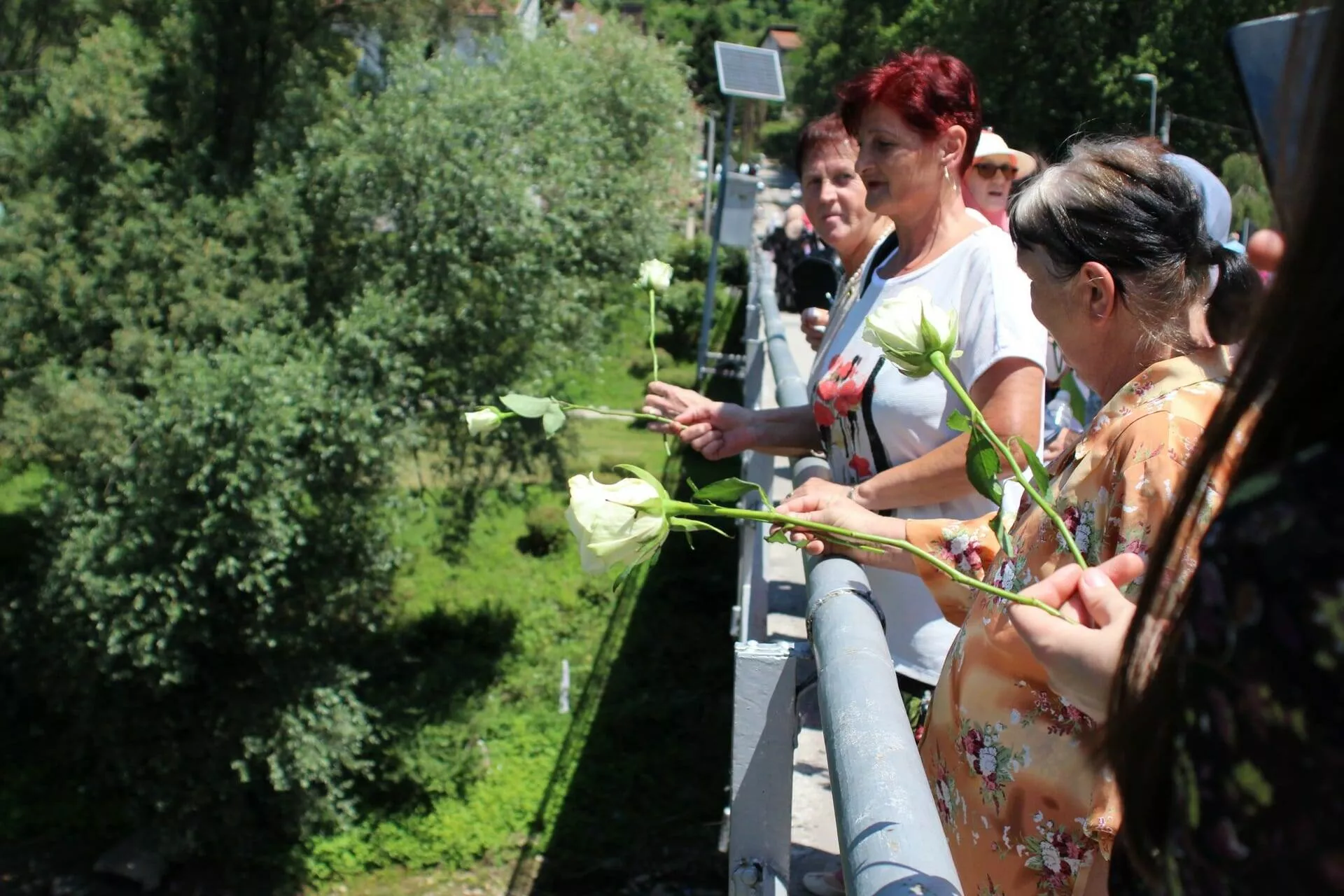
By releasing white roses from the Karlov Most into the Drina River on Sunday, the Day of Remembrance for all innocent victims and forcibly disappeared persons from Foča will be marked, announced victims' associations.
Earlier commemoration of the Day of Remembrance for those killed in Foča.
Mehmed Ćerimagić was taken on July 1, 1992, from the village of Mješaje, along with his brother and other neighbors, to the Foča Penal Correctional Facility. In mid-1993, according to the knowledge of his grandson Elvis Čaušević, he was in a group of men taken to pick plums.
“We know that anyone who went to pick plums never returned! I found out that he was most likely slaughtered in a barbaric way on the bridge in Brod in Foča and thrown into the Drina River. We never found a single bone of his,” Čaušević tells Detektor.
Every year, he brings his enlarged photo to the commemoration.
“The last time I saw my grandfather was at his house at the beginning of the war, when I came with my mother and sister to visit him and my grandmother in the village. He told my mother then: ‘Čupo, run away with the children, something is not right!’ One year, at the commemoration in Foča, I said that I cannot forgive, but we can be grateful if you tell us where our dead are, so we can bury them with dignity,” says Čaušević.
According to data from the victims' association “Foča 92-95,” 619 people from the area of this municipality are still being searched for.
Court rulings in The Hague established that the political and military takeover of power in the municipality of Foča began with Serbian forces shelling the town on April 8, 1992. The shooting and shelling were directed at settlements with a majority Bosniak population, such as Donje Polje, or with a mixed population, such as Čohodor Mahala, and the capture of the town was completed by mid-April 1992.
The Bosniak and other non-Serb population was systematically rounded up in raids; civilians were often treated cruelly, beaten, and sometimes killed. Men and women were separated and transferred to various detention facilities, such as schools and community centers, and the Foča prison, where they were subjected to humiliating and degrading treatment.
By symbolically releasing white roses into the Drina River from the Karlov Most in Foča in memory of all those killed, family members are sending a message that they do not want the crimes in this city to be repeated.
“Karlov Most is located in the immediate vicinity of the Foča Penal Correctional Facility, which during the war was the largest camp for men, and for a period also for women in the Foča municipality. Mostly, men were taken out of the KP home and killed on this bridge. This bridge has a sad history; the same thing happened in 1942,” says Midheta Kaloper from the victims' association “Foča 92-95.”
In the Hague rulings against Dragoljub Kunarac and others, then Radovan Karadžić, Ratko Mladić, Momčilo Krajišnik, and Milorad Krnojelac, it was established that hundreds of Bosniak men, as well as several other non-Serb civilians, were detained in the KP home without being accused of any criminal offense. From the end of the fighting until the end of 1994, there were always several hundred men detained there, for periods ranging from four months to more than two and a half years.
“We consider the Drina to be the largest mass grave in the Balkans, where the remains of our loved ones are still at the bottom of its riverbed, and there is a possibility that they will never be found,” fears Kaloper.
Izet Spahić, the only Bosniak councilor in the Foča Municipal Assembly, says that the victims' families call Karlov Most the “bridge of death” because people were killed on it and thrown into the Drina from there. He says that a very small number of people returned to this city after the war.
“From a security perspective, there were no problems. We managed to establish some communication, and it functions as it must. Foča is a known place of suffering for women during the war. Many criminals have not been brought to justice, we hope they will be. More than 600 Bosniaks are still listed as missing. The ‘Buk Bijela’ project has disturbed us, as we suspect there are mass graves at that location. We have spoken about this publicly, but we have not managed to change anything,” says Spahić for Detektor.
Komentari (0)
Prijavite se za komentiranje
PrijavaJos nema komentara. Budite prvi!
Minuta
Sve →Iz drugih kategorija

High Representative Not Elected: Germans, French and British Sabotaged Americans, New Attempt at End of June

ČOVIĆ WITHOUT MERCY: How Those Who Brought Ademović to Office Created a Political Hell for Him



Sunny Saturday, quite warm



Tragedy in Albanian resort: Two minors drown












