
(Patria) - Bosnia and Herzegovina is entitled to all state property, entities and other levels of government can be owners of property necessary for the exercise of their competencies, and any change of ownership after the breakup of Yugoslavia is null and void.
Among other things, this is stated in the Draft Law on State Property of BiH, which the Presidency of BiH submitted to the legislative procedure yesterday, and which Radio Free Europe (RSE) had access to.
The law was supported at the session of the Presidency of BiH by Denis Bećirović and Željko Komšić, while Željka Cvijanović was against it.
The Draft Law defines what state property is and under what conditions it can be leased or sold. It also foresees the establishment of a Directorate to manage the property and a unified register.
At the beginning of its implementation, 3,000,000 marks will need to be allocated for the law.
State property in BiH has been banned from disposal since 2005, by the decision of the then High Representative Paddy Ashdown, and will remain so until the BiH Parliament adopts a law on it.
What is written in the text?
It states that the law regulates the issue of state property that belongs to BiH - how it is disposed of, managed, used, and under what conditions it is transferred to others for use.
"Entities and other levels of government in BiH can manage and use or own state property that is necessary for the exercise of their individual competencies, to the extent they are authorized by this law," the document states.
The law warns that any disposal of state property or change of records after March 1, 1992, when BiH declared independence, is contrary to the law and invalid.
It is added that "the competencies of all territorial-administrative levels of government in BiH will be respected", and that their interests and needs will be taken into account in accordance with the BiH Constitution.
State property can be sold or leased, and the money obtained is used, among other things, for reforms, job creation, and infrastructure investments.
What is state property?
This refers to property that belongs to the state of BiH based on the succession agreement from 2001, as well as property managed by the Socialist Republic of BiH until 1991.
This includes airspace, waters, the coast, agricultural and forest land, public roads, streets, squares, as well as railway, electricity transmission, telecommunication, and other networks.
The state also owns the border area, national and cultural-historical monuments, as well as the international airports of Sarajevo, Banja Luka, Tuzla, and Mostar.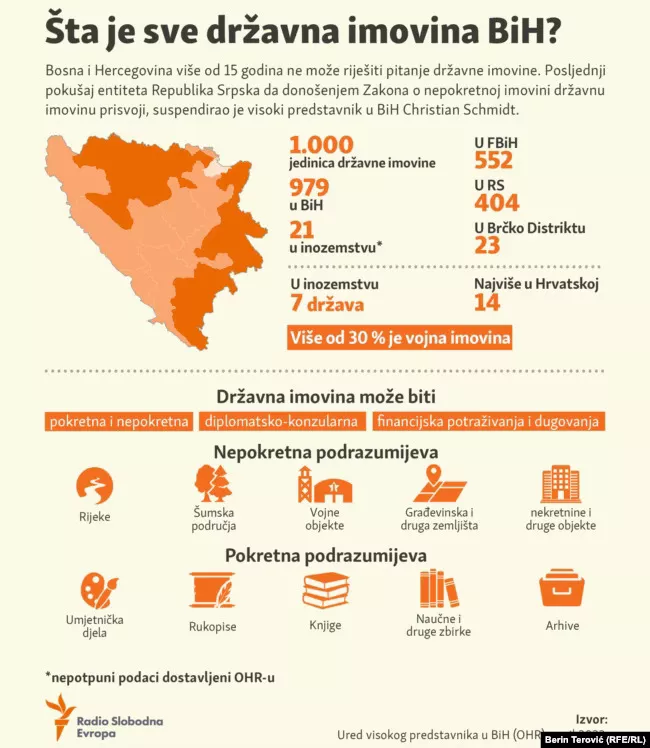
Graphic representation by Radio Free Europe
State property also includes assets necessary for the exercise of public authority by BiH institutions.
The law specifies on the basis of which laws from former Yugoslavia, as well as investments by then-institutions in the territory of BiH, certain public goods belong to contemporary Bosnia and Herzegovina.
Property that has been privatized is excluded from the application of the law.
Who disposes of the property?
The law provides for the establishment of a Unified Register of State Property and the establishment of a Directorate for Management and Record Keeping.
The Council of Ministers of BiH disposes of the property, in accordance with a five-year strategy adopted by the BiH Parliamentary Assembly at their proposal.
State property can be transferred free of charge in exceptional cases, if it will be used for the construction of public facilities, if these facilities are already built on it, or if it concerns the management of public goods.
The BiH Prosecutor's Office is responsible for representing the state in all matters concerning state property, while the Ministry of Finance and Treasury oversees the implementation of the law.
Fines of up to 20,000 KM are foreseen for a person who issues an act of disposal of state property that is contrary to the law.
Within six months of the law coming into force, state bodies and public services, as well as services of lower levels of government, will have to conduct an inventory, appraisal, and registration of the movable and immovable property they use.
If something was acquired through joint investment by different levels of government, ownership will be determined proportionally to the invested money.
The Directorate is obliged to submit a report to the Council of Ministers on the state of state property in the country within one year of the law coming into force, and the Council of Ministers will present the same report to the BiH Parliament within the next six months.
What are the chances of the law coming into force?
As things stand, it is possible that the Proposal will not even reach Parliament.
Marinko Čavara, the second Deputy Speaker of the House of Representatives of the BiH Parliament, said he was "shocked" that members of the BiH Presidency had proposed the law.
- They have previously proposed a law, I don't even know which one, which was also not considered at all in Parliament, nor will this one be considered, because they are not authorized proposers according to the Rules of Procedure of the BiH Parliamentary Assembly, nor the Constitution - claims Čavara.
However, he stated that the issue of state property must be resolved "as soon as possible", because many investments are blocked due to the absence of a law.
Member of the BiH Presidency Željka Cvijanović, who voted against the Draft Law, stated that this body cannot be an authorized proposer, and that this is "politicking".
The official website of the BiH Parliament states that the BiH Presidency, within its competencies, can be a proposer of laws. It is not specified which competencies.
Disputes over state property
The explanation of the proposed law states that there were two previous attempts to adopt this law, in 2008 and 2016, but neither of them even reached the debate stage.
It is emphasized that both entities, RS and FBiH, have appropriated state property, but the RS "has tried to legally regulate the issue of state property in several of its unconstitutional laws".
It is stated that it is unknown how much property has been illegally re-registered, usurped, seized, alienated, and misused.
The RS has previously claimed that state property belongs to the entities, not to the state of BiH, and its political representatives oppose any attempts to pass a law.
Several laws passed by the RS concerning state property have been overturned by the Constitutional Court of BiH, writes RSE.
Komentari (0)
Prijavite se za komentiranje
PrijavaJos nema komentara. Budite prvi!
Minuta
Sve →Iz drugih kategorija

High Representative Not Elected: Germans, French and British Against Americans, New Attempt at End of June

ČOVIĆ WITHOUT MERCY: How Those Who Brought Ademović to Office Created a Political Hell for Him



Sunny Saturday, quite warm



Tragedy in Albanian resort: Two minors drown












