
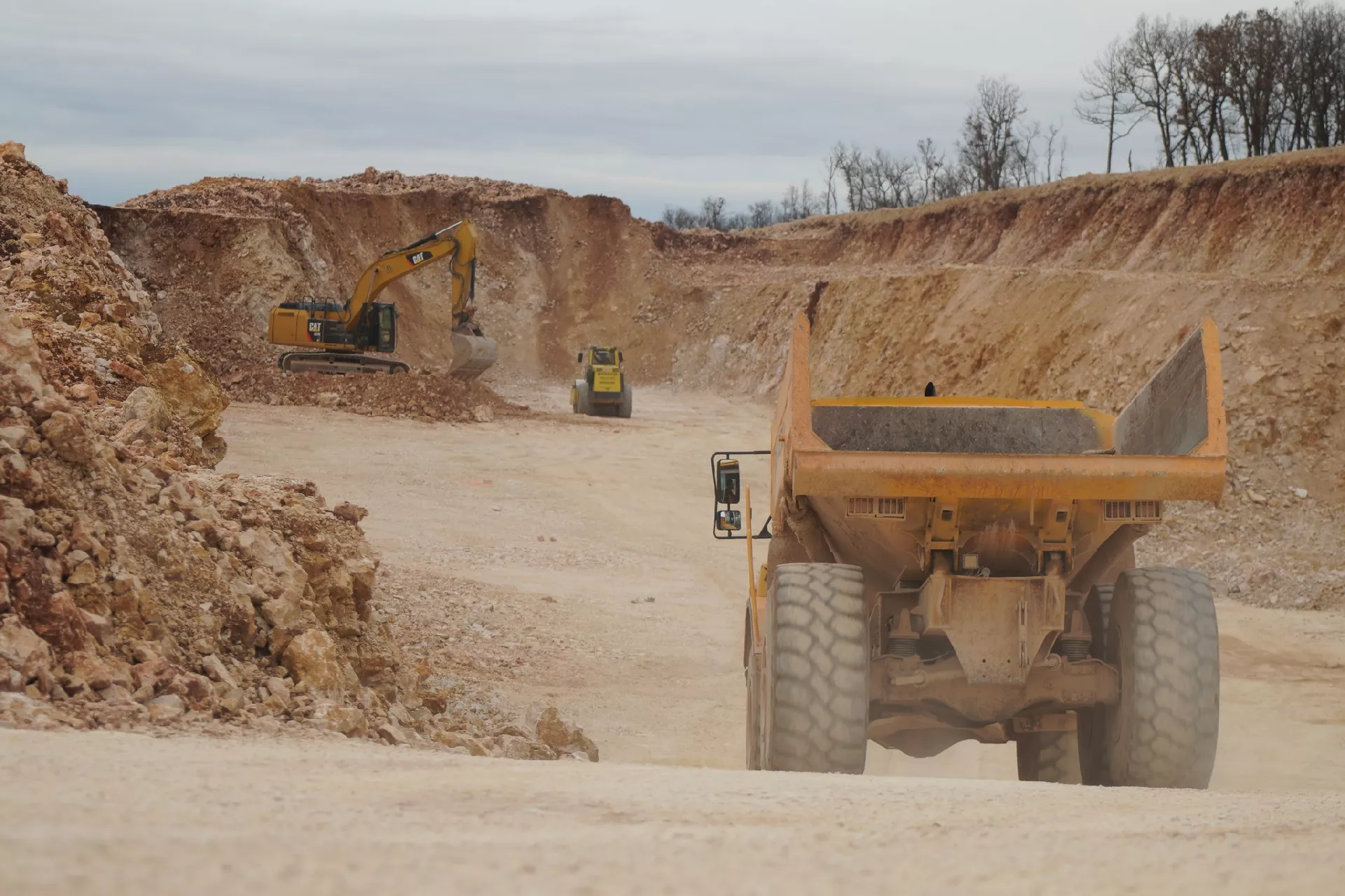
(Patria) - In its three-year business plan for the period 2026-2028, the management of Autoceste Federacije BiH presents ambitious infrastructure plans.
However, the financial part of the document reveals deep structural problems plaguing this public company, primarily – enormous dependence on loan debt, liquidity issues, and a constant search for new sources of financing, writes Istraga.ba.
Information published by the media today about the suspension of works on the construction of the A1 Medakovo - Ozimice highway section due to non-payment to contractors, while international creditors from the EBRD demand the dismissal of the management led by director Denis Lasić and executive director Asmir Dževlan, also indicates that the long-term sustainability of Autoceste's operations is seriously threatened.
Borrowing as a Business Model
The introduction to Autoceste's three-year business plan states that one of the company's key tasks is to "continue activities on securing funds from various sources, international loan funds, grant funds, funds from the budget of the Federation of BiH, or from other sources of financing".
At the same time, the need to "ensure prerequisites for overcoming liquidity problems in cooperation with the Government of FBiH" is emphasized. In other words, the stability of Autoceste's future operations will directly depend on new sources of money – which ones, how much, and from where exactly – is unknown.
Currently, there are ten active construction sites in the Federation – eight on Corridor Vc and two sections of expressways. The total value of contracted works on Corridor Vc amounts to approximately 2.49 billion KM, while around 313 million KM is invested in additional expressway sections.
Numerous new projects are also in preparation, including the Prenj tunnel, the Mostar sjever - Mostar jug and Mostar jug - Kvanj tunnel sections, the Lašva - Travnik - Jajce, Prača - Goražde, and Bihać - Cazin - Velika Kladuša expressways, and the Orašje - Tuzla highway.
Total investments in the construction of highways and expressways are planned at 1.49 billion KM in 2026, 1.57 billion KM in 2027, and 1.61 billion KM in 2028.
The projected revenues of Autoceste Federacije, which come from three main sources (fuel excise taxes, tolls, and road land use fees), are expected to amount to 228.8 million KM in 2026, 285.3 million KM in 2027, and 317.7 million KM in 2028.
However, although an annual revenue increase of several tens of millions of KM is projected, this money is far from sufficient compared to the planned obligations and investments.
Huge Loan Burden
Obligations, including loan repayments, interest, and other financial costs, exceed the company's total planned revenues. Solely on this basis, Autoceste FBiH must secure 380 million KM in 2026, 389 million KM in 2027, and 327 million KM in 2028 over the next three years.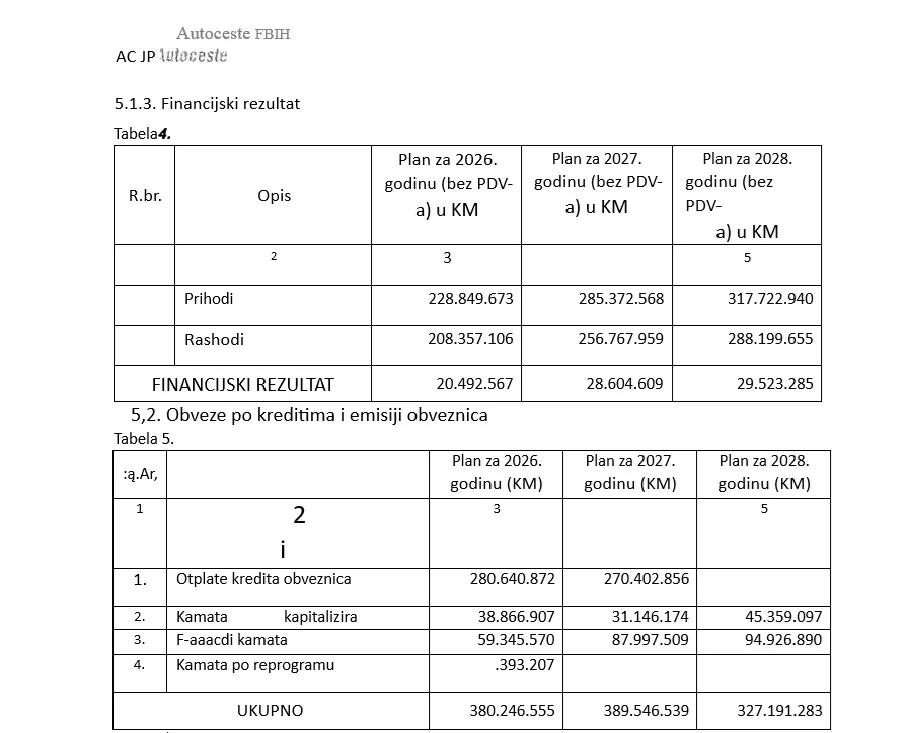
The three-year plan clearly shows that borrowing represents a permanent business model. It states that, in case of insufficient funds, which is a realistic expectation, the company will resort to new borrowings. Funds will be secured through the issuance of securities, short-term commercial borrowings, and new credit arrangements with international financial institutions.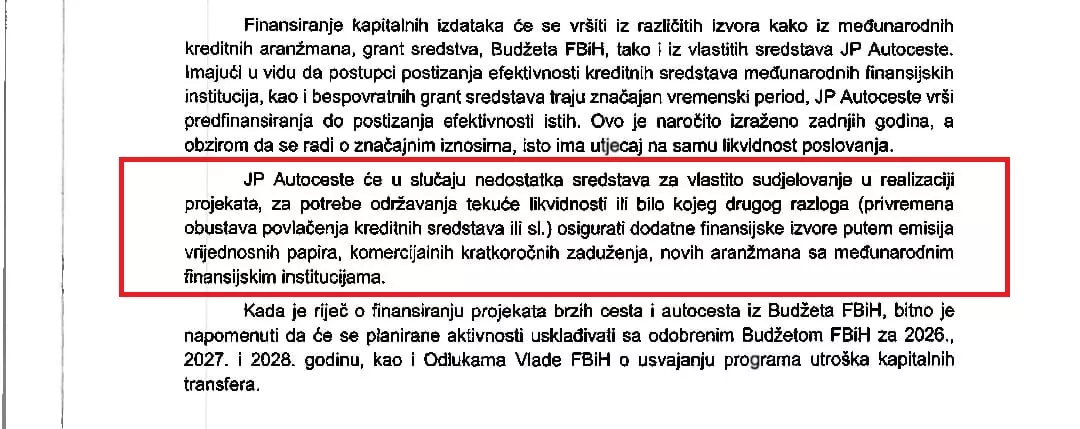
Comparing the planned revenues, loan obligations, and investment plans, it is clear that the business model of Autoceste Federacije BiH is currently based on constant borrowing.
As long as international creditors approve new loans, the highway is being built. The moment the loans stop, as is already happening, the largest infrastructure project in the country also stops.
Komentari (0)
Prijavite se za komentiranje
PrijavaJos nema komentara. Budite prvi!
Minuta
Sve →Iz drugih kategorija

High Representative Not Elected: Germans, French and British Sabotaged Americans, New Attempt at End of June

ČOVIĆ WITHOUT MERCY: How Those Who Brought Ademović to Office Created a Political Hell for Him



Sunny Saturday, quite warm



Tragedy in Albanian resort: Two minors drown












