
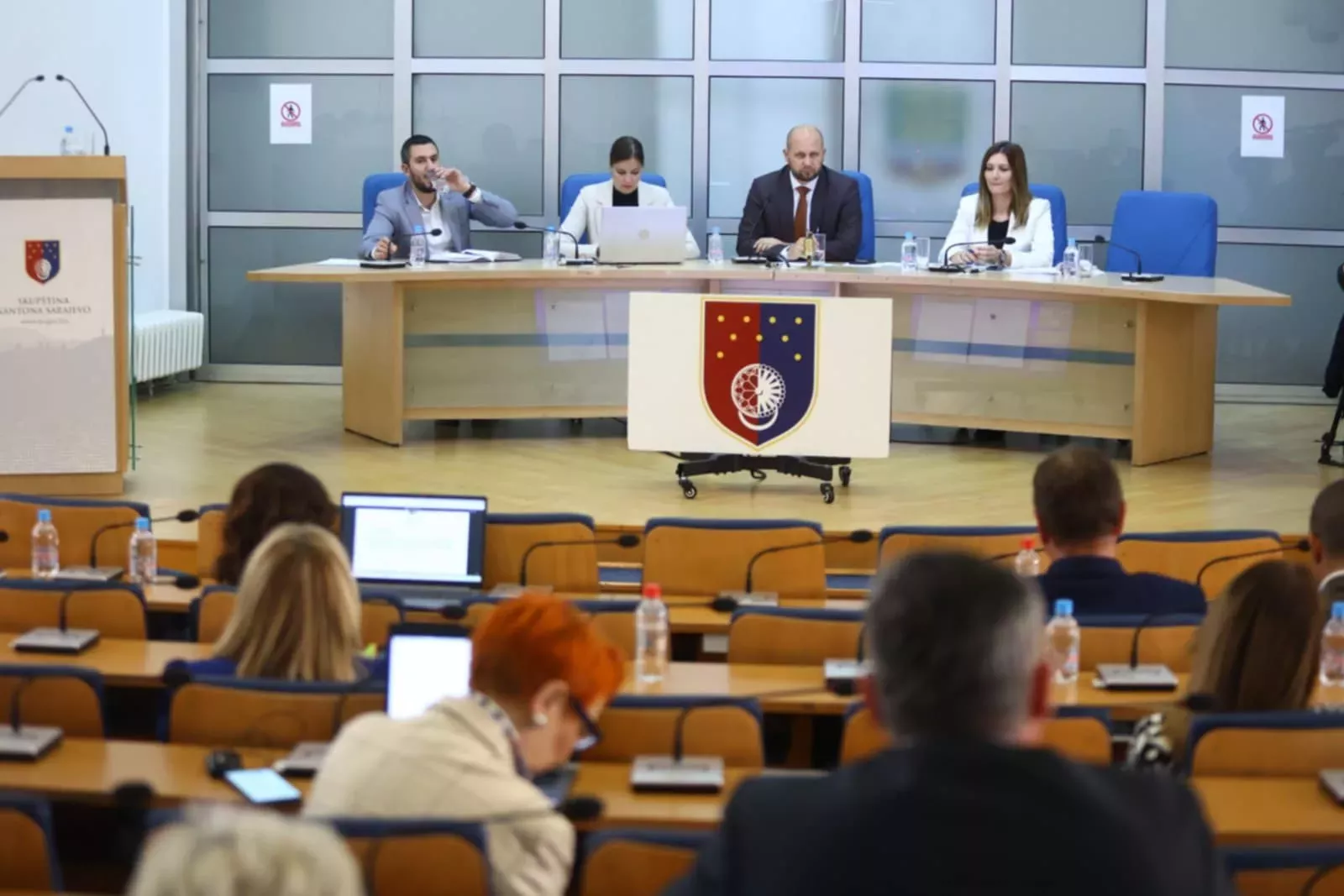
(Patria) - A new attempt by the Commission for Constitutional Affairs of the KS Assembly to give a positive opinion on the proposed amendments to the Rules of Procedure of the KS Assembly, whose proponents are members of the KS Assembly leadership Elvedin Okerić, Jelena Pekić and Vibor Handžić, has failed.
The first attempt was a few days ago, and today the Chairman of the Commission, Aljoša Čampara, scheduled a new session in an attempt to secure a positive opinion before the Rules of Procedure are considered at the next session of the KS Assembly on November 26. However, today there was no majority to support Čampara's intention.
The Commission for Constitutional Affairs includes, besides Čampara, Muamer Bandić, Vibor Handžić (NS), Haris Zahiragić (SDA), and external members: Minela Dacić, Elmina Čopra, Hidajeta Redžić. Bandić warned earlier, and again today, that these are unconstitutional amendments to the Rules of Procedure.
The proposed amendments significantly change the current work of the KS Assembly, reduce and limit the rights of deputies, and completely eliminate certain options that deputies had at their disposal.
Regarding voting in the KS Assembly, the decision on when to vote is made by the Chairman of the KS Assembly, thereby expanding the Chairman's powers.
Also, the amendments to the Rules of Procedure propose the "removal of a deputy from the session with assistance" if they refuse to leave voluntarily.
Regarding the convening of emergency sessions, the conditions for convening an emergency session are significantly changed under the amendments.
The current Rules of Procedure of the KS Assembly, Article 65, specifies:
"Exceptionally, in circumstances of danger to public safety and the safety of citizens on a large scale, natural disasters, major property damage, epidemics and the like, the Chairman may convene a session within shorter deadlines than those provided for by the Rules of Procedure, and the agenda for this session is proposed at the session itself, which is of an urgent nature."
And in the proposed amendments, this article reads:
"Exceptionally, in urgent cases, the Chairman of the Assembly may convene a session within shorter deadlines than those provided for by the Rules of Procedure, and the agenda for this session is proposed at the session itself, which is of an urgent nature."
Thus, besides the fact that urgent circumstances are no longer specified, a session can be convened without a known agenda because the agenda is proposed at the session itself.
Article 83 is also being amended, which specifies that a quorum is determined only at the beginning of the session, and that discussion on individual agenda items is conducted regardless of the number of deputies present. It was not uncommon for there to be fewer than half of the KS Assembly deputies in the hall, so deputies were sought in the corridors or the session was interrupted if there were not 18 deputies in the hall.
Subsequently, the proponents withdrew part of this amendment, which relates to the discussion being conducted regardless of the number of deputies present.
Amendments to these changes to the Rules of Procedure were also submitted by the Democratic Front (DF) Club.
The DF proposed that in the event of a session interruption, the continuation be scheduled for the following day. If the continuation date cannot be determined immediately, the Chairman, in consultation with the Assembly Collegium, determines the continuation date.
They also stated in the amendments that voting should take place immediately after the discussion on an agenda item is concluded.
Given that the proponents of the Rules of Procedure amendments proposed abolishing the right to correct a misstatement after it has been made, only after the speaker finishes, the DF demands that the person correcting the misstatement be given the floor immediately.
The DF also proposed amendments to Article 92, which does not provide for assistance in removing a deputy from the session if such a measure is imposed, while such a proposal exists from the proponents.
The proponents also proposed shortening the deadline for submitting proposals for ministers by the candidate for prime minister from 12 to eight days, while the DF demands it be 10 days.
The DF also submitted an amendment restoring "Government Hour," i.e., the right of deputies, with the mandatory presence of the prime minister and ministers, to ask questions, as well as to express dissatisfaction with the answer, which was eliminated by the proponents' proposed amendments.
Komentari (0)
Prijavite se za komentiranje
PrijavaJos nema komentara. Budite prvi!
Minuta
Sve →Iz drugih kategorija

High Representative Not Elected: Germans, French and British Sabotaged Americans, New Attempt at End of June

ČOVIĆ WITHOUT MERCY: How Those Who Brought Ademović to Office Created a Political Hell for Him



Sunny Saturday, quite warm



Tragedy in Albanian resort: Two minors drown












