
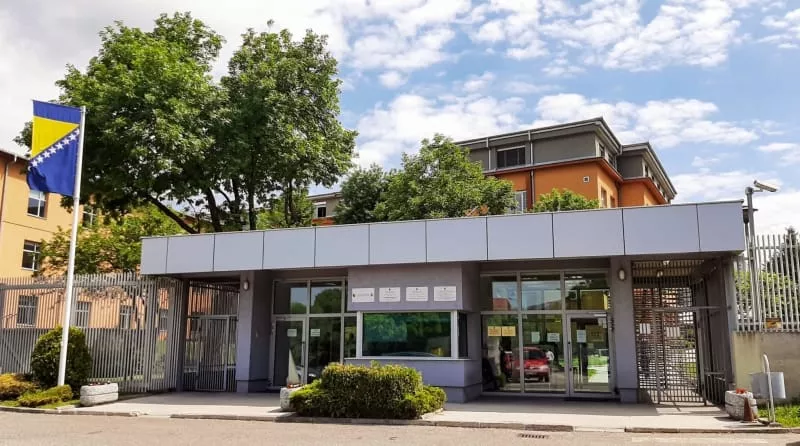
The Prosecutor's Office of Bosnia and Herzegovina has issued an Order on Non-Implementation of Investigation against the Mayor of East Sarajevo, Ljubiša Ćosić, the President of the Veterans Organization of East Novo Sarajevo, Dragiša Tuševljak, and unknown persons for the criminal offense of Inciting National, Racial, and Religious Hatred, Discord, and Intolerance, in connection with the installation of a memorial plaque at Vraca bearing the name of war criminal Ratko Mladić. The criminal complaint against Ćosić, Tuševljak, and unknown persons was filed with the state Prosecutor's Office on March 8, 2022, by Arslan Dučić, a councilor in the Municipal Council of Novo Sarajevo, reports Istraga.ba.
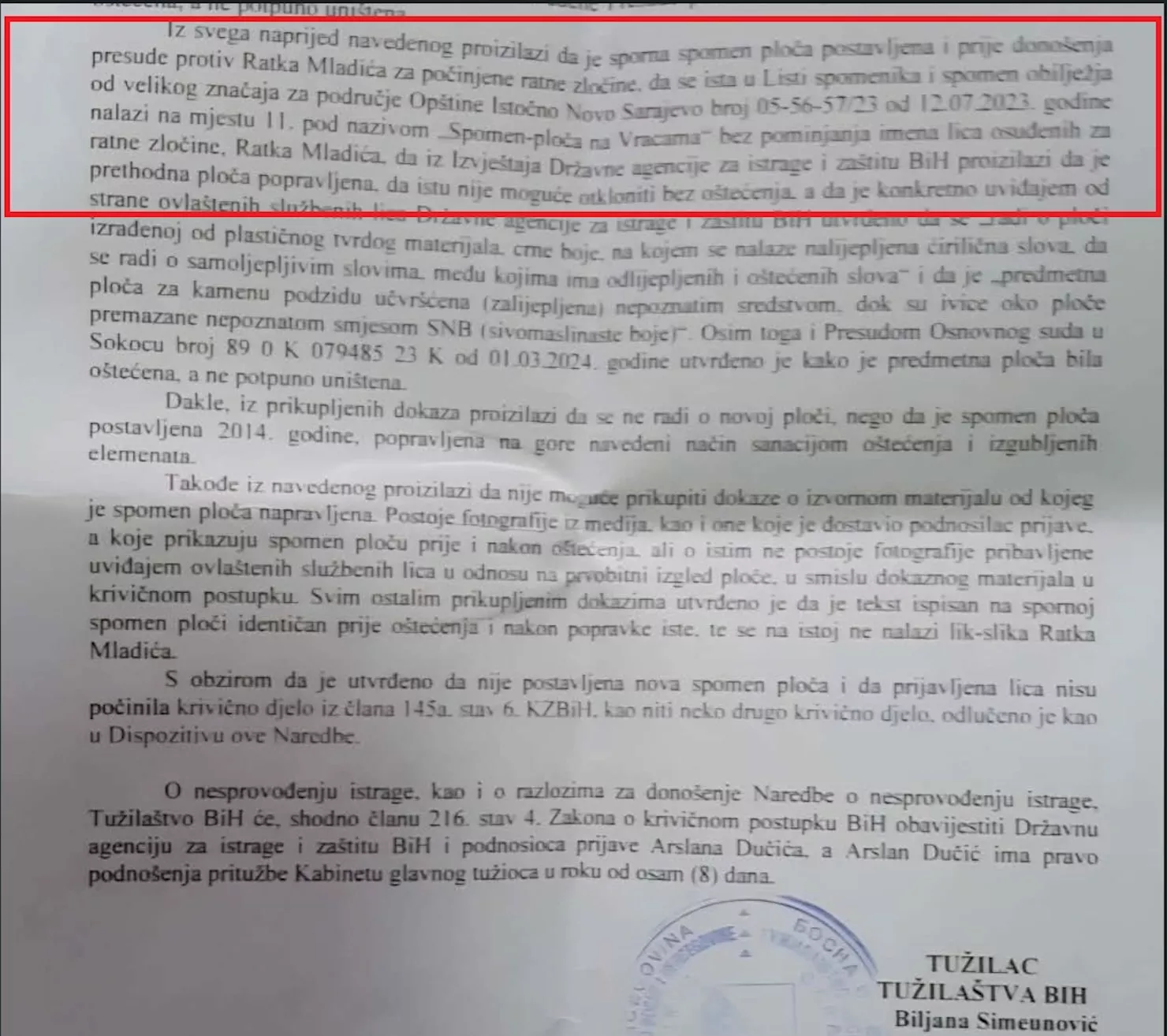
It took the Prosecutor's Office almost four years to determine that Ćosić and others did not commit the said criminal offense, with an unbelievable explanation: the disputed memorial plaque, the Prosecutor's Office found, was originally installed in 2014, at a time when Ratko Mladić had not yet been finally convicted of war crimes in The Hague; it was only renewed in 2022 with the same text as before, meaning the damage was repaired, so the Prosecutor's Office considers there to be nothing controversial about the name of a war criminal being on the plaque?!
"Given that it was determined that a new memorial plaque was not installed and that the reported persons did not commit the criminal offense under Article 145a, Paragraph 6 of the Criminal Code of BiH, nor any other criminal offense, it was decided as stated in the Dispositive of this Order," reads the Order on Non-Implementation of Investigation signed by prosecutor Biljana Simeunović.
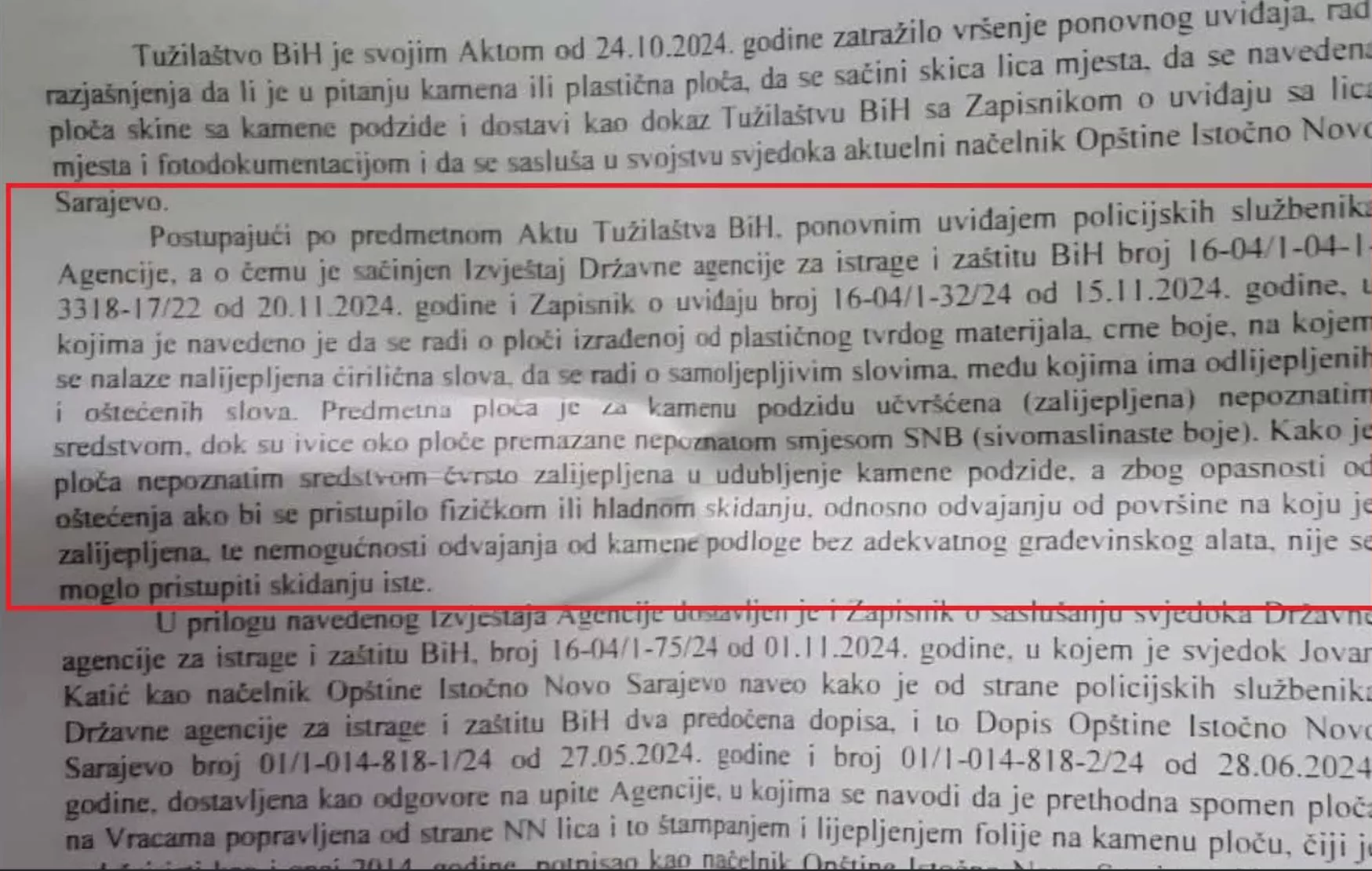
As part of the multi-year "detailed" pre-investigative actions, the Prosecutor's Office also requested an on-site inspection to clarify whether it was a stone or plastic plaque, and for the plaque to be removed and submitted to the Prosecutor's Office with an on-site inspection report and photographic documentation. However, SIPA officers who acted on the Prosecutor's Office's request, as stated, were unable to remove the plaque from the stone base.
"The plaque in question is attached (glued) to the stone base with an unknown substance, while the edges around the plaque are coated with an unknown SMB (olive green) mixture. Since the plaque is firmly glued to the stone base with an unknown substance, and due to the risk of damage if physical or cold removal or separation from the surface to which it is glued were attempted, and the impossibility of separating it from the stone base without adequate construction tools, its removal could not be proceeded with," the Prosecutor's Office states.
One of the Prosecutor's Office's arguments for not conducting an investigation was that "the text inscribed on the disputed memorial plaque is identical before and after its repair, and it does not contain the image of Ratko Mladić." Furthermore, the fact that the plaque with the name of the war criminal is on the List of Monuments and Memorials of Great Importance for the Area of the Municipality of East Novo Sarajevo, where it is registered under the name "Memorial Plaque at Vraca," "without mentioning the names of persons convicted of war crimes" – which was evidently a "mitigating circumstance" for Ćosić and Tuševljak. The two stated in their testimony to the Prosecutor's Office that they do not consider the disputed memorial plaque to be dedicated to Ratko Mladić because it contains an inscription "that speaks of the gathering of the self-organized Serbian people in that area, and that the "battalion was paraded by VRS General Ratko Mladić." They also added that the plaque was "erected as a remembrance of an event that happened spontaneously in 1992, where the Serbian population gathered for the purpose of defending the population and Serbian territory."
The memorial plaque for war criminal Mladić at Vraca has been damaged several times in the past, but the local authorities in East Sarajevo have repeatedly restored and returned it. Ratko Mladić, the wartime commander of the Army of Republika Srpska, was finally convicted in 2021 by the Hague Tribunal to life imprisonment for genocide and crimes against humanity during the aggression against BiH.
Let us recall that with the amendments to the Criminal Code of BiH, imposed by former High Representative Valentin Inzko in July 2021, the denial of genocide and the glorification of war criminals are prohibited.
Komentari (0)
Prijavite se za komentiranje
PrijavaJos nema komentara. Budite prvi!
Minuta
Sve →Iz drugih kategorija

High Representative Not Elected: Germans, French and British Sabotaged Americans, New Attempt at End of June

ČOVIĆ WITHOUT MERCY: How Those Who Brought Ademović to Office Created a Political Hell for Him



Sunny Saturday, quite warm



Tragedy in Albanian resort: Two minors drown












