
By: Sifet Kukuruz, legal expert
The postponement of the operation to arrest Milorad Dodik and his associates would not be a cause for concern in circumstances of a strong pro-state policy and effective institutions responsible for carrying out the arrest operation.
However, the postponement of an arrest in a situation where the policies responsible for its execution do not recognize the state's interest as the purpose of their existence and action, which lack real political power, and in circumstances of institutions whose functioning is undermined from within, whose chain of command is disrupted, and which, due to such circumstances, have become extremely dysfunctional, is and should be a cause for concern. In such circumstances, one cannot speak of postponing the arrest operation, but of capitulation to secessionists.
In the circumstances of a politically "invalid Troika" (Three), which has no say and makes no decisions, the inability to carry out the arrest operation is solely a sign of powerlessness, not political wisdom. Various explanations for not carrying out the arrest operation are a cheap attempt to cover up the responsibility of the leaders of the Troika parties for the state in which Bosnia and Herzegovina finds itself today, thanks, to a significant extent, precisely to their thoughtless policies.
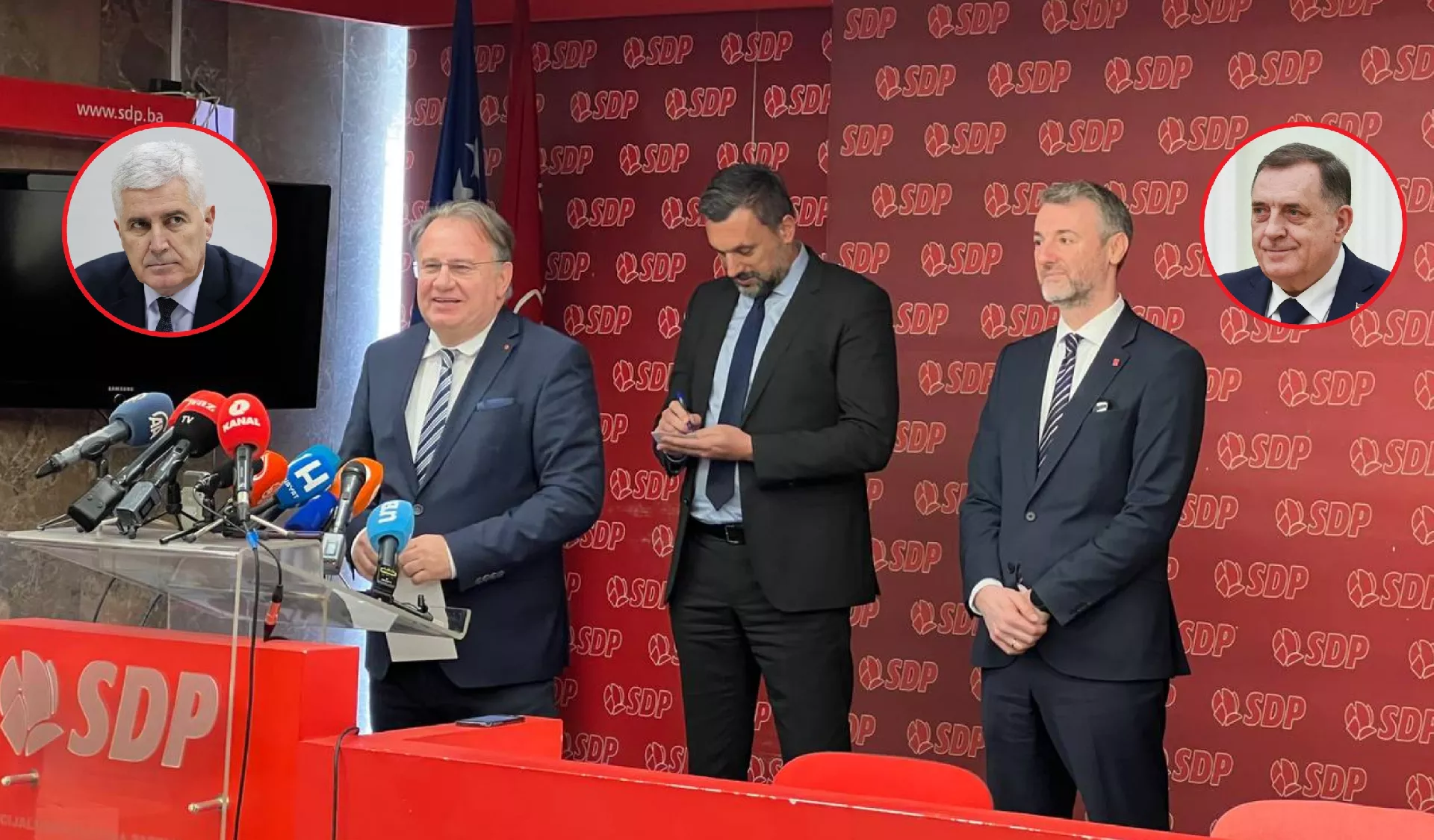
It was Nermin Nikšić, Elmedin Konaković, and Edin Forto, for their own appointments to positions, who handed over the entire security sector to Milorad Dodik. And it is precisely this move that is proving crucial today for the success of the secessionist, or rather, for the impossibility of their arrest.
By handing over the security sector to Milorad Dodik, Nikšić, Konaković, and Forto enabled Dodik to finally begin the practical implementation of his secessionist policy, which, as he himself points out, he had been preparing for years and was only waiting for the right moment for its realization. To understand the current political momentum, one must not ignore the fact that Dodik, although he wanted to, could not realize this plan earlier. He patiently waited for the "momentum" and found it in the leaders of the Troika parties.
By bringing the Troika parties into power at the state level, Dodik got, or more accurately, together with Dragan Čović, created what he had desired for more than a decade, and that is a politically "invalid Troika" that, for the personal interests of the party leaders, is ready for any concession.
The Troika's inability to dismiss SNSD cadres from state institutions, regardless of the arsenal of bulldozers and erasers at its disposal, best shows that the Troika possesses no real political power and is a kind of Dodik's and Čović's "political guinea pig."
Although the Troika tries to hide its inability to arrest Milorad Dodik with hypocritical concern for the safety and lives of SIPA members, it is clear to everyone that this is solely about concern for their own positions and an attempt to diminish responsibility for the state in which Bosnia and Herzegovina finds itself today, partly thanks to the thoughtless policies of the leaders of the Troika parties.
For the postponement of the arrest of Dodik and his associates to represent wisdom and genuine concern for the lives of SIPA members, the person responsible for the arrest would have to pursue a pro-state policy and be institutionally strong, and the Troika fulfills neither of these two conditions, and that is the essence of the problem. The Troika has neither the power nor the instruments to carry out the arrest operation, nor is its action based on a pro-state policy.
The claims of the leaders of the Troika parties that the arrest operation will be carried out when the security conditions are met are, in themselves, politically infantile. What kind of infantile logic is at play can best be explained by the fact that those who defended Bosnia and Herzegovina in the war never conditioned their going to the front lines on the absence of risk to their lives and health. Every time they went to the front lines, it necessarily carried that risk, but it never represented an excuse or justification for not going to the front or for not completing the task.
The leaders of the Troika should know that in war, no one ever conditioned their going to the front lines or an operation on guarantees or promises from superiors that someone carrying out the operation would not be killed. Expecting Milorad Dodik's arrest to be carried out without security risk is like expecting soldiers to go to the front lines without any of them being killed.
Those who freely chose to defend Bosnia and Herzegovina in peacetime with their lives from attacks on its constitutional and legal order certainly do not expect anyone to guarantee them such security. Such a risk is an inseparable part of their calling, and they have consciously and voluntarily accepted this risk. After all, SIPA has carried out numerous high-risk operations in the past and knew how to assess how to neutralize that risk.
By hiding their incompetence behind alleged concern for SIPA members, Nikšić, Konaković, and Forto hypocritically portray any insistence on Milorad Dodik's arrest as a warmongering act. Much suggests that the leaders of the Troika parties expect Milorad Dodik's arrest to be carried out according to a "wedding scenario," in which the suitors, with music and celebration and a few shots in the air, arrive at the house and ask for the bride, after which they return happily and satisfied from whence they came.
Bosnia and Herzegovina will be safe only when people live and work for it in peacetime in the same way they worked and died for it in war. Otherwise, the question arises on what basis the lives of those who died defending Bosnia and Herzegovina in the war are less valuable than the lives of those who consciously and voluntarily took on the obligation to defend Bosnia and Herzegovina in peacetime with their lives.
Finally, there is another very serious argument against postponing the arrest operation. Namely, the passage of time shows that the circle of individuals and institutions protecting and supporting Milorad Dodik is widening and increasing. The question arises – how will those who are currently unable to carry out the arrest of Milorad Dodik and his associates be able to carry out such an operation when, in addition to armed police officers, a wider network of institutions of that entity stands with Milorad Dodik?
Nikšić, Konaković, and Forto should know that precisely by postponing the operation to arrest Dodik, the security risk for SIPA officers is increasing every day. And responsibility for that risk must be attributed precisely to them, because with their irresponsible policy, they laid the foundation for that risk, which is a danger not only to SIPA members but also to Bosnia and Herzegovina.
Komentari (0)
Prijavite se za komentiranje
PrijavaJos nema komentara. Budite prvi!
Minuta
Sve →Iz drugih kategorija

High Representative Not Elected: Germans, French and British Sabotaged Americans, New Attempt at End of June

ČOVIĆ WITHOUT MERCY: How Those Who Brought Ademović to Office Created a Political Hell for Him



Sunny Saturday, quite warm



Tragedy in Albanian resort: Two minors drown












