
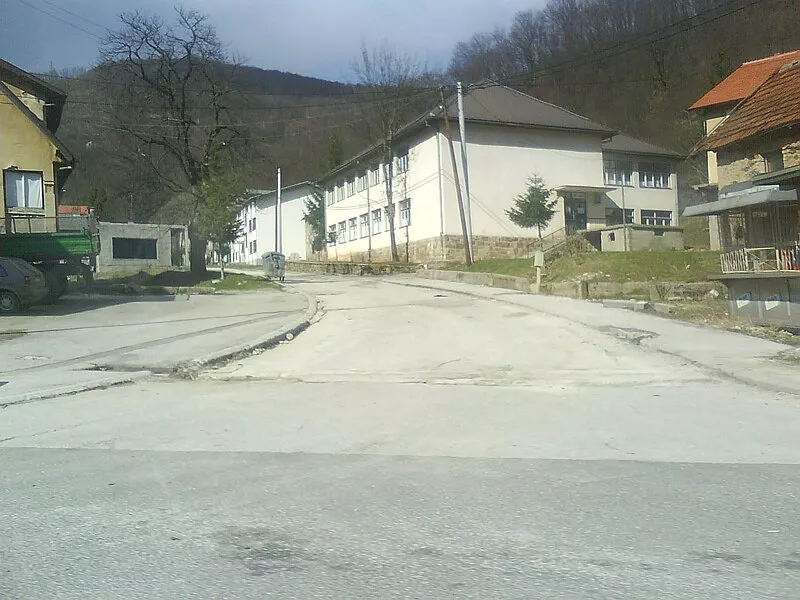
(Patria) - The Coordination of Veterans' Associations reacted after a series of untruths and allegations that "Bradina is a place where, after the 'recent civil war', mass killings and ethnic cleansing of Serbs, the church bells have also fallen silent".
We are transmitting yesterday's reaction of the Coordination in full below.
"Today, as we mark the anniversary of the liberation of Bradina, we feel obliged to address the public regarding the untruths and narratives that are attempted to be imposed year after year.
Unfortunately, in recent years, an event, the commemoration of the victims of a insane, Greater-Serbian policy, has taken on a provocative-propagandistic narrative, similar to that of '92, propaganda that has caused immeasurable damage to our city and homeland, Bosnia and Herzegovina.
Namely, the organizers of the commemoration of the anniversary of military operations in Bradina persistently present inaccurate or partially accurate data - that 88 unarmed civilians were killed in Bradina (this year reduced to 48).
For the truthful information of the public, we are obliged to present facts that give a completely true picture of the events in May 1992 in Konjic and its surroundings, although the most relevant information is probably the court one, and the Hague Tribunal in the Celebici case defined 'the Bradina case as a legitimate military target...'
At the beginning of March, selectively, and from April 20, 1992, totally, well-armed Serb paramilitary forces of the SDS blocked the main road M-17 and all local roads passing through the wider area of the village of Bradina towards five villages under Bitovnja.
Railway traffic on the Sarajevo - Ploče line was also interrupted, and all locomotives and wagons that were in the Bradina Railway Station depot at that time were seized.
Throughout April and until the second half of May 1992, representatives of the authorities of the municipality of Konjic attempted through negotiations to dissuade the SDS paramilitary forces from their sinister intention, which was part of a broader plan, consisting of forming the second ring of blockade of Sarajevo and exhausting the population in the territories of Pazarić, Tarčin, Igman, Hrasnica, Trnovo, etc.
All negotiations regarding the unblocking of the M-17 road, railway communication, and the surrender of weapons ended unsuccessfully, and all demands were rejected by the self-proclaimed local authorities who declared themselves part of the Serb municipality of Konjic.
The last unsuccessful negotiations were held on May 20, 1992, where they were clearly warned that force would be used if the road communication was not unblocked.
The leaders of the rebels consciously procrastinated in order to gain time, expecting promised help and connection with the forces from Hadžići and the breakthrough of the East-Herzegovinian Corps from the direction of Borak.
Military actions in the form of limited use of resources on May 10, 1992, in Velika, and on May 13, 1992, in Prehulja, were attempts by the legal institutions of the Republic of Bosnia and Herzegovina to show the rebels that blockades would not be tolerated. Unfortunately, after negotiations failed.
On May 25, 1992, the military operation 'KOSA' followed by members of the TO, MUP, HVO, and HOS, with the aim of liberating temporarily occupied territories and unblocking road communication, which was successfully completed on May 27, 1992.
Based on relevant data with accurate information about the command staff, the 'Bradina Detachment' of the TO of the Serb Municipality of Konjic was stationed in Bradina with two well-armed companies and one support platoon.
On the monument in Bradina, which bears 88 names as victims of the war from Bradina, 65 of them are among the fallen soldiers, members of the Second Light Herzegovina Brigade at the central memorial in Gacko.
On the same monument in Bradina, there are also seven names of fighters who died in other war units of the so-called VRS in the period 1992-1995 and who have no connection to the mentioned period.
Therefore, they were not civilians, but soldiers, and most of them did not die in Bradina at all, but in other battlefields in Bosnia and Herzegovina after May 25, 1992, dying for the insane idea of 'Greater Serbia'.
The memorial plaque in Bradina can be, and is, a monument, but to a perverted policy, and certainly not to innocently killed civilians.
In the battles for the liberation of Bradina, the enemy had 28 killed and 234 captured. On our side, two fighters were killed, and several were wounded.
We do not deny or comment on the fact that individual crimes occurred as a result of revenge from our side. That is precisely why the competent authorities prosecuted and convicted those responsible in a timely manner.
However, we clearly distinguish between such cases and a systematic criminal enterprise, which was carried out on the territory of the Republic of Bosnia and Herzegovina, including Konjic, by the then Serb paramilitary, military, and political structures.
Konjic is today a city of all its citizens - Bosniaks, Serbs, Croats, and others.
A city that cherishes anti-fascism, freedom, and coexistence. Those who do not want to accept this reality, but instead return to the past and try to justify the defeat of Greater-state projects, must ask themselves: is the place they once tried to destroy - the right place to spread untruths today?
Let the memory last. Let the truth bear witness...".
Komentari (0)
Prijavite se za komentiranje
PrijavaJos nema komentara. Budite prvi!
Minuta
Sve →Iz drugih kategorija

High Representative Not Elected: Germans, French and British Against Americans, New Attempt at End of June

ČOVIĆ WITHOUT MERCY: How Those Who Brought Ademović to Office Created a Political Hell for Him



Sunny Saturday, quite warm



Tragedy in Albanian resort: Two minors drown












