
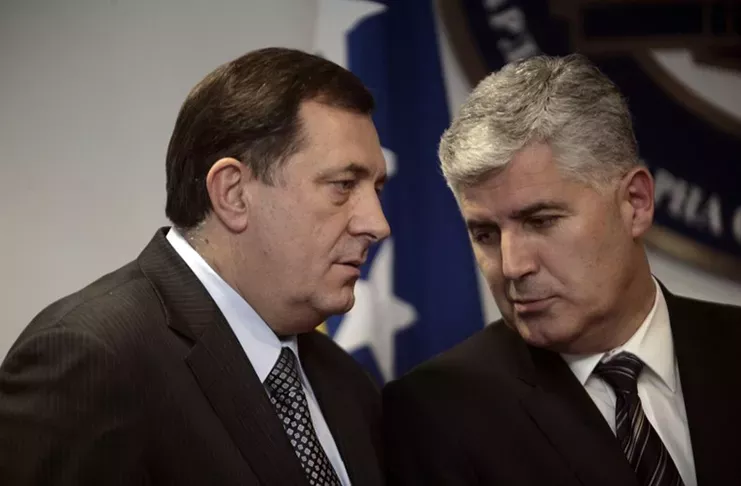
By Rasim Belko
The leader of the Croatian Democratic Union, Dragan Čović, has long kept his opinion on state property under the radar, but during his guest appearance on state television BHRT, he actually expressed views that are completely in line with what Milorad Dodik advocates.
“State property is state property, it’s just that we don’t accept the structure of the state that we have accepted – it is the Dayton structure. Isn’t a municipality, say in Sarajevo, a state? Isn’t a city like Sarajevo, like Mostar, a state? And if something is today owned by the City of Mostar, isn’t that state property? I think the same about entity-level property, as well as property at the BiH level,” Čović stated.
The answer to his questions is simply NO, because state property is not tied to the structure of the state, but to rules and agreements, and ultimately to the Constitution, as well as decisions of the Constitutional Court of BiH, which state: “The holder of state property is exclusively the state of Bosnia and Herzegovina”.
The answer is simple as to why it is not as Dragan Čović claims, because if state property is owned by a municipality, city, canton, or entity, then those levels of government have full rights to dispose of that property, from its use to sale or concession.
In that case, the state of Bosnia and Herzegovina would not exist, because even an illiterate person knows that there is no state without territory. And it was precisely because of territory that Bosnia and Herzegovina was subjected to a double aggression, and now Čović, just like his partner Milorad Dodik, wants what was taken from the state through aggression, the Joint Criminal Enterprise, and genocide to be owned by lower administrative units.
Čović’s concealment was clearly not a consequence of his contemplation of state property, but a certain type of fear of positioning himself on the issue of state property like Dodik, who explicitly says he is ready for secession within 24 hours of any imposed decision on state property.
And while the leader of the HDZ sent messages through the lens of BHRT cameras that Bosnia and Herzegovina is “indivisible”, and that it is up to us internally “to agree on constituent representation”, he actually meant the same as Dodik, who at least honestly says it without hiding behind phrases about a European Bosnia and Herzegovina.
According to Dragan Čović, the indivisibility of Bosnia and Herzegovina looks like this: property of the state is managed by lower levels of government, meaning that the de facto situation on the ground, achieved through double armed aggression, is turned into the final structure of Bosnia and Herzegovina.
It is therefore clear that Čović’s indivisibility implies everything that Dodik’s separatism represents.
For now, according to Čović, the external borders of Bosnia and Herzegovina would remain untouched, but only if internal political processes are controlled by official Zagreb, i.e., his bosses from the parent HDZ.
Thus, the tycoons of the HDZ, Čović and Plenković, will be able to carve up the property of Bosnia and Herzegovina for false support of Bosnia and Herzegovina’s European path. This external indivisibility, according to Čović, also represents Croatia’s right to, bypassing respect for the state and its laws, make decisions in cities where Croats are the majority, with the two HDZs having the say.
In essence, Čović’s indivisibility of external borders represents the informal parallel and special relations of BiH Croats with Croatia. All the same as with Dodik, isn’t it?
What Čović is saying, Dodik would sign and advocate for this instant, because he is aware that in the not-so-distant future, this would mean the final collapse of the state of Bosnia and Herzegovina, which would have no territory, but would have institutions controlled by separatist forces.
In line with this is Čović’s story about the Constitutional Court of BiH, into which, by force and with the help of the OHR, he is trying to push his candidate Marina Vukoja, while at the same time advocating for the realization of Dodik’s interests regarding the removal of foreign judges.
It is therefore clear that Čović’s policy is as separatist as Dodik’s, because their solutions are identical, just in different packaging. And this must be clear to all pro-Bosnian political options that enter into an alliance with the HDZ, because they must be aware that Čović’s hiding behind Europeanism and conciliatory tones represent only a mask that lures into a trap.
And there is no doubt that what Čović says about the indivisibility of Bosnia and Herzegovina is implied as long as official Zagreb can interfere in the internal affairs of BiH. Just like with Dodik.
Only Dodik has parallel relations on paper, and Čović has them on a napkin!
Komentari (0)
Prijavite se za komentiranje
PrijavaJos nema komentara. Budite prvi!
Minuta
Sve →Iz drugih kategorija

High Representative Not Elected: Germans, French and British Sabotaged Americans, New Attempt at End of June

ČOVIĆ WITHOUT MERCY: How Those Who Brought Ademović to Office Created a Political Hell for Him



Sunny Saturday, quite warm



Tragedy in Albanian resort: Two minors drown












