
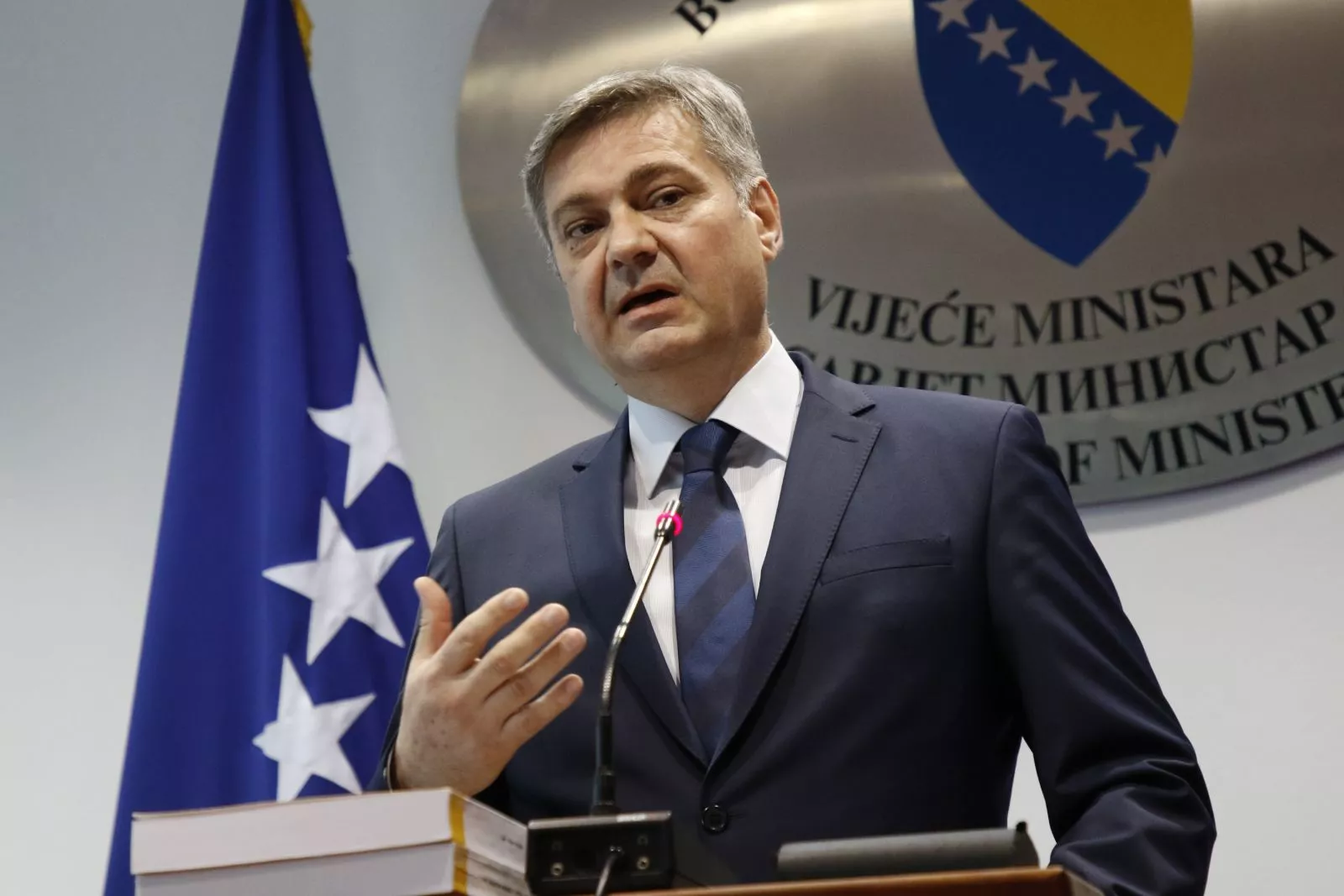
(Patria) - Chairman of the PD PSBiH Denis Zvizdić stated in a social media post that it is necessary to persistently, professionally and factually expose the lies and spin with which officials from the BH entity RS try to justify their subversive and separatist goals aimed against the territorial integrity and sovereignty of BiH.
"Representatives of the authorities in the BH entity RS and their representatives at the state level, in their unconstitutional activities and discussions, cite two quasi-arguments.
The first is the non-existent 'threat' to Serbs at the state level, which is a brazen lie.
According to the last census, 3,531,159 inhabitants live in BiH. More than half, precisely 50.1%, are Bosniaks, Serbs make up 30.8%, Croats 15.4%, and Others 3.7%.
At the level of the state of BiH, there are slightly more than 23,000 employees in total. Of that, more than 32% are from the Serbian people.
In state-level government institutions, there are slightly less than 4,000 civil servants and employees - of which 44% are Bosniaks, 34% Serbs, 21% Croats, and 1% Others.
When it comes to leadership positions, there are 205 at the state level. Bosniaks occupy 36%, Serbs 33%, Croats 29%, and Others 2%.
The Armed Forces of BiH employ about 46% Bosniaks, 36% Serbs, 18% Croats, and 2% Others. In the Joint Staff of the Armed Forces of BiH, there are five Bosniaks, four Serbs, and four Croats.
The number of employees in police-intelligence bodies: 4,800. The national structure of employees is almost identical to that in other state institutions. Therefore, Serbs, on average, hold about 35% of positions.
In courts at all levels of government, about 1,000 positions are filled. About 44% are Bosniaks, 33% Serbs, and 18% Croats.
The second 'key' reason cited by radicalized representatives of the BH entity RS is that they have no influence on decision-making at the state level.
Again, a lie and deception.
If we analyze the constitutional position, i.e., the alleged 'threat' to the Serbian people in the institutions of the state of BiH, we come to the following facts:
- in both Collegiums of the Parliamentary Assembly of BiH - representatives of the Serbian people have the right of veto on all decisions made by the Collegium;
- within one term, representatives of the Serbian people will always, by rotation, for a period of 16 months (thus, identically and completely equally as representatives of the Bosniak and Croatian peoples) have the chairperson of both houses of Parliament;
- entity voting in the House of Representatives of the PA BiH - without 1/3 of the votes from the RS, there is no decision or law;
- entity voting in the House of Peoples of the PA BiH - without 1/3 of the votes from the RS, there is no decision or law;
- one of the three members of the Presidency of BiH is a representative of the Serbian people; by rotation for 16 months within the term, Serbs also have the chairperson of the Presidency of BiH;
- the chairperson of the Council of Ministers of BiH, with the functions and competencies of a prime minister, is a representative of the Serbian people;
- the Council of Ministers of BiH - without the vote of at least one representative of the Serbian people, there is no decision of the Council of Ministers of BiH;
- the Management Board of the Indirect Taxation Authority of BiH - the Minister of Finance from the RS has the right of veto on all the most important decisions of the MB ITA.
These are just some of the facts that show that representatives of the RS in the institutions of BiH have an exceptional constitutional position in BiH as a multi-ethnic state of equal peoples and citizens.
And while this is the situation at the level of BiH, it is diametrically opposite in the BH entity RS, where Bosniaks and Croats are completely excluded, economically threatened, socially marginalized, and security-wise endangered.
Only the following indicator is sufficient to best show the real situation on the territory of the RS.
According to the 1991 census, the population on the territory of today's Republika Srpska was 1,623,842. Of that, there were nearly 900,000 Serbs or 55%, slightly less than 450,000 Bosniaks or 28%, and nearly 150,000 Croats or 10%.
Given this ratio, out of slightly more than 5,500 employees in RS institutions, there should be 1,400 Bosniaks and 550 Croats.
The same ratio should apply among employees in the RS Ministry of Interior.
If we take the 2013 census as a parameter, 82.95 percent of RS citizens declared themselves as Serbs, 12.69 percent as Bosniaks, 2.27 percent as Croats, while 1.25 percent were from the Others category.
If the ratio applied to the last census, then the number of employed Bosniaks in RS institutions should be 660, and Croats more than 100.
Unfortunately, the total number of employees from the ranks of Bosniaks and Croats in the institutions of the BH entity RS is less than 3 percent, while the situation in municipalities on the territory of the BH entity RS is even worse.
These are relevant facts that the domestic public, 'soul-searchers' from neighboring countries, and representatives of the international community should know," stated the Chairman of the PD PSBiH, Dr. Denis Zvizdić.
Komentari (0)
Prijavite se za komentiranje
PrijavaJos nema komentara. Budite prvi!
Minuta
Sve →Iz drugih kategorija

High Representative Not Elected: Germans, French and British Sabotaged Americans, New Attempt at End of June

ČOVIĆ WITHOUT MERCY: How Those Who Brought Ademović to Office Created a Political Hell for Him



Sunny Saturday, quite warm



Tragedy in Albanian resort: Two minors drown












