
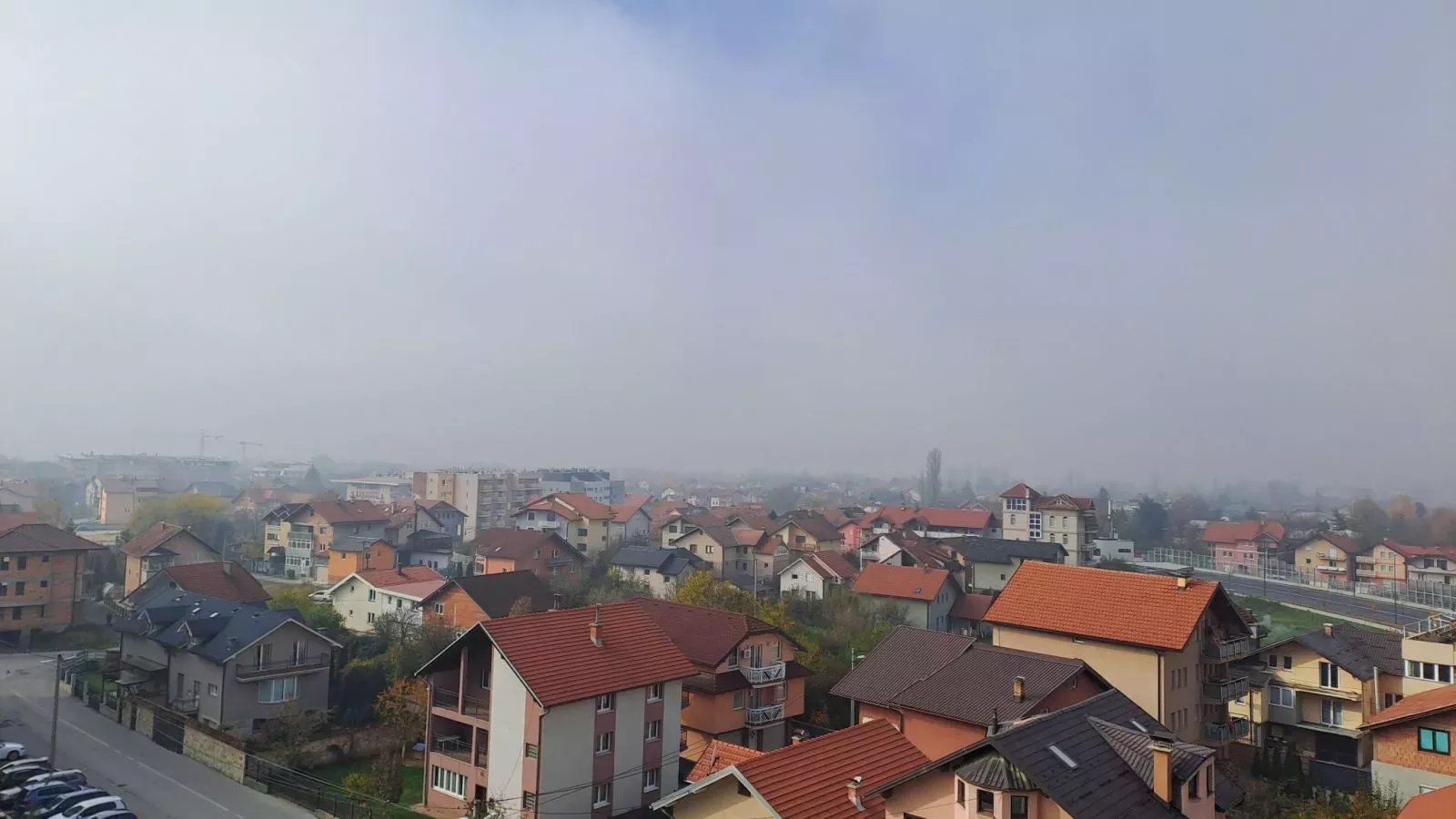
(Patria) - According to the criteria of the European Environment Agency (EEA), the air quality in Sarajevo has reached the highest level of danger with an air quality index of 6/6. Such air is designated as "dangerous for human health". Possible exacerbation of symptoms and intensity of diseases in people with heart and respiratory diseases, such as asthma. Everyone else could start feeling the negative effects of pollution on their health.
The following groups should reduce any outdoor physical activity: people with lung and heart conditions, pregnant women, children, and the elderly. Everyone else should also avoid prolonged or strenuous exertion while outdoors.
Meteorologist Nedim Sladić explained that no significant improvement in air quality is expected in the next 24 to 48 hours, adding that the use of pyrotechnics will further pollute it.
“At the very end of 2024, we will not have problems with uncleared snow, which we have all become accustomed to, nor with air temperatures which, unlike in previous years, will not be positive. It is likely to be very unpleasant to stay outdoors for a long time, considering that the current air quality index in the capital of Bosnia and Herzegovina, according to European criteria, has reached its maximum (i.e., 6/6), and is characterized as dangerous to human health,” Sladić stated.
He also explained how this type of air pollution occurred.
“Under the influence of an anticyclonic field over Central Europe, which defines the meteorological picture in our country as well, the atmosphere is stable, while warmer air is arriving from the Mediterranean region at higher altitudes. Due to physical properties, colder air is forced to descend and 'fill' the basin areas, creating artificial lakes of cold air, further modified by current ground conditions (e.g., snow depth, air humidity, etc.) – also known as temperature inversion, where air temperatures increase with altitude instead of decreasing. Air currents in an anticyclonic field are weak or often negligible, and advection mainly occurs in the upper layers of the atmosphere due to the established temperature difference on broader spatial scales, while the atmosphere near the ground is static as the pressure and temperature difference is almost uniform. In such an atmosphere, polluting particles accumulate rapidly and are not hindered, as there is no possibility of particle dispersion upwards, as the basin cover acts like a compressor, forcing particles to 'press' against the ground, meaning particles cannot mix vertically. Aeropolutants can then only spread horizontally. The situation will partially worsen during the next 24 hours due to the use of pyrotechnics, which, in addition to existing suspended particles, is expected to cause a temporary increase in sulfur dioxide concentrations,” he emphasized.
He then added that a change in weather and a significant improvement can be expected from January 2, 2025. At that time, the arrival of a cold front from the northwest will break the influence of the anticyclone.
“The change in weather will be heralded by a gradual strengthening of the south and southwest wind, which will gradually aid vertical air mixing and the generation of turbulent vortices with which the polluted air will mix with the surrounding cleaner air. However, the current situation suggests that this process will be slower in the lower layers of the atmosphere, where atmospheric pressure will remain high for a larger part of the day, and the temperature at altitude will only slightly decrease. With the passage of a cold front from the northwest, which will first bring precipitation, first rain, and then new snow, as well as a change in wind direction from south to north and northwest, the temperature inversion is predicted to be canceled due to the penetration of a cold air mass, and thus the lifting of the basin cover. Consequently, polluting particles from the lower layers of the atmosphere will be able to disperse into the free atmosphere, which will enable a significant improvement in air quality. On Friday, 03.01.2025, the air quality is expected to be good (index: 2/6), often excellent (index: 1/6), according to the criteria of the European Environment Agency (EEA),” Sladić concluded.
Komentari (0)
Prijavite se za komentiranje
PrijavaJos nema komentara. Budite prvi!
Minuta
Sve →Iz drugih kategorija

High Representative Not Elected: Germans, French and British Against Americans, New Attempt at End of June

ČOVIĆ WITHOUT MERCY: How Those Who Brought Ademović to Office Created a Political Hell for Him



Sunny Saturday, quite warm



Tragedy in Albanian resort: Two minors drown












