
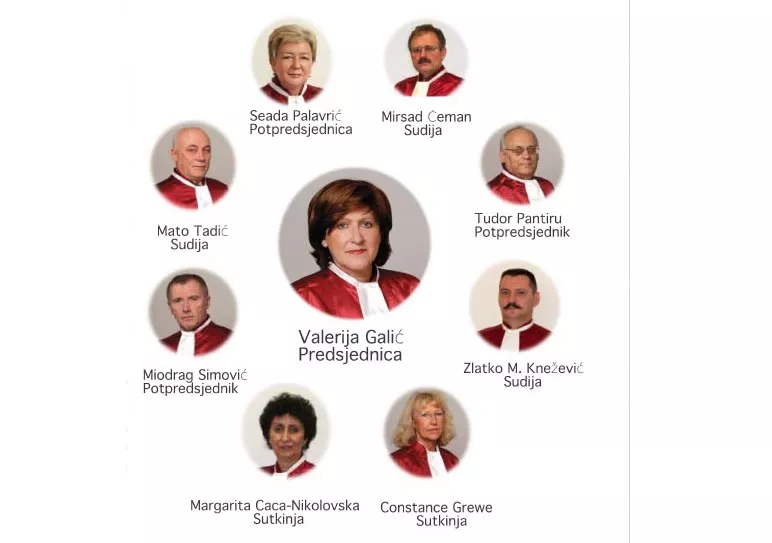
Decisions of the Constitutional Court of Bosnia and Herzegovina are final and binding. It is competent to decide on any dispute arising between the entities of Bosnia and Herzegovina, the Federation and the Republika Srpska, or between Bosnia and Herzegovina and one or both entities, as well as between institutions of Bosnia and Herzegovina.
Bosnia and Herzegovina got it 51 years ago. Today it consists of nine judges, who are considered perhaps the most moral of all in the country. Six judges are elected from Bosnia and Herzegovina (four are elected by the House of Representatives of the Federation, and two by the Assembly of the Republika Srpska), the remaining three members are appointed by the President of the European Court of Human Rights after consultations with the Presidency. These three members cannot be from Bosnia and Herzegovina, nor from neighboring countries.
The Constitutional Court of Bosnia and Herzegovina can also react when rulings of any court in Bosnia and Herzegovina become subject to dispute. It is also competent in matters referred to it by any court in Bosnia and Herzegovina regarding whether a law, on whose validity its decision depends, is compatible with the Constitution of Bosnia and Herzegovina, the European Convention for the Protection of Human Rights and Fundamental Freedoms and its protocols, or with the laws of Bosnia and Herzegovina...
From a historical perspective and the problems of transition of socialist countries, Bosnia and Herzegovina is one of the rare examples that can be found in the history of constitutional courts, given that the former Yugoslavia was the only country that still had a system of constitutional courts under a socialist regime.
The first Constitutional Court in the former Yugoslavia was established back in 1963, and this is also the starting point of the history of constitutional judiciary in this country. In accordance with the federal structure, in addition to the Constitutional Court at the federal level, six republics, and even two autonomous provinces – Kosovo and Vojvodina, also had their own constitutional courts before the dissolution of the former SFRY.
The Constitutional Court of Bosnia and Herzegovina was constituted for the first time on February 15, 1964, based on the Constitution of 1963, and was retained by the later Constitution of 1974. This Constitutional Court primarily had jurisdiction in abstract normative control, such as deciding on the conformity of (republic) laws with the Constitution and on the constitutionality and legality of other regulations and general and self-governing acts, as well as resolving disputes between the Republic and other socio-political communities, and conflicts of jurisdiction between courts and bodies of socio-political communities.
The Constitutional Court of Bosnia and Herzegovina has reacted several times after the end of the conflict in Bosnia and Herzegovina in 1995 until today, and among the Court's decisions that will perhaps remain longest in the memory of BiH citizens is the decision of the Constitutional Court of BiH from 2004 when the Court ordered the removal of names of municipalities such as Srpski Sanski Most, Srpski Mostar, Srpsko Goražde.
Namely, the Court demanded that the prefixes "Srpski" (Serb) in the names of several municipalities in BiH be removed, after they were added following the establishment of peace in BiH.
The Constitutional Court of BiH ordered the removal of names such as Grad Srpsko Sarajevo, Srpski Drvar, Srbinje, Srpski Ključ, Srpska Kostajnica, Srpski Brod, Srpska Ilidža, Srpsko Novo Sarajevo, Srpski Stari Grad and Srpsko Orašje.
The President of the Constitutional Court of Bosnia and Herzegovina is currently Judge Valerija Galić. Judge Seada Palavrić, Judge Miodrag Simović are vice-presidents, as well as Judge Tudor Pantiru, a Moldovan who now lives in Romania.
The functions of judges of the Constitutional Court in BiH are currently performed by Judge Mato Tadić, Judge Constance Grewe (German), Judge Mirsad Ćeman, Margarita Caca-Nikolovska (Macedonia) and Judge Zlatko M. Knežević, Patria writes.

Komentari (0)
Prijavite se za komentiranje
PrijavaJos nema komentara. Budite prvi!
Minuta
Sve →Iz drugih kategorija

High Representative Not Elected: Germans, French and British Sabotaged Americans, New Attempt at End of June

ČOVIĆ WITHOUT MERCY: How Those Who Brought Ademović to Office Created a Political Hell for Him



Sunny Saturday, quite warm



Tragedy in Albanian resort: Two minors drown












