
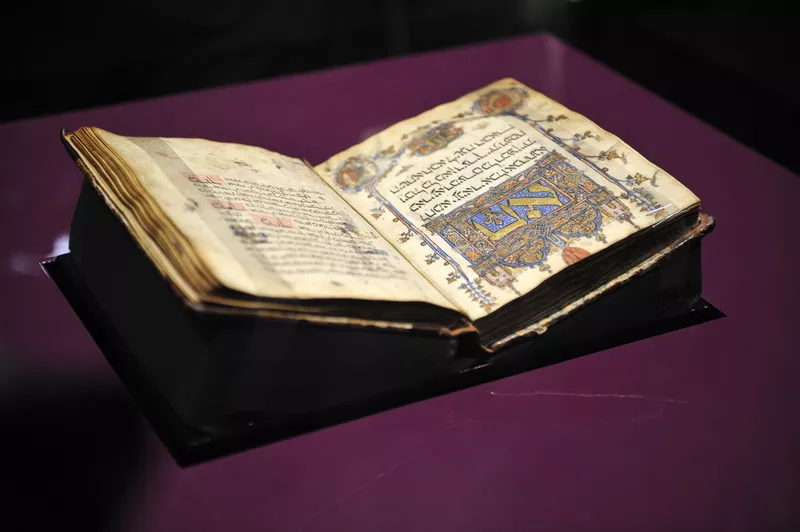
SARAJEVO, (Patria) - The National Museum of Bosnia and Herzegovina has once again made the Sarajevo Haggadah available to the public since December 2021, on regular schedules every Tuesday, Thursday and the first Saturday of the month from 12:00 to 13:00 h.
The story of the Sarajevo Haggadah, whose value has never truly been assessed, is interesting to ordinary citizens as well as researchers. The book, which tells of the history, customs and life of the Jews, found its way to Sarajevo, where the Jewish community has existed for centuries. On the official website of the National Museum, there is a text by director Mirsad Sijarić about the Sarajevo Haggadah, which we reproduce in full.
"If we were to try to single out the brightest pearls from the unlocked treasury of material and intangible cultural heritage kept in the National Museum of Bosnia and Herzegovina, we certainly could not omit the copy of the Passover Haggadah, a Jewish illuminated codex, known worldwide as the Sarajevo Haggadah. The Haggadah itself (Hebrew: story, narration) represents a kind of collection of religious precepts and traditions incorporated into the prayer order for celebrating Passover, the holiday commemorating the liberation of the Jews from Egyptian slavery. These books were of particular importance during the ritual family dinner – the Seder, when all household members and guests, with the book in hand, read from them or followed the narratives about the path to freedom, as well as everything ritually connected to that well-known Old Testament story. The tradition of reading texts from the Haggadah within the family circle contributed to the creation of a relatively large number of such books, among which the Sarajevo Haggadah, due to its artistic value and historical significance, holds a leading place.
The Sarajevo Haggadah consists of 142 leaves of parchment measuring 16.5 x 22.8 cm, made from exceptionally thinned and bleached calfskin. On the first 34 leaves, there are 69 miniatures that inspiredly depict the creation of the world, Egyptian slavery, the exodus from Egypt under Moses' leadership, and further, until the status of leader of the Jews was taken over by Joshua, son of Nun. The last four miniatures are exceptional in that they have no direct biblical character. On the next 50 leaves, the text of the Haggadah is written on both sides in square Hebrew script of the medieval Spanish type. The last part of the book consists of a subsequently added poetic-liturgical supplement, containing several poems by the most famous poets of Hebrew literature from its so-called golden age (10th–13th centuries), such as: Yehuda Halevi, Yitzhak ben Yehud ibn Ghiyyat, Solomon ibn Gabirol, Abraham ben Meir ibn Ezra, and others. The discovery of the Sarajevo Haggadah aroused great interest among art historians of the time because it represented one of the rare proofs that among Jews, despite the strict prohibition in God's commandments (You shall not make for yourself a carved image, or any likeness... Exodus 20:4), figurative depiction of human and animal figures was present, and at a very high artistic level. Based on the stylistic analysis of the illuminations and miniatures on its pages, it was determined that the book was created in medieval Spain, in the area of the former Kingdom of Aragon, most likely in Barcelona around 1350 – possibly as a wedding gift for members of two famous families, Shoshan and Elazar, because their coats of arms: a shield with a rosette/rose (Hebrew – shoshan) and a wing (Hebrew – elazar) are found on the page that also bears the coat of arms of the city of Barcelona.
According to a note in the book itself, after the expulsion of Jews from Spain (1492), it changed owners, but we do not know the names of either the new or the old owners. A note from 1609 states that the book does not speak against the church, which is probably the result of an inspection of its content by the Inquisition. During the 16th and 17th centuries, the book was located in northern Italy, as confirmed by two brief notes on its pages, but when and under what circumstances it reached Bosnia is unknown. Its reliable trace in history reappears in 1894 when the National Museum purchased it from the Sarajevo Sephardic family Koen for the sum of 150 crowns. It was sent from Sarajevo for analysis to Vienna, from where, after certain vicissitudes, it was returned a few years later. Consistent with its own destiny, the Sarajevo Haggadah did not find lasting peace even in the museum collection. In the first days after the entry of German military forces into Sarajevo in 1941, their authorities demanded from the then director Joza Petrović that the already well-known leather codex be handed over. Petrović, with the help of curator Derviš Korkut, at enormous risk of such an act, managed to evade this demand, and the Haggadah was moved to a safer place, according to credible accounts, to a mosque in one of the Muslim villages on Mount Bjelašnica, where it awaited the end of World War II. The next attempt at alienation occurred in the 1950s when again employees of the National Museum of Bosnia and Herzegovina prevented the theft, only for, hopefully, the last time this valuable manuscript was threatened at the beginning of the siege of Sarajevo in 1992, when the National Museum of Bosnia and Herzegovina found itself on the front line of the city's defense and suffered severe destruction, from which it has still not fully recovered. Recently, the Sarajevo Haggadah has, for the first time in its extremely rich and turbulent history, been exhibited and made accessible to the wider cultural public in a specially secured space, on special occasions and under precisely defined conditions.
The presented facts about the Sarajevo Haggadah, both those obtained through analyses and research, and those known to us through brief notes written on its pages, as well as through the traditions that have accompanied it for decades, make this book an invaluable source for researching the cultural past of a people in a centuries-long search for a homeland, and a living witness to the openness of a society and environment in which fear of the different has never been an incurable disease."
Komentari (0)
Prijavite se za komentiranje
PrijavaJos nema komentara. Budite prvi!
Minuta
Sve →Iz drugih kategorija

High Representative Not Elected: Germans, French and British Sabotaged Americans, New Attempt at End of June

ČOVIĆ WITHOUT MERCY: How Those Who Brought Ademović to Office Created a Political Hell for Him



Sunny Saturday, quite warm



Tragedy in Albanian resort: Two minors drown












