
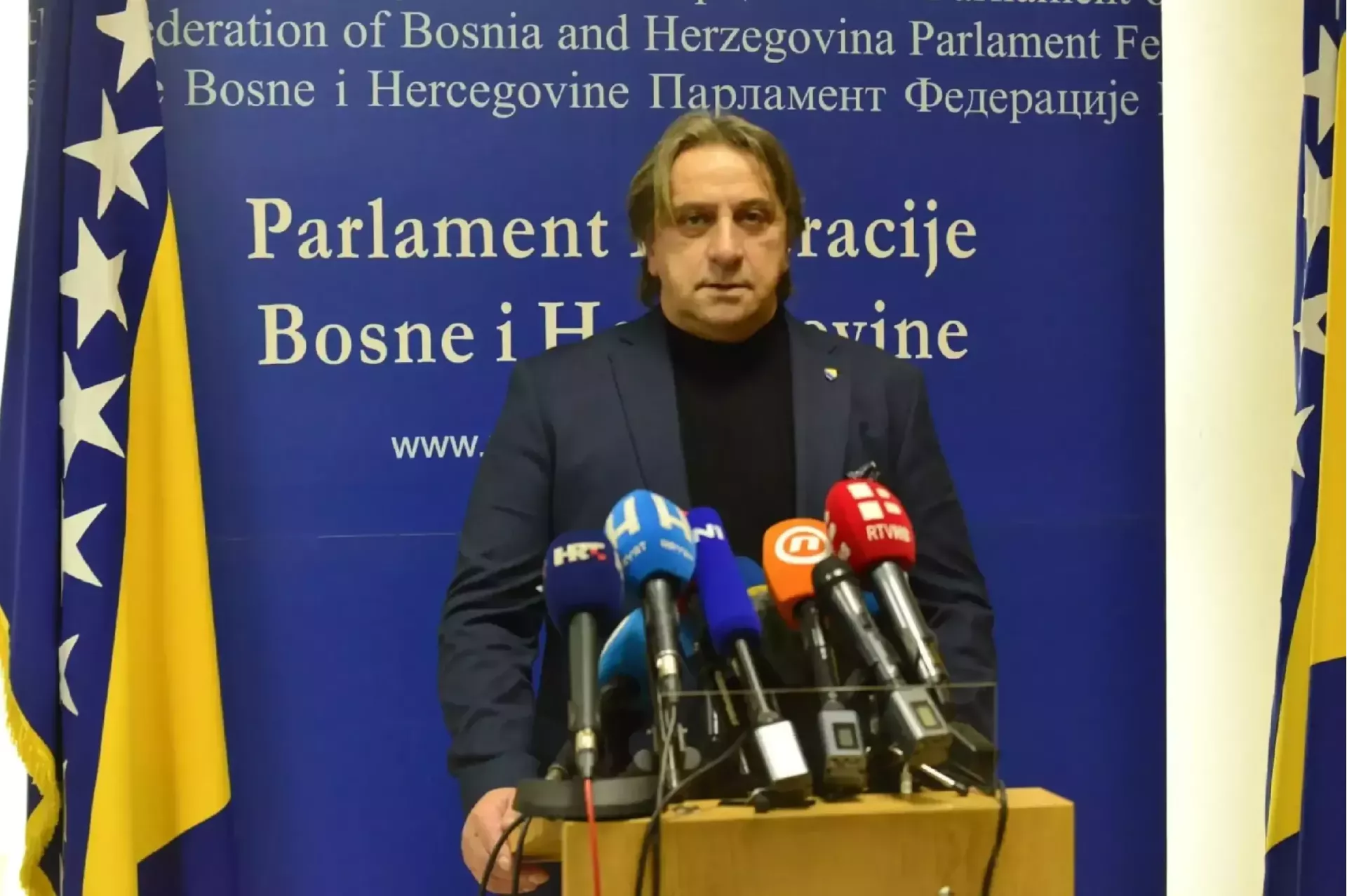
(Patria) - Opposition representatives in the FBiH Parliament (DF, SDA, and SBiH), as authorized proposers, submitted a request a few days ago to convene an extraordinary session of the House of Representatives.
They proposed only one item for the agenda - "Information on alleged illegal actions of Prime Minister Nermin Nikšić and interference in the work of the police bodies of the Federation of BiH".
Hajrudin Žilić, President of the Main Board of the Democratic Front (DF) and a representative of that party in the FBiH Parliament, clarifies that the current convocation of the federal House of Representatives has held 15 extraordinary sessions to date.
- The fact that the request to convene a session is being problematized for the first time is indicative in itself. Of course, due to the existence of a procedural basis, the procedure and jurisdiction of the request to convene it are not being problematized, but the merit, i.e., the content and topic that the representatives want to discuss, is being problematized.
Dragan Mioković has replaced his role as Speaker of the House of Representatives with the role of "lawyer" for Prime Minister Nermin Nikšić, whose (in)actions, or rather (in)deeds, the representatives of the citizens demand to discuss - says Žilić in an interview with the Patria News Agency (NAP).
He reminds that Mioković stated in a public statement that he would undoubtedly convene the session. However, Žilić adds, the issue here is not whether he will or not, whether he wants to or not, but the issue of respecting the Rules of Procedure of the House of Representatives of the FBiH Parliament, and thus the Constitution of the Federation of BiH.
- It would be too much if Dragan Mioković's name were directly linked to inconsistencies related to respecting the Constitution for the third time during one mandate - emphasizes Žilić.
The first time this happened, our interlocutor reminds, was when, with an unprecedented suspension of the Constitution for one day, by the political mentors of the Trojka, he became a participant in power, i.e., in the position in the Federation, and the second time when he abruptly changed his mind and personal stance on the election of Marin Vukoja to the Constitutional Court of BiH and politically bargained for the position of Speaker of the House of Representatives.
- In a public statement, and on the occasion of the request to convene an extraordinary session, Mioković clumsily engages in lawyering and belittles the representatives who, on behalf of the citizens of the Federation, demand a discussion about the Prime Minister's interference in the work of the Federal police bodies.
Namely, Mioković goes so far as to accuse opposition representatives of wanting to turn Parliament into a courtroom. In translated meaning, he accuses them of undermining democracy and Parliament as the strongest institutional expression of a society's democracy - says Žilić.
He finds the arguments that Mioković presents as proof of his claims that the opposition wants to turn Parliament into a courtroom to be interesting.
- Mioković, namely, states that it is unserious to demand a discussion about something that is described as "alleged" (the term "alleged irregularities of the Prime Minister" is used in the request to convene the session).
Well, Mr. Mioković, I will use some terms close to you to resolve your "dilemma". If you believe that the term "existence of grounds for suspicion" should have been used instead of "allegedly" in the request, then it is an accusation, and if you believe that "without any doubt" should have been stated, then it is a verdict.
Therefore, Mr. Mioković, the terminology used is precisely contrary to what you might secretly desire and does not suggest the idea of turning Parliament into a courtroom.
This argument of yours is in complete contradiction with what you are trying to impute to the representatives and deputies of the citizens, who "dared" to invoke the political and moral responsibility of the person who was one of the actors in your appointment to the position of Speaker - emphasizes Žilić.
He considers Mioković's second argument to be even more tragicomic.
- Namely, in a public statement, he states that, along with the request to convene the session, in addition to a certain number of signatures of representatives, materials for the session and a draft conclusion must also be submitted.
It is evident that haste or perhaps panic have taken their toll, and the Speaker has clumsily mixed up the order of actions. According to the Speaker, it is necessary to first define the conclusion and then discuss it, or rather, then discuss what has already been concluded.
It is quite certain that none of the above is unusual in situations when one tries to defend something that is difficult to defend, or when one starts inventing arguments to refute something that is a fact.
Only one more argument is missing from Mioković's arguments, and it would have the same logic and meaning as the arguments he has already presented. Namely, all that remains for him is to mitigate or completely deny the Prime Minister's own admission regarding, to say the least, the impermissible way of communicating with employees of the Federal Police Administration (FUP) - notes Žilić.
As for the merit of the "spengavanje" affair itself, the NAP interlocutor believes that it is a criminal offense.
- Of course, my opinion is not relevant; competent bodies should determine that. The competent bodies are the prosecutor's office and the court. As a citizen and as a representative, I am aware of this, and the vast majority of citizens of the Federation are also aware of it.
The Prime Minister, it seems, allows himself not to know based on certain actions. He demands "spengavanje" (by which he means arrest and prosecution, as he himself says) from the police.
The Prime Minister should, unless he has some bad intentions, certainly know that investigations are conducted by prosecutor's offices, that orders are issued by courts, and that the police, as an executive body, act exclusively on their orders - said Žilić.
He assessed the request for the Prime Minister to be accountable to the citizens, indirectly through their representatives, for his (in)actions, (in)activity, (in)deeds, as completely legitimate, rather than talking about it in propaganda videos, "which, to be fair, are also paid for by the citizens".
- Personally, I am irresistibly reminded of an audio recording, revealed not so long ago, in which Prime Minister Nikšić demands from a certain interlocutor the employment of some person or persons, and otherwise, if he does not do so, he will be dismissed from the position to which he appointed him.
Therefore, he is prone to exerting political influence. The question is whether in the concrete case of "spengavanje" the alternative to not fulfilling his request, which he, by his own admission, sent to the acting director of the FUP, is the same.
The Prime Minister claims that as Prime Minister he has the right to inquire about the status of an investigation. The answer is - of course he does, but not through private messages and correspondence, but in the way prescribed by the Law on Internal Affairs of the Federation of BiH.
A Prime Minister who presents himself as a fighter against corruption and a righteous person who is attacked for conscientiously performing his duties would inquire about the status of an investigation in a legitimate manner - explains Žilić.
He notes that Article 14, Paragraph 2 of the Law on Internal Affairs of the Federation of BiH states: "Instructions, guidelines, and suggestions determined by the Government of the Federation or the minister within the jurisdiction of the Police Administration, in accordance with this law, are submitted to the police director in writing".
And Article 15, Paragraph 4 of the aforementioned Law states the following: "The report from Paragraph (1) of this article may also relate to individual cases if requested by the bodies from Paragraph (2) of this article, if not otherwise stipulated by law or if it does not jeopardize the operational work of the Police Administration".
- Any other action is contrary to the law, any differently formulated request is an attempt at political influence and abuse of position, i.e., using the position that an individual holds - concluded Žilić in an interview with NAP.
(D.K.)
Komentari (0)
Prijavite se za komentiranje
PrijavaJos nema komentara. Budite prvi!
Minuta
Sve →Iz drugih kategorija

High Representative Not Elected: Germans, French and British Against Americans, New Attempt at End of June

ČOVIĆ WITHOUT MERCY: How Those Who Brought Ademović to Office Created a Political Hell for Him



Sunny Saturday, quite warm



Tragedy in Albanian resort: Two minors drown












