
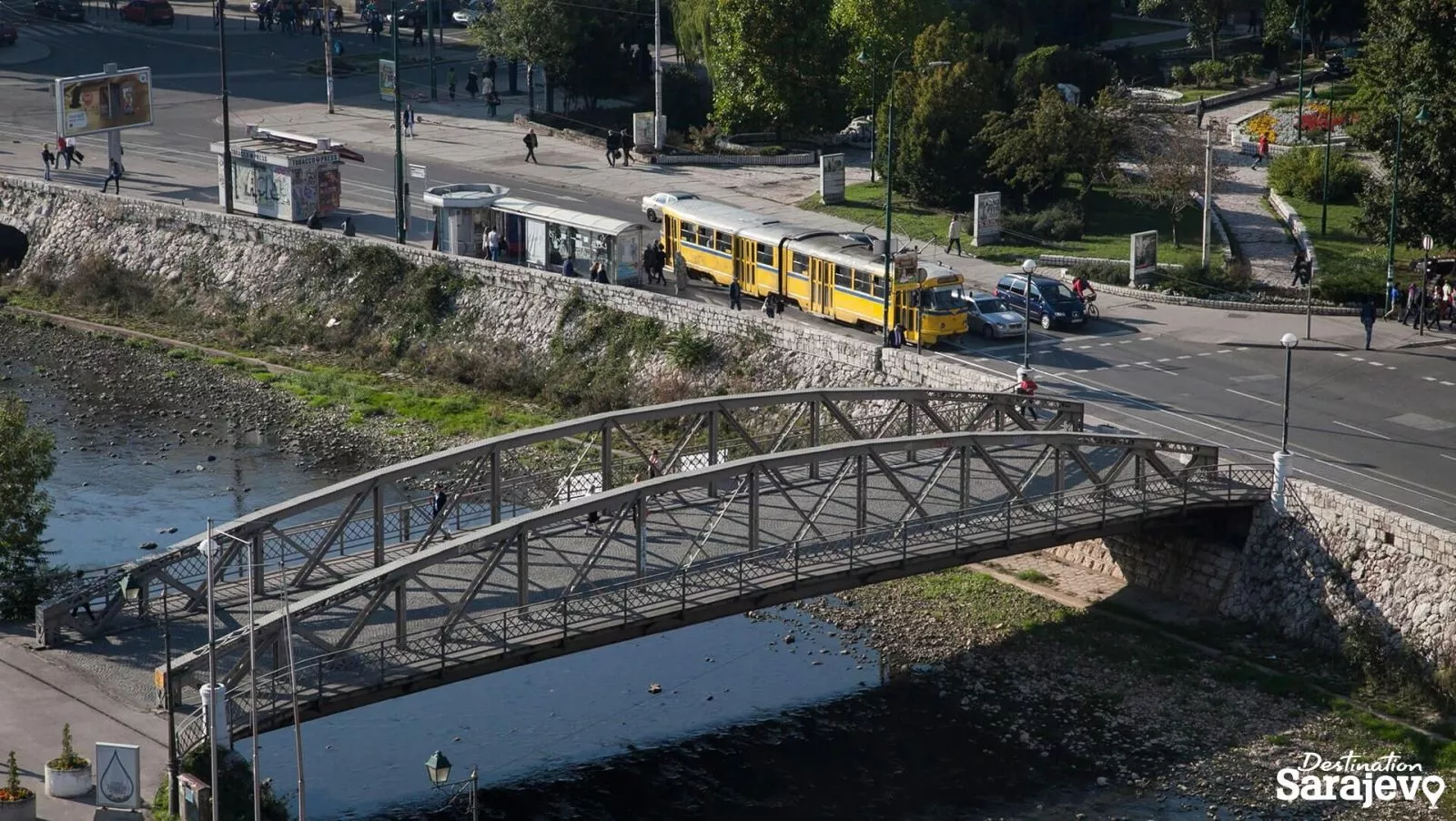
SARAJEVO, (Patria) – The initiative by councilor Zvonko Marić to rename the pedestrian Iron Bridge in Skenderija (Ajfelov most) to the bridge "Đorđe Balašević" or "Balašavićem most" was not accepted at the session of the Commission for Public Recognitions and Commemoration of Historical Events and Personalities of the Centar Municipality.
In their explanation, they state that the original Skenderija bridge was built of wood between 1485 and 1490, during the second term of Skender-beg Mihajlović as the governor of Bosnia. It was built diagonally to the Miljacka river flow about 100 meters downstream from the current (pedestrian) Skenderija bridge, approximately near the current bust of Vladimir Perić Valter, and it stood diagonally to the river flow. The bridge connected Skender-beg's endowments, the Nakšibendi lodge and imaret on the left bank, and the palace and caravanserai on the right bank of the Miljacka. Skender-beg's son, Mustaj-beg Skenderpašić, built a mosque on the left bank around 1515, which no longer exists today, and which was the first domed mosque in Sarajevo. From the 16th century to the present day, the entire area has been called Skenderija, and within it are: KSC Skenderija, Skenderija bridge, Skenderija street, MZ Skenderija-Podtekija.
The Skenderija bridge has continuously existed in the wider area from the end of the 15th century to the present day. It has been repaired several times, and since the end of the 18th century, it has been rebuilt from the foundations three times: in 1787, 1833, 1861 (about which there is a preserved chronogram by the author Fadil-paša Šerifović), and 1881.
To reduce maintenance costs, and amidst the regulation of the Miljacka river flow, the Sarajevo city administration replaced the wooden bridge with an iron structure several tens of meters upstream in 1893, which still exists today. The bridge retained the name Skenderija even after the replacement of the structure in 1893, and after the construction of a new four-lane bridge intended for motor vehicles in the 1970s.
The Commission for Public Recognitions and Commemoration of Historical Events and Personalities unanimously adopted the following conclusion: "Skenderija", "most Skenderija" or "Skenderija ćuprija" is the original, autochthonous name of the bridge, it is an integral part of the history and tradition of the city of Sarajevo, and as such appears in historical documents, archival material, cadastres, legal and sub-legal acts, intangible heritage and colloquial speech, and should not be subject to consideration for a name change.
Komentari (0)
Prijavite se za komentiranje
PrijavaJos nema komentara. Budite prvi!
Minuta
Sve →Iz drugih kategorija

High Representative Not Elected: Germans, French and British Sabotaged Americans, New Attempt at End of June

ČOVIĆ WITHOUT MERCY: How Those Who Brought Ademović to Office Created a Political Hell for Him



Sunny Saturday, quite warm



Tragedy in Albanian resort: Two minors drown












