
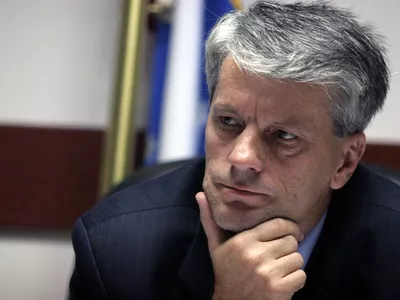
By Dr. Enver Išerić
Bosnia's closing arguments before the judicial panel chaired by Gabriel Escobar, Special Envoy of the United States Secretary of State
I, Bosnia and Herzegovina, am going through the most difficult period since the signing of the Dayton Peace Agreement. There is no fault of mine in this, and all international organizations, the most significant world military and economic powers, as well as international judicial institutions, know this. All the fault of all the actors has been presented to the UN Security Council through the report of the High Representative Christian Schmidt, and attention has also been drawn to developments with unforeseeable consequences for international peace and security.
Therefore, Mr. Escobar, I wish to point out the following to you:
1. I was subjected to aggression by two neighboring countries, Serbia and Croatia, in the period 1992-1995.
I call as witnesses:
- The UN General Assembly, which in 1974, by Resolution 3314, adopted the definition of aggression, in which we find elements of the principle of prohibition of the use of force from Article 2, paragraph 4 of the Charter: "Aggression is the use of armed force by a State against the sovereignty, territorial integrity or political independence of another State, or by any other manner inconsistent with the Charter of the United Nations, as illustrated by the following examples: ... No territorial acquisition or special advantage resulting from aggression shall be recognized as lawful." No territorial acquisition or special advantage resulting from aggression shall be recognized as lawful."
The state of division of my territory into entities and its constitutional arrangement was, without a doubt, created by force, i.e., by an act of aggression, and as such cannot be recognized.
- The UN Security Council, by its Resolution 757 (1992) of May 30, 1992, emphasized that the Security Council condemned the failure of the authorities in the Federal Republic of Yugoslavia (Serbia and Montenegro), including the Yugoslav People's Army (JNA), to take effective measures to meet the demands of Resolution 752 (1992) and demanded that all Croatian army units still in Bosnia and Herzegovina, without delay, act in accordance with paragraph 4 of Resolution 752 (1992), and UN Security Council Resolution 836 (1993) of July 4, 1993, among other things, emphasized: "Reaffirming that any acquisition of territory by force or by ethnic cleansing is illegal and totally unacceptable."
2. I was prevented from defending myself against aggression, which is contrary to Article 51 of the UN Charter
I call as witnesses:
- The UN General Assembly, which adopted the UN Charter in 1945
- The UN Security Council, which by Resolution 713 of September 25, 1991, imposed an arms embargo
3. I was not allowed to liberate my territory, occupied by aggression, by my Army in 1995
I propose as evidence:
- Interview of Alija Izetbegović, the first president of the Presidency of the Republic of Bosnia and Herzegovina, given to TV Liberty on June 13, 2000, in which he stated:
"When we were moving towards Banja Luka, when there was an offensive in that direction, huge columns of Serbian refugees were blocking the Posavina corridor on the way to Serbia. Milošević was faced with these angry refugees who could threaten the survival of the regime in Yugoslavia, and he told the Americans that if it continued, he would send three or four divisions to establish balance. The Americans, it seems, believed him because Ambassador Menzies came to me, around the end of September, and said that America was asking for the offensive towards Banja Luka to be stopped, precisely for these reasons. We did not stop the offensive immediately, and he came again five or six days later and told me very clearly: 'If the action continues, we will bomb you in the same way we bombed Serbian troops at the end of August and the beginning of September. This is a serious warning.'
In that situation, we had to stop that action, because it would have been an extremely unfavorable situation for us, which would have further encouraged Serbian extremists, and who knows how things would have developed further. But, I think the Americans believed, rightly or wrongly, Milošević's threat that he would send three or four divisions to support the Serbian resistance in Banja Luka. I think that was decisive, the pressure on America, and then the American pressure on us. That's how it came to this, that there are no winners or losers in Bosnia and Herzegovina."
4. With the mediation of the USA and other world powers (witnesses and guarantors of the Dayton Peace Agreement), under threat of force, I was forced to sign the Dayton Peace Agreement. I propose as evidence:
- Statement by Alija Izetbegović – Chairman of the Presidency of the Republic of Bosnia and Herzegovina, which reads: "The negotiations were conducted under conditions of blackmail and with a sword over Bosnia's head. The people attacked by numerically superior and better-equipped enemies were subjected to severe suffering, and the peace offered was always contrary not only to my principles but also to elementary justice. After Srebrenica, Bosnia could not have waged war for another year, and if it had rejected the Dayton Agreement, it would have had to continue fighting, completely isolated. Bosnia was a severely wounded patient before the winter of 1995, and thanks to the Dayton peace, it survived."
- The Vienna Convention on the Law of Treaties of 1969, which prohibits coercion and threat in the conclusion of international treaties and which, in Articles 51 and 52, stipulates:
Article 51: "The expression of a State's consent to be bound by a treaty which has been procured by the coercion of its representative through acts or threats directed against him shall be without any legal effect."
Article 52: "Any treaty the conclusion of which has been procured by the threat or use of force in contravention of the principles of international law embodied in the Charter of the United Nations shall be void."
5. States that committed aggression against my territory participated in the adoption of my Constitution, and the issue of adopting the constitution is within my exclusive jurisdiction, which is contrary to Article 2 of the UN Charter, which stipulates that "The Organization is based on the principle of the sovereign equality of all its Members."
I propose as evidence:
- The Dayton Peace Agreement of 1995
- The UN Charter of 1945
6. The Constitution of BiH, as an annex to the agreement, contains provisions that are contrary to the imperative norm of general international law on the prohibition of discrimination against people and is therefore void. I propose as evidence:
- Judgments of the European Court of Human Rights in the cases Sejdić-Finci, Zornić, Pilav, Pudarić
7. Provisions that enable the blocking of the work of my institutions are incorporated into my Constitution, which makes me an ineffective state and does not allow me to ensure equal rights for my citizens throughout my territory, as well as my progress towards the standards of modern democratic states. I propose as evidence:
- The Constitution of Bosnia and Herzegovina and its provisions governing decision-making processes
8. My enemies have been blocking the work of my institutions for the past six months with the intention of proving that I am an impossible state and that my territory should be divided by neighboring countries as agreed in 1991 in Karađorđevo.
I propose as evidence:
- Insight into the situation on the ground
- Report of the High Representative for Bosnia and Herzegovina, Mr. Christian Schmidt, submitted to the UN Security Council
9. Due to all that has been presented, I propose that the judicial panel (PIC) chaired by Gabriel Escobar, Special Envoy of the United States Secretary of State, make a decision that will:
a. Amend my Constitution to prevent the blocking of my institutions and ensure equal rights for all my citizens
b. Prevent the satisfaction of demands from political parties seeking changes to electoral legislation that would return my citizens to the Middle Ages
c. Enable me, like other countries in the world, to have one president elected by all my citizens
d. Order the High Representative to dismiss from all positions and ban political activity of persons who violate my Constitution and refuse to execute the rulings of the Constitutional Court
e. Order the judicial institutions to immediately prosecute all criminal offenses against the constitutional order and the security of my citizens
10. Only this decision is just, and by its adoption, the injustice inflicted upon me by the international community will be rectified, and at the same time, conflicts will be prevented, because any threat to my sovereignty and territorial integrity will be met with a very decisive response. If the blocking of my institutions continues, I will continue to act according to the Constitution of the Republic of Bosnia and Herzegovina, which does not recognize the existence of entities.
Komentari (0)
Prijavite se za komentiranje
PrijavaJos nema komentara. Budite prvi!
Minuta
Sve →Iz drugih kategorija

High Representative Not Elected: Germans, French and British Sabotaged Americans, New Attempt at End of June

ČOVIĆ WITHOUT MERCY: How Those Who Brought Ademović to Office Created a Political Hell for Him



Sunny Saturday, quite warm



Tragedy in Albanian resort: Two minors drown












