
For NAP writes: Hamza Memišević, PhD candidate at the Faculty of Political Science UNSA
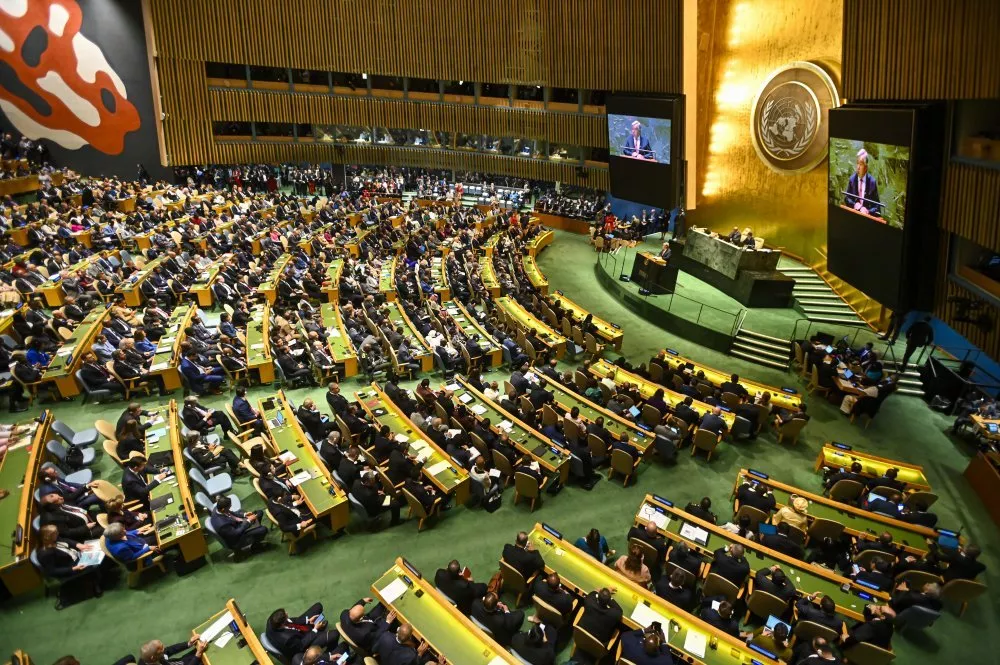
Ambassador of Bosnia and Herzegovina to the United Nations Zlatko Lagumdžija announced to the media that the text of the resolution on the genocide in Srebrenica has finally been agreed upon and will be discussed next week. The initiative by Germany and Rwanda, with the support of a large part of the UN member states, to declare July 11th as the International Day of Remembrance of the Genocide committed in Srebrenica in 1995, judging by the information arriving daily, has finally reached its epilogue.
The essence of the resolution is contained in seven points, among which it is stated that July 11th is the international day of remembrance of the victims of the genocide in Srebrenica and that the denial of genocide is unequivocally condemned. At the same time, UN member states are invited to preserve the established facts through their educational systems. It further states that the glorification of war criminals is strongly condemned and emphasizes the importance of future work in finding and identifying victims. The remaining points of the resolution call on member states to adhere to the Convention on the Prevention and Punishment of the Crime of Genocide, and then request the UN Secretary-General to establish a program to mark the 30th anniversary of the genocide in Srebrenica. The last point contains a call to all organizations, including the non-governmental sector, to mark the International Day of Remembrance of the Genocide in Srebrenica with appropriate content.
The text of the resolution has reached its epilogue, but how effective is the resolution? The question is what was intended by the delay in the final text, was it to appease the facts or Serbia, which for who knows what time will take on the role of victim in public, while happily rubbing its hands behind the scenes, because Bosniaks have again received crumbs with which they are unfortunately satisfied.
The entire process of finalizing the text of the resolution was slowed down by Serbia's diplomatic games and amendments from the current government of Montenegro, about which certain Bosniak masterminds told us that it is a pro-European government and policy, devoid of any Greater Serbian aspirations. As if it is impossible to be a Greater Serb and a Westerner? Wasn't the "Yugoslav Army in the Homeland" favored by the West during World War II, and isn't Vučić today an example of that alliance?
An even better example is Vuk Drašković, who, at the moment when information appeared in the public that Germany and Rwanda were initiating a resolution on the Serbian genocide against Bosniaks in Srebrenica, rushed to a BiH media outlet and (pointed out) that Serbia should accept that resolution as soon as possible, given that it is a local genocide. Yes, Drašković reasons well, but Bosniaks reason poorly, almost not at all.
The Serbian genocide against Bosniaks in Srebrenica during July 1995 was the culmination of Serbian genocidal policy in Bosnia and Herzegovina. The Bosniak population of Gornje Podrinje (Višegrad, Goražde, Foča, Rogatica, and Čajniče) completely disappeared in 1992. How effectively the Serbian policy cleansed Gornje Podrinje is clearly shown by statistics, with the exception of Goražde, where the Bosniak factor managed to be preserved. And Bosnian Krajina had an identical fate, where the Bosniak and Croatian population, especially in Prijedor, was subjected to systematic killing and detention in concentration camps.
How did the Bosniak political, academic, social, or whatever elite allow the localization of genocide against Bosniaks? Ratko Mladić, in May 1992, after being presented with six strategic goals, stated: "Therefore, we cannot cleanse, nor can we have a sieve to sift only so that Serbs remain or Serbs perish and others leave. That, people, is genocide. We must invite every person who has kissed these lands and the territory of the state we want to create with their forehead."
In accordance with the aforementioned, it is necessary to understand that genocide is policy. Genocide is a crime of the system - the state, not individuals, despite the fact that a large number of individuals are necessary to achieve the goals, who, however, are not isolated from the system of government, but are part of that system and work for that system. The so-called individuals from the ranks of the Serbian people did not kill and commit genocide for personal gain, but on the contrary, in the name of Serbdom and the Serbian state.
However, let's return to the government of Montenegro, which demanded the individualization of the Serbian genocide against Bosniaks in Srebrenica and the Dayton Peace Agreement as a permanent category for Bosnia and Herzegovina. The amendment by the Montenegrin authorities on the individualization of guilt for genocide was accepted in the text of the resolution. From the very beginning of the text's drafting, the individualization of guilt was unquestionable. Representatives of major powers in Bosnia and Herzegovina, such as the British Ambassador, stated that the guilt is not on the Serbs and Serbia but on individuals. In fact, by defending the Serbian position and Serbian interests, Western powers keep what truly happened during the period of aggression against the Republic of Bosnia and Herzegovina and the genocide against Bosniaks away from the public.
Former representative of the Republic of Bosnia and Herzegovina before the International Court of Justice, Francis Boyle, speaking about the events during the Serbian aggression against Bosnia and Herzegovina, said that the legal representatives of the BiH authorities were faced with enormous pressure from Great Britain, France, and Russia, all in order to abandon the filing of a lawsuit against Serbia and Montenegro in 1993. As for the second amendment, there was no need for it. The High Representative in Bosnia and Herzegovina, Christian Schmidt, during recent, but all too standard political upheavals in BiH, clearly stated that he is the guarantor of the Dayton Agreement, so the change of the Dayton constitutional structure has not been, nor will it be, considered an option in international circles.
Bosnia and Herzegovina is the child of those who stand behind the resolution. If the international community had wanted to abolish the Serbian entity in Bosnia and Herzegovina, it would not have institutionalized that entity in 1995 with the Dayton Peace Agreement. With the final text of the resolution, but also with the acceptance of the amendments by the Montenegrin authorities, the policy of appeasing Serbian national-political goals has continued.
As many times before, Serbia will get away with minimal scratches. This resolution could open a series of resolutions, but primarily in those parliamentary benches where the Serbian factor is the majority. It would not be surprising, given the announcements by Andrija Mandić, the President of the Montenegrin Parliament, or the recent statements by Dodik in Donja Gradina, that the resolutions might include the label of collective guilt for non-Serb peoples. When Dodik insults Bosniaks or when last week he labeled Croats as a genocidal people, there were no reactions from Serbian politicians and international officials. It is obvious that guilt must be individualized only when Serbs are executioners and Bosniaks are victims.
Bosniaks must finally realize that Bosnia and Herzegovina is not and must not be a provisional arrangement. Our history is our right and our obligation, not a rag that others should tailor for us. It is time to change what the Frenchman De Kervel wrote in the mid-19th century about Bosniaks. His observation reads: "The great misfortune of this part of the Slavic people is that it is unknown, except through the reports of its enemies."
Komentari (0)
Prijavite se za komentiranje
PrijavaJos nema komentara. Budite prvi!
Minuta
Sve →Iz drugih kategorija

High Representative Not Elected: Germans, French and British Sabotaged Americans, New Attempt at End of June

ČOVIĆ WITHOUT MERCY: How Those Who Brought Ademović to Office Created a Political Hell for Him



Sunny Saturday, quite warm



Tragedy in Albanian resort: Two minors drown












