
By Sead Omeragić
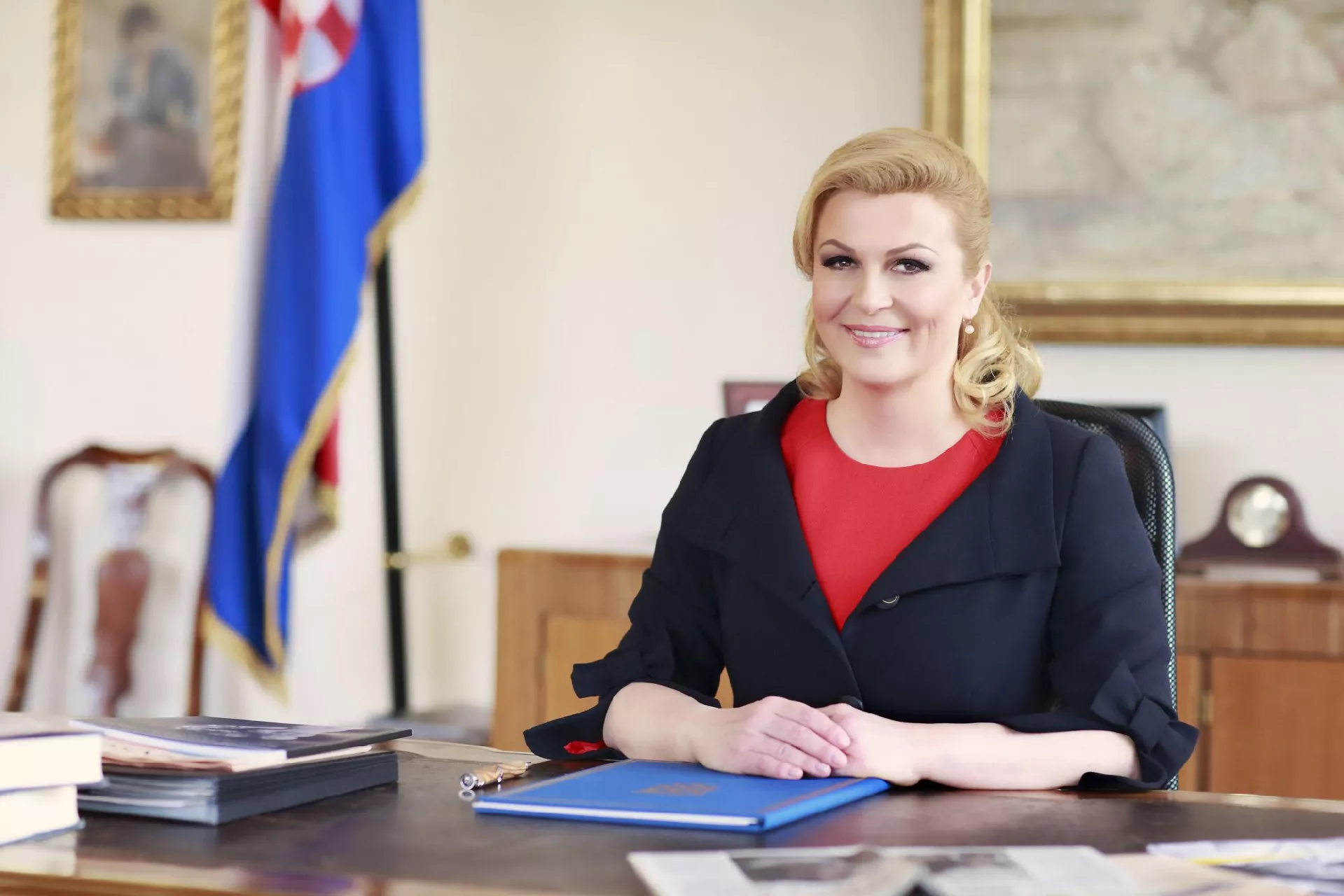
After the statement by Croatian President Kolinda Grabar Kitarović that she wants absolute security of her border with Bosnia and Herzegovina due to allegedly thousands of ISIL fighters returning from Syria to BiH, and after accusations against Bosniaks for terrorism, there were strong reactions. For many citizens in BiH, this resonated unpleasantly, as they have bad experiences with similar statements about the secure border of the Republic of Croatia and terrorism.
It is interesting how Grabar Kitarović's political role model, the first president, the father of her HDZ and nation, Franjo Tuđman, treated the territory and borders of BiH, and even his own country, as a commodity. In May 1991, Tuđman sat with four guests in Banski dvori.
When the conversation turned to BiH, he immediately said something that shocked those present: "State borders at the end of the twentieth century cannot be marked by the conquest of an Asian power." Tuđman then continued the story about the advantages of the Banovina borders from 1939, which was a Nazi plan to divide Bosnia and Herzegovina between Nedić's Serbia and Pavelić's Croatia. Professor Ivo Banac asked him: "And what does Mr. Milošević think about that?"
Tuđman nervously replied: "Milošević agrees with that." Banac repeated the question about the Banovina borders with a touch of irony: "Are you sure he agrees?" Tuđman decisively answered: "Yes, he agrees." Turkey is still treated very poorly in the Croatian media today, as it was then. The period of good treatment lasted longer than expected. Tuđman's catastrophic treatment of BiH's sovereignty is a separate story. He believed he could trade the territory of this country as his private property. Owen writes about a lunch with Tuđman.
Even then, Tuđman was exchanging cities in the neighboring country. He told Owen: "For three cities in central Bosnia, Vitez, Novi Travnik, and Busovača (with two strategic arms factories), I have to cede Stolac to the Muslims." Thus, he was ceding a city where they were the absolute majority to Bosniak Muslims.
This is how the founder of HDZ and Kolinda's political role model understood the borders of BiH and ownership of Bosnian cities. Unfortunately, we have seen similar things from the current government in the Republic of Croatia. And again, it is about Stolac.
'Role model' did not only divide and trade the territory of Bosnia and Herzegovina. He also traded with the territory of Konavle, a beautiful and fertile area in the hinterland of Dubrovnik. On December 9, 1993, at a meeting at the Hunting Lodge in Dobanovci, Serbia, Milošević, Krajišnik, and Karadžić were present, while from the Croatian side, Hrvoje Šarinić and Mile Akmadžić were present, who came after prior agreements with Tuđman, who skipped that meeting.
Šarinić offered that through Konavle, Bosniaks "Muslims should be given access to the sea from Molunat to Vitaljina, and Bosnian Serbs from Vitaljina to Cape Oštro." When Haris Silajdžić was asked about this agreement, he said: "Neum and nothing else," referring to the natural border of BiH. Tuđman, of course, told Silajdžić that this was out of the question. The finance department of HVO in Herceg-Bosna (as it was the government of HVO, i.e., a military junta) issued an order on January 29, 1992, to impose an absolute embargo on the rest of Bosnia and Herzegovina.
Nothing more would be able to pass through the border of the so-called Herceg Bosna. Food in Bosnia would be distributed in spoonfuls for years. On April 14, 1993, the "regime of movement within the territory of Herceg-Bosna" was changed. All roads and exits were closed towards Croatia. The bans applied only to Bosniaks. For two years, life in the rest of the country with a Bosniak majority would be lived under terrible circumstances. More than two hundred thousand Bosnian Croats would share the fate of the besieged cities of Sarajevo, Tuzla, Zenica, Bihać, Brčko because they did not want to leave their homes and homeland. Starvation of those who remained in the siege in BiH was not only a Serbian but also an absolute strategy of Tuđman's regime.
News of terrible hunger spread through ordinary citizens in European metropolises. As early as April 1993, Tilman Zilh, president of the Society for Threatened Peoples, wrote to Cardinal Kuharić: "Official Croatia has been condoning the policy of war criminals Milošević and Karadžić for months, by, through its vassals, in the so-called Republic of Herceg-Bosna, illegally seceded from Bosnia, cutting off all existential ties to the outside world... While thousands of Bosnians are dying of hunger and cold, the so-called Boban administration is confiscating food, medicine, medical instruments, clothing, and weapons intended for Bosnia," warned Tilman Zilh.
Honest Cardinal Kuharić immediately spoke out against Boban's policy, and then Boban brutally and outrageously attacked him publicly. In the early spring of 1993, while the terrible offensive on Srebrenica was underway, HVO held 25 trucks of weapons and ammunition in Grude, which were heading towards Tuzla. The Croatian side had already taken, according to the agreement, two-thirds of the total shipment of these weapons, but they still did not allow this convoy to proceed to its destination. Richard Holbrooke writes in his memoirs that weapons were massively going to Bosnia and Herzegovina and the BiH government forces, and that the US tacitly allowed it.
But... "The Croats, who do not want to allow the Muslims to become too strong, have not allowed them to acquire heavy weapons or artillery. Second, every shipment of weapons has a 'Croatian arms tax,' that is, what Croats set aside for their army and HVO in Bosnia and Herzegovina," Holbrooke explained. The problem, he explained, was the fifty percent tax that Croatia took from all shipments, while 25 percent was to be set aside for the forces of Croats in BiH.
Both sides, however, took far more than agreed, so the units of the Bosnian government received crumbs of at most ten percent, mostly the worst part of the weapons, wrote Holbrooke. In his memoirs, David Owen notes: "What Croatia represented for Bosnia and Herzegovina as a route for arms delivery, it charged the Bosnian government heavily in money or by demanding 50 percent or more of the weapons for itself, and sometimes both. Cut off from the world, mostly Muslim, the Bosnian government forces depended on the Croats."
David Owen observed that "Bosnian Serbs bought food and fuel from Croats during most of the war in which they allegedly held each other by the throat." Ibrahim Đedović spoke about free trade between Serbs and Croats in the middle of the war, mediated by Fikret Abdić, on HTV in November 1993. "We had no problems with passage (convoys of food and fuel) through the Serb Krajina." The host corrected him: "The so-called RSK." David Owen also shared his knowledge of these excellent relations: "In early 1995, fuel from Split and Zadar reached the Bosnian Serb army through the Krajina corridor, with the complicity of the Croats." ... Owen admitted that he himself encouraged such fuel deliveries: "Fuel reached the Serbs in Croatia directly from Croatia and with the approval of the Croatian government. Tuđman knew what we were doing and approved all our efforts"...
Therefore, as far as Tuđman was concerned, food and gasoline could go to Knin and Banja Luka, but not a single bite for Sarajevo. During the time of Tuđman, Boban, and Prlić, upon mention of Bosnia and Herzegovina, Croatian borders were completely and unscrupulously closed. Although the data has been processed, to this day, there is silence about the horrific number of children who died of starvation in maternity hospitals across the besieged part of BiH. A high-ranking Slovenian politician informed the BiH government on July 23, 1993, that the Croatian president Tuđman had ordered another large delivery of fuel to the Serb army in Bosnia.
Fuel was transported via the Metković-Čapljina highway towards Berkovići, a settlement between Stolac and Bileća. The Croats gave the fuel to the Serbs almost for free at that time so that they could launch an offensive on Sarajevo and thus tie down the forces of the Army of RBiH. Namely, HVO was preparing a major offensive on central Bosnia. Stipe Mesić, at a conference, provided data on this fuel trade: "INA (Croatian oil company) exported 2 million tons of oil to Bosnia during the war.
Every day, 400 tons of food and 112 tons of gasoline were brought to Ključ by convoys from Croatia. The oil was only formally sold to Fikret Abdić, and he forwarded it to the Republika Srpska and Serbia." The international community knew all this well and tolerated it, Mesić added. The case of two Turkish ships confirms how firm Croatia's borders were when it came to Sarajevo and the territory of the legal authorities in BiH. One ship carried 4500 tons of food, which HVO seized and literally sold off, while from another smaller tanker, they took all the oil and sold it, so not a single barrel reached the besieged territory of BiH.
Both ships were paid for by voluntary contributions from Turkish citizens. Two more tankers from Islamic countries arrived in the port of Rijeka, and all trace of them was lost there. In a correspondence between the prime minister of the so-called Herceg-Bosna, Prlić, and RS, Lukić, dated February 26, 1994, it is stated that a semi-annual delivery of 5.2 million liters of fuel from Herceg-Bosna to RS was discussed. For the Hague Tribunal, an analysis of the laws passed by the para-state Herceg-Bosna on February 26, 1993, was carried out. The state border of HZHB was defined by three decrees. The Decree on crossing the state border, the Decree on the movement and stay of foreigners, and the Decree on the registration of foreigners. Foreigners in Herceg-Bosna were citizens of RBiH. The threat from the Croatian president "resounded historically" because it unusually reminded of the years-long terror of Tuđman and Boban over the civilians of Bosnia and Herzegovina, which complemented the worst terror of Milošević and Karadžić over Bosnia and Herzegovina.
The terror inflicted on Sarajevo, Tuzla, Zenica, and dozens of besieged cities from '92 to '95 is indescribable. Finally, the most important thing regarding that interstate border: In the trials at the Hague Tribunal, passes of foreign Islamic fighters, so-called mujahedin, bearing the signature of Gojko Šušak, were shown.
Only then was the secret revealed as to how these people entered BiH, even during the conflict. Mrs. Grabar Kitarović treated the children in Dubrovnik to a hundred Serbian chocolates and apologized to them.
She treated us to two thousand ISIL fighters, and didn't even think of apologizing.
Komentari (0)
Prijavite se za komentiranje
PrijavaJos nema komentara. Budite prvi!
Minuta
Sve →Iz drugih kategorija

High Representative Not Elected: Germans, French and British Sabotaged Americans, New Attempt at End of June

ČOVIĆ WITHOUT MERCY: How Those Who Brought Ademović to Office Created a Political Hell for Him



Sunny Saturday, quite warm



Tragedy in Albanian resort: Two minors drown












