
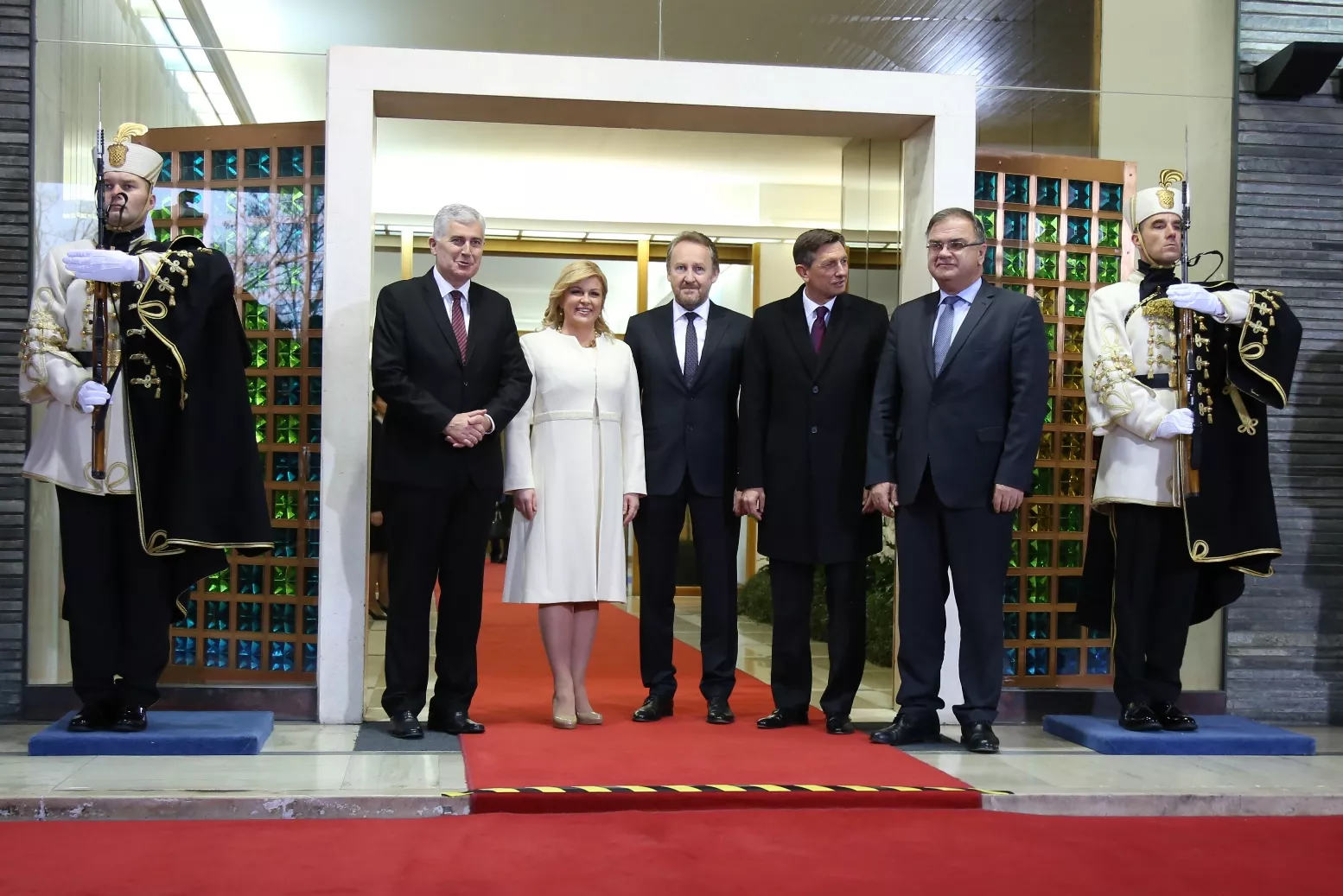
Members of the Presidency of Bosnia and Herzegovina attended the meeting of Brdo-Brijuni Process leaders in Zagreb, at the invitation of the President of the Republic of Croatia Kolinda Grabar-Kitarović and the President of the Republic of Slovenia Borut Pahor, as leaders of the Brdo-Brijuni presidential process, reports the BiH news agency Patria.
All presidents of the countries in the region, US Vice President Joseph Biden, President of the European Council Donald Tusk, and Austrian President Heinz Fischer responded to the extraordinary meeting.
A declaration titled "A Common Strategic Vision of a Europe that is Whole, Free, and at Peace" was adopted at the meeting.
They discussed current challenges, as well as opportunities for strengthening stability, security, and prosperity in Southeast Europe. It was agreed that to achieve these common goals, they must continue to strengthen the transatlantic partnership between the United States and the European Union, and inject new energy into the EU enlargement process for candidate countries and the Euro-Atlantic integration process for those wishing to join NATO. The European Union and the United States expressed their firm commitment to advancing and supporting these European and Euro-Atlantic integration processes of the Brdo-Brijuni Process members, which will help achieve the common strategic vision of a Europe that is whole, free, and at peace.
The momentum of accession processes varies among the countries of Southeast Europe. Some countries are experiencing challenges in their individual progress on the path of European integration, contributing to a sense of despondency and providing fertile ground for populism and instability that often flourish in circumstances of unresolved political and inter-ethnic tensions. This can adversely affect the active support of EU member states for EU enlargement, reinforcing this negative pattern, which must be broken on both sides.
In the last decade, significant progress has been made in Southeast Europe in consolidating democratic institutions, improving relations among neighbors, and enhancing open dialogue between civil society and political leaders, as demonstrated at today's meeting. Although the EU enlargement process is an effective tool for the transformation and modernization of candidate countries, commitment to this process needs to be re-strengthened. This process must be considered not only a technical but a political process of utmost importance.
Each country is aware of its responsibility for strengthening the rule of law, fighting crime and corruption, strengthening its institutions, ensuring the implementation of ambitious structural reforms, reducing chronic unemployment, fostering development and competitiveness, and improving the business and investment climate. Open bilateral and regional issues should be addressed constructively, in accordance with international law and its principles.
The leaders of the Brdo-Brijuni Process renewed their common commitment today to building trust, developing bilateral and regional dialogue, providing appropriate mutual assistance in European and Euro-Atlantic integration processes, and promoting further cooperation and reconciliation. They committed to improving economic cooperation and connectivity through regional infrastructure projects, with particular attention to energy security. The focus was on guaranteeing the prosperity of younger generations by providing them with mobility programs and employment opportunities. The synergy between the Brdo-Brijuni Process and the Berlin Process was emphasized here. In this context, the results of the Vienna Summit were welcomed.
It was agreed that regular dialogue at the operational level between the United States, the EU, and the countries of Southeast Europe is necessary in the fight against global security threats. The current dramatic migration crisis presents an unprecedented challenge from both humanitarian and security perspectives, and requires dialogue and agreement to better protect the external borders of the European Union and significantly alleviate the migration pressure on the affected countries.
United in solidarity and appalled by the brutality of the terrorist attack in Paris, as well as the terrorist acts in Ankara, Sinai, Beirut, and Bamako, they called for effective and efficient global solutions aimed at addressing the root causes of radicalism, violent extremism, and terrorism, which affect us all. Broader international cooperation, as well as better coordination and information exchange among police agencies, is key.
Komentari (0)
Prijavite se za komentiranje
PrijavaJos nema komentara. Budite prvi!
Minuta
Sve →Iz drugih kategorija

High Representative Not Elected: Germans, French and British Sabotaged Americans, New Attempt at End of June

ČOVIĆ WITHOUT MERCY: How Those Who Brought Ademović to Office Created a Political Hell for Him



Sunny Saturday, quite warm



Tragedy in Albanian resort: Two minors drown












