
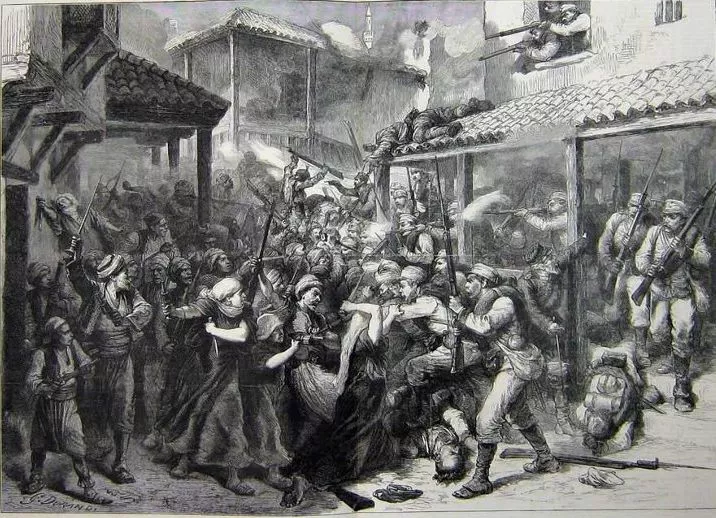
Sarajevo and Bosnia and Herzegovina, 136 years ago, put up an unprecedented resistance to the Austro-Hungarian monarchy, which, according to the agreement at the Berlin Congress, began the occupation of Bosnia and Herzegovina in the summer of 1878, reports the Bosnian news agency Patria (NAP).
In three days, on August 19, it will mark the 136th anniversary of when Sarajevo, fiercely defending itself, fell under the occupation of the Austro-Hungarian monarchy. However, in the year when the capital of Bosnia and Herzegovina marked the 100th anniversary of the Sarajevo assassination, this event was completely forgotten by the city authorities, although it has great historical and political significance for Bosnia and Herzegovina.
Although the resistance that Bosnia and Herzegovina, and especially Sarajevo, offered to the occupier that summer of 1878, even without the support of the Ottoman state and Istanbul, shocked Europe and forced the great monarchy to deploy nearly a hundred thousand soldiers from multiple directions, little is known or spoken about it in the Bosnian public.
According to historical sources, Sarajevo officially fell on August 19, 1878, after fierce battles within the Sarajevo neighborhoods of Kovači and near Alipašina Mosque.
- They shot from every house, from every window, from every door... even women participated in the resistance – states in the Austrian descriptions of the occupation of Sarajevo.
After the great world powers agreed in Berlin that the Turkish empire should withdraw from Bosnia and Herzegovina, and leave our state to the administration of Vienna and Budapest, the population in Bosnia and Herzegovina and Sarajevo rebelled against such political trade.
The resistance in Sarajevo was led by dignitaries such as Muhamed ef. Hadžijamaković and Abdulah ef. Kaukčija. Within Bosnia and Herzegovina, in a large number of cities, tens of thousands of defenders were mobilized in a short time, stopping the Austro-Hungarian army.
Battles were also fought near Maglaj, Jajce, Vitez, and at Vranduk. One of the most famous leaders of the popular resistance to the occupation was Salih ef. Vilajetović, known as Hadži Loja. Along with the mufti of Pljevlja, Mehmed ef. Šemsekadić, Hadži Loja offered the strongest resistance until the last days of the occupation. According to all relevant historical sources, Bosnian Serbs and Croats also fought alongside Hadži Loja's forces.
The legendary folk hero, hafiz and imam of a mosque in Sarajevo, Hadži Loja, was eventually captured and handed over to the Ottomans. He was forbidden to return to Sarajevo and Bosnia and Herzegovina. He died in Mecca, the Holy City, where he was also buried.
According to Austrian sources, more than 5,000 soldiers were put out of action during the months-long battles in Bosnia and Herzegovina, of which a thousand were killed and 4,000 seriously wounded. The surprising resistance of Bosnia and Herzegovina to the agreed occupation caused, according to sources from Vienna, fierce political conflicts within the Monarchy itself, reports NAP.
Komentari (0)
Prijavite se za komentiranje
PrijavaJos nema komentara. Budite prvi!
Minuta
Sve →Iz drugih kategorija

High Representative Not Elected: Germans, French and British Sabotaged Americans, New Attempt at End of June

ČOVIĆ WITHOUT MERCY: How Those Who Brought Ademović to Office Created a Political Hell for Him



Sunny Saturday, quite warm



Tragedy in Albanian resort: Two minors drown












