
By: A. Čorbo-Zećo
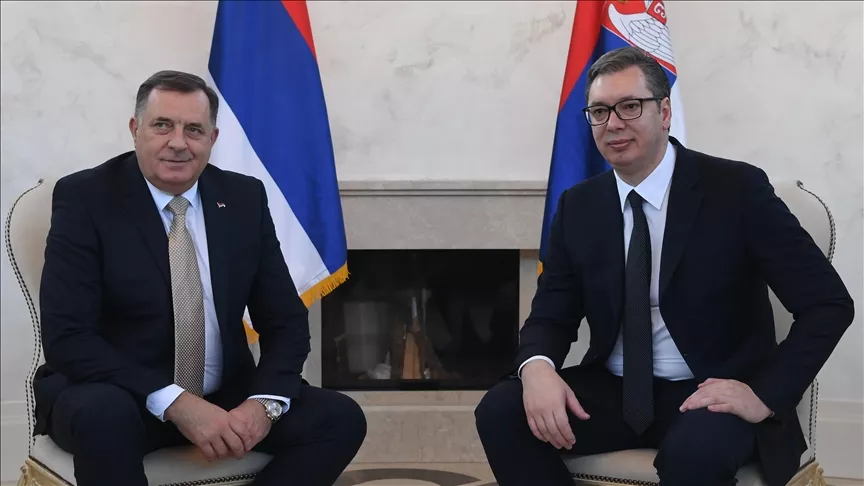
The political symbiosis of Aleksandar Vučić and Milorad Dodik, which for years seemed unbreakable, has shown its first serious cracks in recent days. While Vučić is increasingly reserved in his comments on the situation in Bosnia and Herzegovina and is clearly trying to calm his tone towards the West, Dodik, paradoxically, is turning to Croatia and thanking Zagreb for its "principled stance" in the UN Security Council.
So much for the claims of the Trojka (coalition of SDP, NiP, and NS) that they succeeded in breaking the partnership between HDZ and SNSD.
Vučić's statement that "know that whoever is praised by the Croats is not doing much good for the Serbian people" is interpreted in regional political circles as a clear message directed precisely at Dodik. Because, while Vučić is trying to maintain the image of a stabilizing leader of the Balkans, Dodik, with his statements and constant conflicts with the international community, is becoming an increasing burden for Belgrade.
Dodik is using the new situation to show that he is not isolated. His "thanks to Croatia" is not diplomatic courtesy, but a political message to Vučić, as well as to the Trojka: "I am no longer dependent solely on Belgrade." Because, realistically, Zagreb can get done whatever it wants through Brussels. We know this through the actions of Christian Schmidt.
By thanking Croatia, Dodik is trying to legitimize his narrative about "equal dialogue of constituent peoples," because this concept also suits Croatian policy towards BiH. In this Dodik–Čović–Zagreb triangle, he sees a chance to balance pressures from both Belgrade and the West, which is increasingly favorable to him.
What is happening now is not a dramatic split, but a tactical correction of relations. Vučić no longer defends Dodik, but still uses him as a vent through which he can deliver nationalist messages, and he always has someone in reserve, for example, at this moment, Draško Stanivuković. Because it is not impossible that Dodik becomes a "moderate" leader, and the opposition takes over his current course.
For Dodik, this means the loss of a political support that has guaranteed him security and legitimacy for years. That is why he is trying to find new addresses of support, from Zagreb to Moscow and Washington.
Symbolically, the moment when Dodik thanks Croatia, and Vučić publicly warns him through sarcasm, marks the end of the political idyll between the two "brothers," as they like to call themselves.
The axis that has functioned for years based on mutual interest is now turning into a cold, cautious alliance, in which each side is looking for ways to survive political pressure from the outside and preserve power at home.
Komentari (0)
Prijavite se za komentiranje
PrijavaJos nema komentara. Budite prvi!
Minuta
Sve →Iz drugih kategorija

High Representative Not Elected: Germans, French and British Sabotaged Americans, New Attempt at End of June

ČOVIĆ WITHOUT MERCY: How Those Who Brought Ademović to Office Created a Political Hell for Him



Sunny Saturday, quite warm



Tragedy in Albanian resort: Two minors drown












