
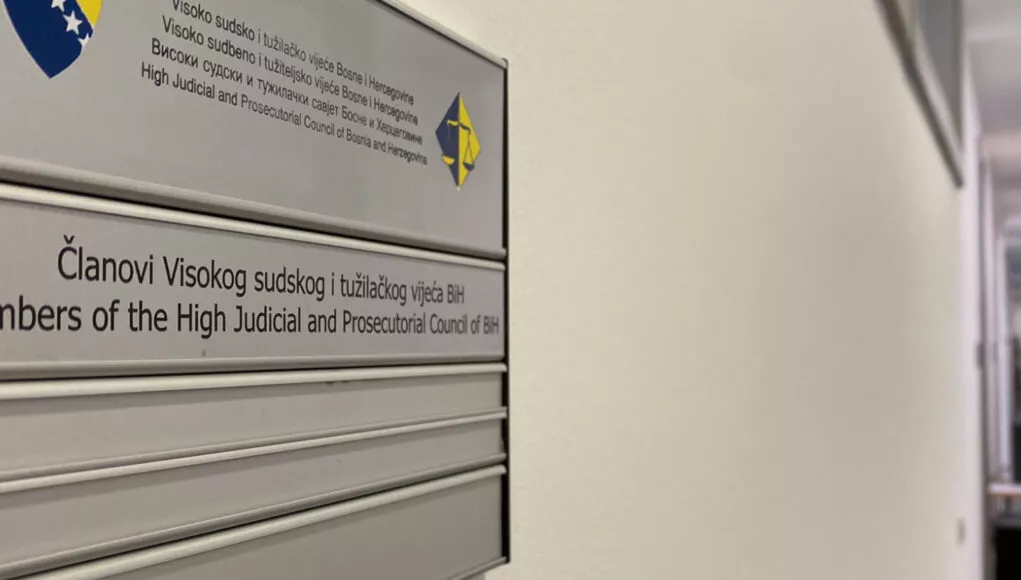
(Patria) - The highest judicial body in Bosnia and Herzegovina has not respected the earlier agreement nor the warnings, which is why the European Union is currently considering its future funding of the asset oversight process for judges and prosecutors, Detektor has confirmed.
This decision by one of the largest donors to the domestic judiciary comes after the High Judicial and Prosecutorial Council (HJPC) changed the method of engaging external experts who monitor the asset verification of judges and prosecutors, confirmed by the EU Delegation in BiH.
The Delegation stated that earlier this year, the HJPC considered a draft amendment to the rulebook, which would essentially change the framework underpinning the external monitoring of asset verification of judges and prosecutors and would pose a serious risk of rendering the external monitoring program ineffective. The draft amendment, they said, raised a number of concerns regarding the effectiveness, credibility, and independence of external monitoring.
These concerns, they added, were officially raised by Valentina Superti, Director for the Western Balkans in the European Commission's Directorate-General for Neighbourhood and Enlargement Negotiations, in her letters to HJPC President Sanin Bogunić on February 10 and April 13.
“Despite this, the HJPC of BiH adopted the said amendments to the rulebook on April 15, thereby essentially disregarding the Commission's opinion,” the EU stated.
“We are currently assessing our course of action, including any impact on EU funding of the monitoring operation,” the EU Delegation confirmed to Detektor.
The introduction of asset verification for judges and prosecutors through amendments to the Law on the HJPC was key for BiH in obtaining candidate status for EU membership. The adoption of the new law is still considered one of the most important for the continuation of the European path.
The High Judicial and Prosecutorial Council on Wednesday adopted amendments to the rulebook regarding the external monitoring of the Department for Asset Verification of Judicial Office Holders and the method of engaging external experts who monitor their work. Council members decided that external experts will be selected through a public competition, with two members of the commissions appointed by the European Union and one by the HJPC.
The Council members made this decision without consulting the EU, and it differs from the previous agreement, confirmed by the EU Delegation in BiH for Detektor.
As they state, the European Commission's support for the implementation of amendments related to integrity is reflected through the external monitoring program, funded by the EU, which monitors the work and overall functioning of the HJPC Department for Reporting on Assets and Interests, as well as disciplinary proceedings. Specific implementation modalities were agreed with the HJPC, which envisaged the hiring of external experts and their support staff through an open, transparent procedure based on the candidates' expertise.
Any changes to the established modalities should be mutually agreed upon between the HJPC and the European Commission, the Delegation stated in its response.
The HJPC and the EU have had disagreements for several months regarding the engagement and work of external experts who should help ensure that the asset verification of judges and prosecutors, which the domestic judiciary is conducting in this way for the first time, is carried out efficiently and transparently. Council members had previously rejected the proposal of EU experts, who are funding this process.
Following this, the HJPC began changing the rules for their engagement.
On the first day of the HJPC session this week, the Department for Legal Affairs presented a summary of the Council's proposal and the European Commission's response, stating that the Council's proposal was to conduct the engagement procedure based on a public call published by the Council, with the formation of a commission, but that they received a response from the European Commission that they did not agree with this proposal because they believe the Council should not select experts in the proposed manner to avoid perceived or actual conflicts of interest.
Brussels stated, as explained, that the Council's role should be limited to verifying whether the selected expert meets the minimum qualifications.
In a statement, the HJPC said it opted for the majority of the composition of the selection commission for external monitoring experts to consist of members selected by the international partner – the EU, “thereby further confirming the Council's unquestionable commitment to creating a perception of complete independence of experts for external monitoring of the Department's work.”
The work of external experts has been funded by the European Union since July 2025. External experts have a mandate to monitor disciplinary proceedings arising from asset and interest procedures, but do not provide suggestions on final decisions.
In a new report, external experts warn that the Department for Asset Verification of Judges and Prosecutors continues to operate with insufficient capacity, and the refusal of household members to provide data and limited international cooperation are slowing down work, calling into question the possibility of processing all reports within deadlines.
Komentari (0)
Prijavite se za komentiranje
PrijavaJos nema komentara. Budite prvi!
Minuta
Sve →Iz drugih kategorija

High Representative Not Elected: Germans, French and British Sabotaged Americans, New Attempt at End of June

ČOVIĆ WITHOUT MERCY: How Those Who Brought Ademović to Office Created a Political Hell for Him



Sunny Saturday, quite warm



Tragedy in Albanian resort: Two minors drown












