
By: A. Čorbo-Zećo
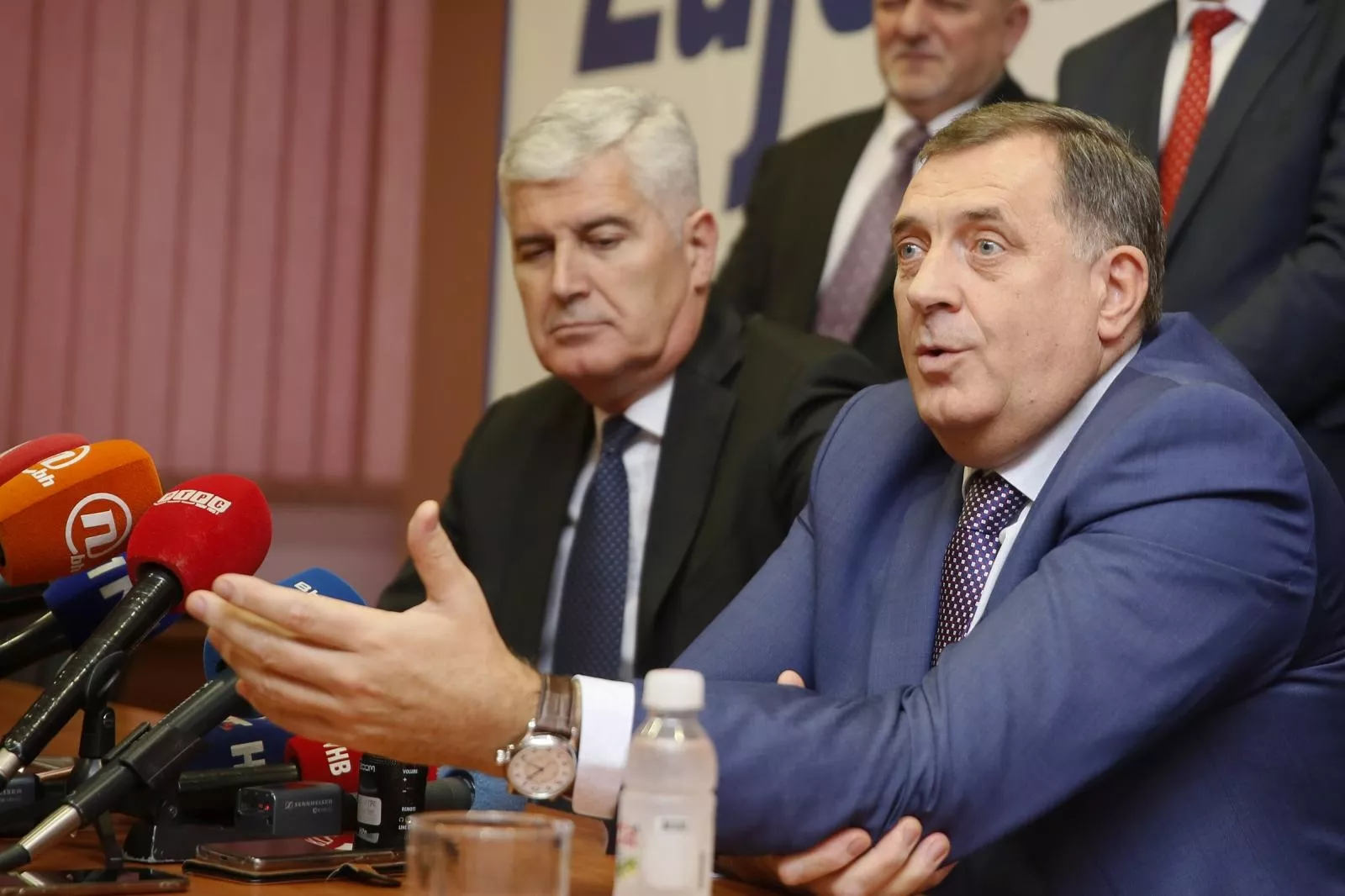
As time goes by, it is becoming increasingly clear that Dragan Čović, leader of the HDZ BiH, is not interested in the Election Law that would fully fulfill all civilizational norms and values of democracy. His interest is the division of Bosnia and Herzegovina, and this is evidenced by his coalition alignments with Milorad Dodik, and it is clear that they have been working on this for years. They have the full support of Zagreb and Belgrade in all of this, and they have even managed to win over certain international officials!
Their coordinated and synchronized work is evident from Dodik's announcement that it is possible for his party to support the Croatian Democratic Union of Bosnia and Herzegovina (HDZ) and boycott the General Elections in October next year!?
Dragan Čović and the HDZ know that they would not gain much by boycotting the elections, as they would lose power in the Federation of Bosnia and Herzegovina, but when Dodik 'threatens' a boycott, the public gets the impression that the 'negotiations' regarding the Election Law must be concluded as soon as possible!
And the current situation in BiH can also be read from BiH's progress towards the European Union so far.
Bosnia and Herzegovina applied for EU membership in February 2016, which the European Commission reviewed and subsequently adopted its Opinion on Bosnia and Herzegovina's application for EU membership on May 29, 2019, stating, among other things, that the "Commission posed a total of 3,897 questions to Bosnia and Herzegovina on all policies relevant to the EU integration process. It took the country 14 months to answer the first 3,242 questions and 8 months to answer an additional 655 questions."
Despite the established coordination mechanism for EU-related issues, the authorities could not agree to provide answers to 22 questions: 1 on political criteria, 4 on regional policy, and 17 on education policies. All of this speaks to the in/effectiveness of the Coordination Mechanism, which has 33 working groups and a total of 1,700 members.
In order to open accession negotiations for Bosnia and Herzegovina to the European Union, BiH will have to thoroughly improve its legislative and institutional framework to ensure the fulfillment of 14 key priorities. These 14 priorities are distributed across areas, and one of these areas is the amendment of electoral legislation, specifically towards ensuring the transparency of the electoral process and the financing of political parties.
"Another priority is the fundamental improvement of the institutional framework, including at the constitutional level, in order to, among other things, introduce a substitution clause to enable the state to temporarily exercise the competencies of other levels of government after accession in order to prevent and eliminate violations of EU law and the enforcement of judgments of the European Court of Human Rights, in order to eliminate discrimination against citizens.
And instead of all state bodies of Bosnia and Herzegovina, parliamentary political parties, and friends of Bosnia and Herzegovina (USA, EU) focusing on the 14 priorities, the issue, or rather the demand of the HDZ BiH to resolve the so-called issue of legitimate representation, has emerged like a bolt from the blue, as well as the issue of the very survival of the state of Bosnia and Herzegovina, posed by Milorad Dodik and SNSD, through demands for the transfer of BiH competencies by the entity of Republika Srpska and the creation of what he calls a 'sovereign Republika Srpska within Bosnia and Herzegovina'.
It should be emphasized that none of the judgments of the European Court of Human Rights or the Constitutional Court of Bosnia and Herzegovina relate to the issue of legitimate representation of constituent peoples in the Presidency of Bosnia and Herzegovina, or the election of members of the Presidency by only one people. Such demands are even contrary to the 14 priorities that Bosnia and Herzegovina must fulfill, as one of these priorities requires BiH to ensure equality and non-discrimination of citizens, particularly in accordance with the judgment of the European Court of Human Rights in the case Sejdić and Finci," emphasizes Enver Išerić, legal expert for NAP.
Furthermore, Bosnia and Herzegovina is also required to remove the veto right in the decision-making process, which applies to administrative bodies and representative bodies, especially in the Houses of Peoples, but also in the House of Representatives of the Parliamentary Assembly of Bosnia and Herzegovina (entity veto).
"From all of the above, the conclusion is that the negotiations on the so-called limited constitutional reform and amendment of the election law are being conducted in a manner that is in complete contradiction with the demands of the European Union, as well as with the democratic principles applied in modern states, which relate to the election, functioning, and work of state bodies.
This conclusion was further confirmed during the vote of SNSD and HDZ in the House of Peoples of the Parliamentary Assembly on the SNSD's proposed conclusion regarding the abolition of the 'Law on Prohibition of Genocide Denial', thereby clearly, unequivocally, and very openly expressing their positions on genocide, crimes, and criminals, as well as on international courts that have established their existence through their judgments. Politicians who represent and implement such policies must be engaged with in a completely different way than what we have had the opportunity to witness so far.
Milorad Dodik assures us that his actions will not cause war, because he will prevent the functioning and operation of the state of Bosnia and Herzegovina through peaceful means by adopting various unconstitutional decisions in the National Assembly of the Republika Srpska entity.
"The 'peaceful separation' advocated by Milorad Dodik is nothing more than war, because no one surrenders their homeland peacefully," notes Išerić.
He explains that they are telling Milorad Dodik that all those who love their homeland, Bosnia and Herzegovina, will prevent his 'peaceful' anti-constitutional actions and attacks on the constitutional order through legal and 'peaceful' means.
"Therefore, all institutions of Bosnia and Herzegovina, whose work Milorad Dodik has blocked, should continue to operate as if they were at full capacity, give Dodik a deadline to unblock the work of the institutions, and if he continues with the blockades thereafter, return to the functioning of Bosnia and Herzegovina according to the Constitution of the Republic of Bosnia and Herzegovina. All of this needs to be communicated to the USA, the European Union, and the Peace Implementation Council, i.e., the guarantors of the Dayton Peace Agreement.
The only alternative to this is the complete capitulation of pro-Bosnian parties to the still-existing aspirations of neighboring countries for the complete destabilization of Bosnia and Herzegovina, which they are carrying out through their exponents in Bosnia and Herzegovina, and after that, its final division," added Išerić.
Komentari (0)
Prijavite se za komentiranje
PrijavaJos nema komentara. Budite prvi!
Minuta
Sve →Iz drugih kategorija

High Representative Not Elected: Germans, French and British Sabotaged Americans, New Attempt at End of June

ČOVIĆ WITHOUT MERCY: How Those Who Brought Ademović to Office Created a Political Hell for Him



Sunny Saturday, quite warm



Tragedy in Albanian resort: Two minors drown












