
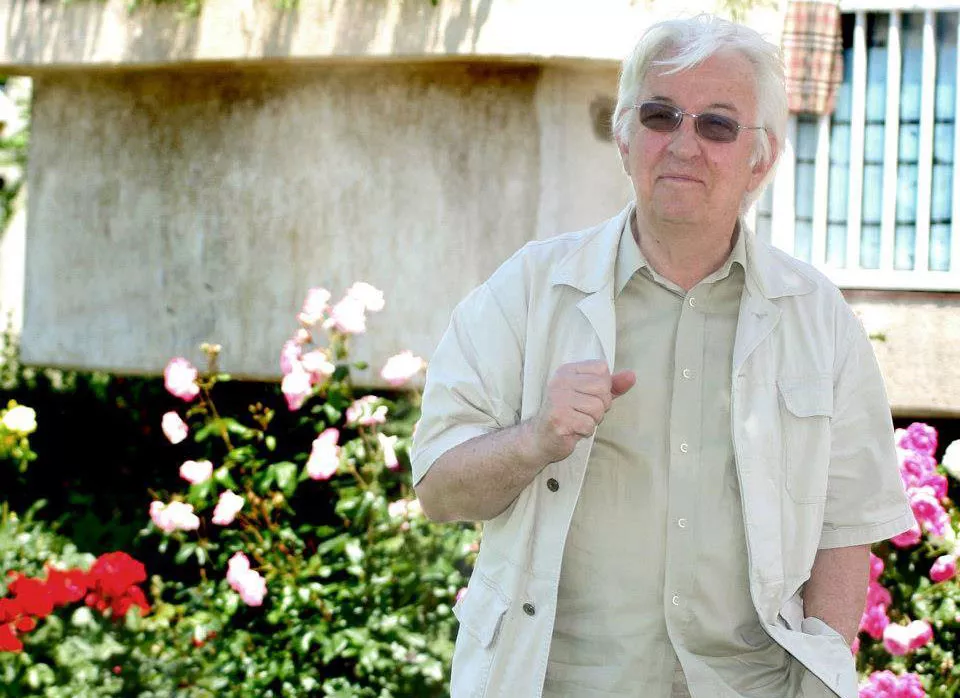
Vehid Gunić became a legend in his lifetime, a beloved man in Bosnia and Herzegovina. Of all the jobs he did, he was mostly a journalist and travel writer. In more than thirty books, he managed to bring to life people we tend to forget and managed to snatch from oblivion many things in this country that were doomed to be forgotten. One would think that Vehid Gunić never even took a break, given how much work he did in his life. He is currently in Oslo and once again in a new fight for life. He talks to the Patria agency about his life, hopes, desires, past, and future.
PATRIA: After your first victory over cancer, you said a wonderful sentence: I am a factory of cheerfulness that does not fall so easily. Now the illness has returned, so many people are asking, even on social networks, how you are after this last therapy. On social networks, it is visible that people always associate you with joy and optimism, saying: What illness, our Vehid will overcome it again.
GUNIĆ: A long time ago, the great writer Derviš Sušić ended a letter to Meša Selimović with the words: "...In life, brother, the most important thing is to stay alive..." Many years later, the wonderful poet Duško Trifunović, with whom I had the good fortune to work for about twenty years, exclaimed aphoristically: "Life has become a mass phenomenon." I, therefore, have been part of this phenomenon for the eighth decade and in this existence, I am doing everything to stay alive, because "dying is nothing new..." A few days ago, I received the first immunotherapy, so I cannot yet speak about its effects, except for one of the several possible side effects. One of the reactions is itching. Our people say: when it itches, it doesn't hurt. It both itches and hurts me. Immunotherapy is a novelty in attempts to stop the spread of the disease. It is a very, very expensive method (one dose costs around 5,000 euros), which is based on the knowledge that a certain dose of this substance (whose composition is kept secret) needs to be injected into the human body, so that the strengthened body fights cancer cells that have attacked it. So, after the first dose, a whole front (battle line) has opened up within me, on which, as in life, good and evil fight. I believe in the victory of the former.
It is important to say that all this happened to me due to my lack of health education, because I went from doctor to doctor for months seeking relief for my varicose veins. Only at the modernly equipped clinic "Čikago" in Sarajevo did they tell me: "What veins? Melanoma has returned and has taken a large hold in two places." So, as our people would say; looking for a needle - I lost the big needle. For your reminder; a čuvalduz is a large needle with which quilt makers stitch quilts and mattresses. The great Sidran would say: "It was, it passed - now it's f***ed!"
PATRIA: Your wife Fatima was killed by a shell with three of her students in the classroom, during a lesson. Bosniaks are a small nation, but they are scattered all over the planet. Your family is also scattered all over the world. So are your friends. Many think that's why you became and remained a great traveler and travel writer?
GUNIĆ: The brutal murder of my late Fatima during her last lesson among students, the murder of her students, and the wounding of many students, are certainly strong reasons for my constant unease, suffering, and search for some truth and reasons why we, as the most European nation, are condemned to constant persecution, suffering, and pain. Can there be a more monstrous crime than the murder of a teacher on the most honorable task, during a lesson, among students? It was not a stray shell, but a guided shell from the lair of that filth in Nedžarići. Modern history has no such examples from wars that have happened and are happening in the world.
When it comes to traveling, I would say that in my childhood I thought that when I grew up, I would become a journalist, because in my vague understanding of journalism, I assumed that journalists were constantly traveling somewhere. Many years later, as a journalist who ventured on trips to the farthest points on the planet, I somewhere put forward the slogan: HE WHO DOES NOT TRAVEL - DOES NOT LIVE. Travel at least to Trebinje or Goražde if you can't go to Tasmania, for example. And I, driven by professional curiosity, have been to Tasmania twice. My dream was also to travel across America by truck. Thanks to the wonderful human giant Izet Izo Dizdarević, this dream also came true. Izo and I, in his "Volvo" truck, cruised the roads of America twice and covered about 27,000 kilometers. We testified about this together with the television series "Thus We Discovered America." I will soon testify about this in my book "Journeys for the Sake of Return," which I recently submitted to the publisher - "Bosanska riječ" by the enterprising poet Šimo Ešić. I like the title of that book, because the essence of my travels is contained in the beauty of returning. In fact, I travel precisely to return to the most beautiful country in the world, a country that has its spring and a spring of good people and a river that forms its backbone. That's why I once, paraphrasing a poet, ecstatically and pathetically exclaimed: WHAT A DANUBE, WHAT A SAVA - THAT'S HOW BOSNIA EXTENDS!
PATRIA: When you first got sick, Abdulah Sidran prayed to God not to let you die, because you are more needed here, and there, he added, you would be idle anyway. He even wrote an epitaph for you: "Here lies the apple of his people's eye, the writer and travel writer Vehid Gunić." Your friendship is imbued with simultaneous struggles for life. Sidran also fought battles against cancer. One wonders: How can someone constantly create in that struggle, because you create even more intensely alongside the fight for life.
GUNIĆ: Sidran taught me to understand illness and treatment like any other job that needs to be done and finished. When the first melanoma appeared and when I ended up in the hospital, Sidran sent me a message: "What are you afraid of? I have already overcome three cancers. I have the capacity for at least two more..." He added: "Those cancers can't do anything to us. Only women can finish us off."
Neither Avdo nor I are giving up. By the way, Sidran is essentially much sicker than me, but with his encouragement, cheerfulness, and refusal to give up, he is more healing than my medications available from modern pharmacology. I am very sorry that he, as a truly great genius who has graced us, is spending his immeasurable talent on polemics with some windbags who have occupied positions in all important state funds and services, and this results in the fact that he, as one of the leading European film screenwriters, has not received any stimulation for any of his screenplays for years, nor for his monumental book like "Raw Skin Redemption." Not to mention how he, as one of the greatest poets of these regions, along with Mak and Skender, of course, has not written poetry for a long time, because he is frantically preoccupied with existential problems and worries about his family if, by some normal natural law, it were to happen that he leaves and the family remains uncared for. I share that concern of his, as his brother in conviction, and I am just as worried as he is.
The photo from the hospital where Sidran, by my sickbed, is praying to dear God not to take me yet, because he, as my friend, needs me more than I would be some idler in the heavenly gardens, was very well received by people. Regardless of the fact that both Sidran and I, as he likes to say, are Tito's communist stepchildren. Faced with our own illness, and the illness of family members, a certain moderate atheism becomes very shaky. Then the Almighty is invoked, because only HE can decide whether to leave you or send you to some distant lands.
All in all, regardless of his rare gift for spending even when he has nothing, Sidran, in the face of existential concern for himself and his family, like Don Quixote, charges at windmills, at some pensioners, at some scoundrels and freeloaders, and leaves the least time for writing, although he knows how to do it better than all those who have brought him to this blockade. Bosnia will miss Sidran, but Sidran will no longer be. His spirit will remain to hover over Sarajevo.
As for me, here in Oslo, I have finished a book of travelogues, I am keeping a diary, and I am joyfully spending time with my grandchildren, my true dear universes. In Oslo, more than a hundred years ago, the famous Ibsen said that for one who reaches the meaning of music, there is a whole new continent. I, on the other hand, think that for one who gains a grandchild, a whole new universe is revealed, an entire galaxy, in fact.
 Gunić and Sidran: Long-standing friendship
PATRIA: You did what other journalists can only dream of. For example, interviews with numerous great personalities. Among them is the legendary Muhammad Ali. Based on long communication, you created a book about the Sarajevan Nobel laureate Vladimir Prelog. You wrote about the Sarajevan bohemian Vlado Dijak. Even before the war, you wrote a book about your native Kozarac. Then you wrote a moving memoir of Dr. Eso Sadiković. It's as if we all lived in two halved worlds. There are also "Letters to the Future." You connect these lives of ours from before and after the horrors of war. It's as if your goal all along was to put the broken pieces back together.
GUNIĆ: You said that beautifully. I also published an anthology of Bosnian erotic poetry and many other books, including a book of our proverbs. So far, I think, five editions have been published. Each of them contains this one: EITHER WITH A STONE ON THE POT OR WITH THE POT ON THE STONE, THE POT IS STILL DAMAGED. We are that pot of noble terracotta that is constantly being broken, and some of us are trying to reassemble it from those shards, no matter how Sisyphean it may seem, even if it seems futile to some. Small nations, as the great Albert Camus would say, can fight evil only with spirit. I add - only with reason. Of course, above all, with education. That's why I rejoice when our Ajla Merdanović is declared child of the year in Europe during the war, or when a great university in America declares our Nađa Halilbegović an honorary doctor and honors her by giving her the inaugural speech on behalf of a hundred doctoral candidates. By the way, our Nađa is considered the best American orator. She graduated from both theater and music academies. She regularly concludes her speeches with a guitar and the song ŠTO TE NEMA (What's Missing About You). Before the war, she sang in the Sarajevo children's ensemble Palčići. She was wounded during the war. She published her moving testimony about the war in BiH under the title SARJEVO CHILDHOOD WOUNDED BY WAR. So, only with reason, only with education and investment in education, and by utilizing this great intellectual potential in the diaspora - can we survive. But to whom can we say this today in such a perversely structured country, when everyone thinks that everything starts with them. Nothing starts with them. Perhaps some form of BiH begins with our Nađas, Ajlas, and so many young talented people in the country and beyond its borders.
PATRIA: You once said that the fight against oblivion is currently unequal, but that memory will win. This morning, on my way to work, I was connecting how right you were. A whole human life is a fight against oblivion. Everything we create, everything we do is to win that fight. What other battles against oblivion would you like to fight? Who are the people you would snatch from oblivion and return to memory?
GUNIĆ: I have long been obsessed with a desire that I will surely write, if I have health and life. It would be a book about people I knew, whose resting place is the Sarajevo cemetery LAV. These would be quiet walks through memories of those wonderful people I knew and loved. For completely understandable reasons, I would begin with an account of my late Fatima, who deserves both a book and a film. Nearby is her perhaps best student Ismar Kadrić, who died as a fifteen-year-old courier in Alipašino Polje. Nearby is the grave of the humorist and top reporter Omer Zorabdić, with whom I had the pleasure of working. There is my friend, the first music editor of TV Sarajevo, Dejan Zagorac, then the top radio reporter Aleksej Nejman, then next to him the late Željko Ružičić, and across from them one of the best reporters of "Oslobođenje" Vlado Mrkić. At LAV is also the poet whose poetry we grew up with, Izet Sarajlić, and his "MALA VELIKA MOJA" (My Small Great One), then the parents of my Sidran, and at the end is the grave of the genius Radmilo Bato Zurovac, the most versatile editor of the once famous Radio Sarajevo.
After the first melanoma surgery, three years ago in Oslobođenje, I announced the idea of renaming the Grbavica stadium, while Osim was still alive, to the "Ivica Osim" Stadium. It would be a wonderful human gesture towards that great man of Sarajevo and dear "Željo." If he had stayed in Japan for a few more years, I think the Japanese would have named their Olympic stadium after him. Osim was the biggest star in Japan. I know this because I was in Tokyo during his illness and witnessed the ovations he received when he appeared at the stadium so ill. I also wrote to our Academy of Sciences and Arts with a proposal to elect Ivica Osim and our brilliant journalist Gojko Berić as honorary members of the Academy, at least. People in Pešter have a very witty saying: "Memo doesn't ask about the baggage." Memo was some poor man who had a horse and a cart on which, as the last part of the wedding procession, as baggage or baggage handler, he carried the bride's trousseau. Some bandits intercepted him and started robbing him, taking the trousseau. Memo firmly resisted, saying: "Get away from there. I'm in charge of this!" One of those thugs grabbed him by the collar and pulled him off the cart, saying: "Memo, you're not in charge of anything!" That sentence, with which someone is humiliated, entered the folklore of Pešter and Sandžak and is used by those who want to humiliate someone. And somehow, like Memo, no one asks me about anything, because otherwise, the Academy or the Municipality of Novo Sarajevo would have already announced it. I know that Mayor Koldžo supports this idea and that, if there is life and health, he will also persevere in it. Furthermore, I long ago proposed to Koldžo, and Armis Mašić from Art House Sevdah also supports me in this, that Wilson's Promenade, or at least a part of it, be arranged according to the model of the Boulevard of Stars in Hollywood. There is enough space on the sidewalks in Wilson's to install brass plaques or stars with the names of deserving individuals who have left a particularly deep mark on the life of Sarajevo: from the founder of Sarajevo, Isabeg Ishaković, to the Nobel laureate Vladimir Prelog, Alija Isaković, Safet Isović, Mirko Kamenjašević, Sulejman Kupusović, or Hajrudin Šibo Krvavac, for example. Furthermore, my wish is that the area around Safet Isović's grave near the Alipašina mosque be arranged as a small memorial center, like those built around the eternal resting places of famous people. We have not had and will not soon have a better and more distinguished interpreter of sevdalinka than Safet Isović. My idea is to erect a stone bench made of hreša stone next to Safet's grave and to place a fountain next to or in front of it from which water would flow continuously. It would be a small, modest memorial space, because dear Sajo, even at the height of his fame and popularity, was a modest, even somewhat shy and endlessly dear man. In addition, if I had my way, I would urgently replace the name of Aziza Šaćirbegović street with the name of Vladimir Prelog. The neighboring street is named after his father, Professor Milan Prelog. If Aziza is a deserving citizen, then she should be given that detour on the road to Žuč which now bears the name of the Sarajevan, Nobel laureate Vladimir Prelog. In addition, I would replace some funny names of some Sarajevo streets and give them names by whose works we grew up, such as Petar Kočić or dear Branko Ćopić, because they are also our writers. I am convinced that Safet Isović, and the recently deceased Jovica Petković, as well as the unsurpassed charmer radio reporter Mirko Kamenjašević, also deserve their streets. But I don't ask about the baggage.
PATRIA: You have done a lot for your Bosnia. People especially appreciate you for always elevating sevdalinka as our cultural value as an important part of Bosnian identity. They have stolen or tried to take away many things from us. Even Bosnian ćevap. The other day I joked with a man from Krajina, I told him: Banjaluka ćevap remains as a brand, but there's a problem. 'What problem?' he asked me. Well, some want to claim Banja Luka for one nation.
GUNIĆ: In early 1992, in Gornji Šeher, the oldest part of Banja Luka, which monsters renamed Srpske Toplice, I, along with the actress and poet Dara Stoiljković, promoted the book of the famous Banja Luka ćevap maker Bilo Hamzić, BANJALUČKI ĆEVAP. The book is more durable than fights. So, the book and Banjaluka ćevap remain, and those who try to erase such traces will pass and be gone. When it comes to sevdalinka, an interesting chapter on theft and appropriation of others' property can also be found in Andrić's novel The Bridge on the Drina. I cannot quote, but only paraphrase Andrić, who roughly says: In the past of these regions, people did not take houses, land, women from each other, but even songs. When the First Serbian Uprising broke out, inspired by the successes of that uprising, Serbs rewrote the then Bosnian song "When Alibeg was a young bey, his girl carried the banner" into the song "When Đorđije was a young bey, his girl carried the banner..." Thus, says Andrić, the song went from mouth to mouth as the most precious loot. It was somehow around this time that our Skender Vakuf, founded in 1463 by Ali-dedo Skender, overnight became Kneževo. A cynic would add: how can it be Kneževo when it is visible at every step that it is Skender Vakuf, regardless of the fact that the barbarians destroyed both mosques, including the old one where the founder's tomb was. History cannot be erased by destruction. Everything is written down somewhere.
We don't really have much talent for preserving traces of material culture that testify to our existence on this land. Our brand was also the Sarajevo carpet. On the eve of the assassination, or on the day of the assassination, June 28, Sofia and Ferdinand, I believe, also visited the Sarajevo carpet factory. Sofia received a Sarajevo carpet as a gift. There is no company or individual who would not use such a fact for advertising purposes. Our carpet factory was looted during the war, the looms were transported somewhere to Pale or I don't know where. Only the name remained. My good friend Hajrudin Hadžialić bought that name, so the carpet factory initially produced pillows and mattresses. The Turks donated about fifty small looms to Bosanski Petrovac, so the famous weavers of Petrovac sat at the looms again. Perhaps this activity could be united with the Carpet Factory in Sarajevo, which still exists, at least in name. The famous late Zaim Imamović used to say sometimes: "Everyone knows their own..." Of course, the weavers in Bosanski Petrovac also have a problem with raw materials; there is no wool. Now we import that raw material, and Bosanski Petrovac is located in the most ideal terrain for sheep farming and flax cultivation. I'm going too far, all the way to thinking about the wonderful pre-war company Bosnafolklor, which no longer exists. That's why we have Chinese souvenirs in the heart of Sarajevo, in Baščaršija, therefore.
When I was filming my documentary about Prusac about ten years ago and saw how a beautiful clock tower was decaying, how the roof was leaking, how the old clock mechanism that ticked "alaturka" time had not been working for years, I vowed that if I ever had the means, I would restore both the tower and its clock. This happened this year. Under the supervision of the Federal Institute for the Protection of Cultural and Historical Monuments, we installed a new roof, renovated the facade, and the old Prusac clockmaker repaired the clock, which has been ticking again since May 1st of this year. Alongside it, my heart also beats. There you go...
PATRIA: I really don't know if you are included in school programs? Can our children read your travelogues, your wonderful stories about valuable Bosnian people? Can they learn from you about the great Bosnian tradition?
GUNIĆ: I am not in the programs or textbooks, because I do not belong to any party, clan, or group. I am a man of BiH and I will remain so. And there could have been a place for one of my travelogues or for a "parable," as someone from Ljubuški would say, or some other magnificent achievement from my important book BOSANSKE IZREKE (Bosnian Proverbs), whose first edition was published under the somewhat surreal title NA NEBU PAUČINA (Cobwebs in the Sky). I returned our proverbs to us with the hope that we will focus less on what was presented to us as Serbian, through Vuk Stefanović. Let there be Serbian too, but we have our own. So, I don't chase textbook compilers, nor various corrupt freeloaders in various funds, but I play my own movie, as far as I can go. And he who knows where he is going gets the farthest. Did I mention that I traveled more than Columbus, Amerigo Vespucci, and the famous and timeless Zuko Džumhur, combined. The Federal Ministry of Education would do a good deed by providing primary and secondary schools in the Federation with a little more money, so that Sidran and I, as well as other authors, could visit schools. My accounts are first-hand. Even many chemistry teachers and professors today do not know that I filmed a documentary and wrote a book about the famous Sarajevan Vladimir Prelog, a Nobel Prize winner for his contributions to the stereochemistry of organic molecules and chemical reactions. That's where we are, and perhaps that's where we are, and perhaps we are not.
PATRIA: If you had a magic wand, what would you do, what would you change in Bosnia? I, for example, would suggest making excellent Bosnian encyclopedias. Because that was also the long-standing wish of the late Alija Isaković, Professor Muhamed Filipović, Professor Mustafa Imamović... I say this because your entire life's work was like creating an encyclopedia of dead and living valuable Bosnian personalities...
GUNIĆ: If I had a magic wand, I would first bring back to life the innocent victims of the past war, and first of all my late Fatima. I would completely change, and perhaps even halve, the curriculum for primary and secondary schools. I would turn schooling up to high school into a children's game. My grandchildren here in Norway look forward to every trip to school as if it were a trip to receive New Year's gifts. I would insist on learning foreign languages. My older grandson Alan, he is only 12 years old, besides Norwegian, fluently speaks and writes in Bosnian and English. In addition, he is learning German and Spanish. On all television channels, by order from the highest level, I would introduce daily programs titled HOW TO LOVE YOUR COUNTRY AND YOUR CITY. I would follow the thoughts of the great Native American chief who said: "We have not inherited this that we have, but borrowed it from those who will come to this world..." Some people need to be persistently reminded that, for example, the lifeblood of this beautiful and unfortunate country, the river Bosna, cannot absorb or digest millions of plastic bags and bottles that the uninformed throw into the river. To digest such a "poisonous morsel," the earth needs at least a hundred years. On the road from Banovići to Zavidovići, I saw car bodies, car tires, and even "Smederevac" stoves in the beautiful Krivaja river. My good land, they lie when they say they love you...
Croats, I hear, are already publishing some version of the BiH encyclopedia. A true, scientifically conceived encyclopedia of BiH should be created by a group of impartial encyclopedists such as, for example, Rusmir Mahmutćehajić, Senadin Lavić, Dževad Karahasan, Gavrilo Grahovac, Željko Škuljević, Nijaz Alispahić, Enes Kujundžić, Emir Hadžihafizbegović, Vojislav Vujanović, Esad Bajtal, but also Mustafa Imamović, mentioned in your question. It seems to me that Professor Filipović is already a bit tired, although he has done similar work before. About forty years ago, he compiled a separate section on BiH as an addition to the Encyclopedia of Yugoslavia, published by the Yugoslav Lexicographical Institute in Zagreb. Perhaps his experience can be useful. But, as the poet would say, it is not my place to meddle in that; mine is to walk...
Interview by: Sead Omeragić
Komentari (0)
Prijavite se za komentiranje
PrijavaJos nema komentara. Budite prvi!
Minuta
Sve →Iz drugih kategorija

High Representative Not Elected: Germans, French and British Sabotaged Americans, New Attempt at End of June

ČOVIĆ WITHOUT MERCY: How Those Who Brought Ademović to Office Created a Political Hell for Him



Sunny Saturday, quite warm



Tragedy in Albanian resort: Two minors drown












