
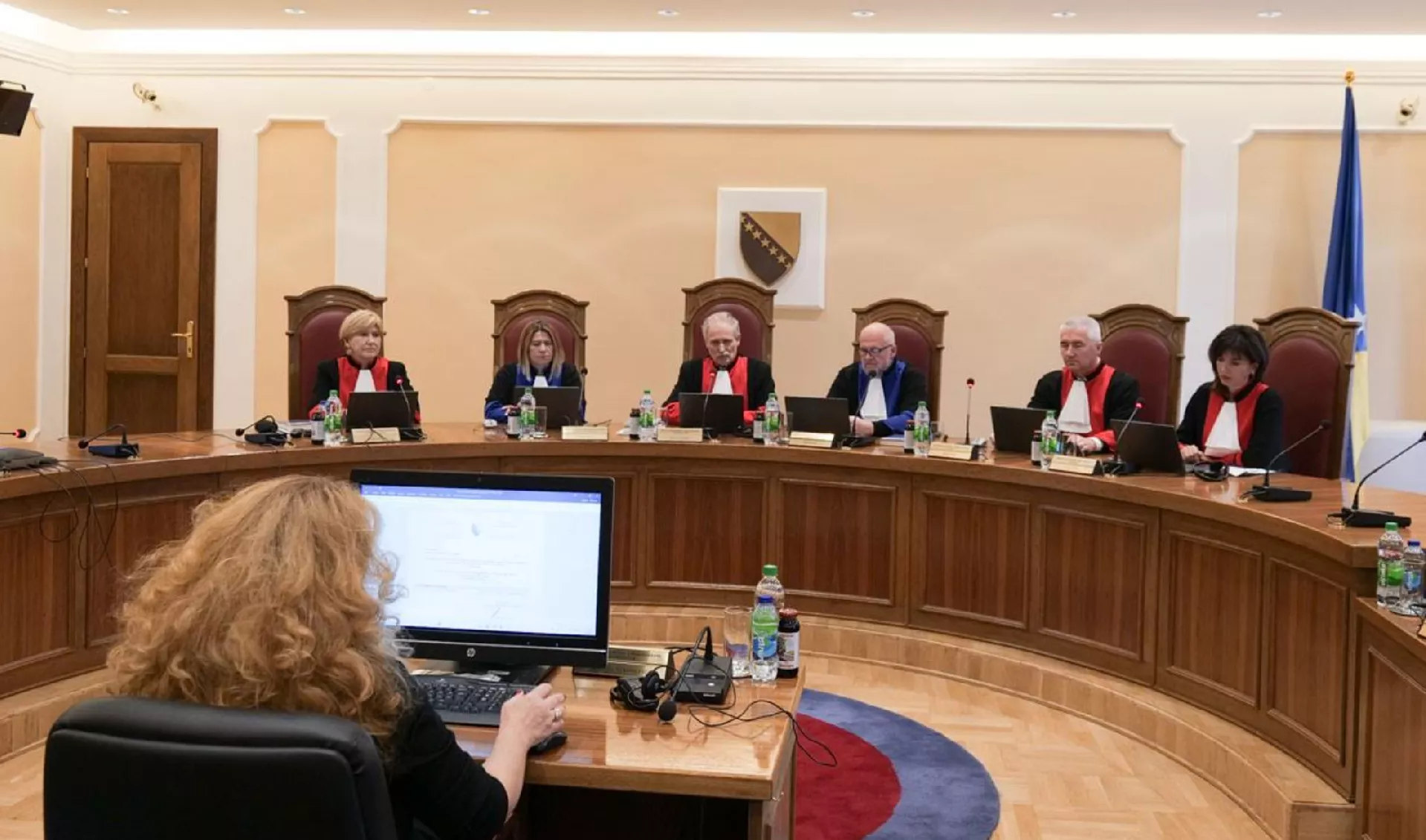
(Patria) - The Constitutional Court of BiH upheld the appeal of protected witnesses, two victims of war crimes, against the verdict of the Supreme Court of the Federation in the part where violations of the right to privacy were established through the disclosure of their personal data in the verdicts of regular courts.
By the decision of the Constitutional Court, the Government of Sarajevo Canton is obliged to pay the protected witness "B" and the protected witness "N" the amount of 5,000 KM each within three months of the delivery of this decision as compensation for non-material damage due to the violation of the right to privacy, with the obligation to pay statutory default interest on any unpaid amount or part thereof after the expiry of that period.
"The Supreme Court of the Federation of Bosnia and Herzegovina, the Cantonal Court in Sarajevo, and the Municipal Court in Sarajevo are ordered to take appropriate measures within their jurisdiction within six months from the date of delivery of this decision to regulate the rules of procedure in cases, outside of criminal proceedings, that require the protection of the parties' identities due to their status as protected witnesses," states the Constitutional Court.
The decision of the Constitutional Court of Bosnia and Herzegovina states that the appellants had the status of protected witnesses and were victims of sexual violence during the war. They were witnesses against the accused in criminal proceedings before the Court of BiH.
"By a final verdict of the Court of BiH, the convicted person, as a member of the Army of Republika Srpska Bosnia and Herzegovina, was convicted of committing the crime against humanity through the actions described in the operative part of the verdict, including the rape of the appellants, and was sentenced to a long-term prison sentence," the decision reads.
In order to initiate civil proceedings, the witnesses' legal representatives requested the Court of BiH to disclose their data for this purpose, which the Court did, ordering everyone to keep this data as official secret and to exclude the public from further proceedings.
"The submission also stated that for the protection of the officials of the competent court and the legal representatives of the appellants, it is necessary to file the lawsuit in this manner, i.e., that the appellant's name be entered into the CMS (computerized case management system for courts) under the pseudonym assigned to them in the criminal proceedings," it is stated in the part of the decision describing how the case was filed in the lawsuit before the Municipal Court.
After the verdict was rendered, following the mention of the court's name and the presiding judge, the appellants were listed as plaintiffs with their full names and addresses, along with their pseudonyms, i.e., designations "B" and "N".
The Cantonal Court then dismissed the appellants' lawsuit, repeating their data in the verdict, as well as in the letter returning the case file with the second-instance decision.
"In the response to the defendant's appeal, the full names of the appellants were stated. In the letter from the Municipal Court submitting the case file to the Supreme Court regarding the appeal, the full names and addresses of the appellants were stated," the Constitutional Court states, adding that in the letter from the Municipal Court, by which the Supreme Court's verdict was delivered to the appellants' legal representatives, the full names and addresses of the appellants were stated.
The Constitutional Court adds that the Cantonal Court did not comment, while the Supreme and Municipal Courts indicated that the appellants were designated as "B" and "N" in the CMS, and the Supreme Court further stated that the contested verdict was not published on the internal network, nor was it published on the internet in the court's database of judicial decisions, nor was an access code issued for external access.
"The Constitutional Court has no reason to doubt the statements of the Supreme and Municipal Courts. However, the mere fact that the personal data of the appellants were stated in the introductory parts of the verdicts means a potential danger that third parties could gain access to the verdicts and learn their identity," the decision states, adding that the danger increased with the publication of their data in other correspondence.
It is not disputed that the appellants were designated by pseudonyms in the CMS, the Constitutional Court writes, but what is disputed, and what the appellants point out, is the fact that their personal data were published in the verdicts of regular courts because there is no clear regulation that would govern the issue of personal data protection for protected witnesses in the decisions of regular courts outside of criminal proceedings.
"Therefore, in this specific procedure, special attention from the courts was necessary to prevent their secondary victimization and stigmatization," it was stated, among other things, in the decision which found that the appellants' right to privacy had been violated.
Victims of war crimes start from criminal proceedings, and their claims for compensation are directed to civil proceedings which, according to our Law on Civil Procedure, do not recognize identity protection measures, says TRIAL International, an organization for the protection of victims of international crimes.
"If a victim of war crimes wants to exercise this right, they must either disclose their identity or abandon their claim because this issue has not been resolved within the criminal proceedings," said Ajna Mahmić from TRIAL International.
This decision is an important step because it orders the courts in BiH to establish clear rules for the protection of victims and protected witnesses in all proceedings, not just criminal ones.
The Supreme Court of the Federation of BiH, the Cantonal and Municipal Courts in Sarajevo are obliged to adopt rules on the method of recording and anonymizing personal data in the automated case assignment system, which, according to Mahmić, would significantly facilitate the legal protection of war crime witnesses.
"I don't know if this can bring a concrete solution in the future or completely eliminate this practice, but it is certainly the first positive decision of this nature after a long number of years," says Mahmić, legal advisor.
She states that the next step is for the High Judicial and Prosecutorial Council to create some form of guidelines for all courts in order to harmonize the practice with the verdict of the Constitutional Court of BiH.
"I would say that the general conclusion is that the applicable legislation in this specific case does not provide a sufficient level of identity protection for endangered witnesses, nor does it allow protected witnesses full access to rights such as compensation, in relation to which it is clear that it is necessary to adopt both a new regulation that would govern the issue of personal data protection for protected witnesses in the decisions of regular courts outside of criminal proceedings, as well as amendments and additions to the existing Law on Civil Procedure," adds Mahmić.
The joint law office "Amer and Dženita Homarac" represented the appellants in this case. Amer Homarac says that the adoption of this appeal has special significance because it shows the seriousness of the need for data protection.
"I believe it will have an effect on the seriousness of understanding the need to protect the identity and data of victims, especially when they are protected in such a way that such protection measures have been imposed on them," he told Detektor.
Komentari (0)
Prijavite se za komentiranje
PrijavaJos nema komentara. Budite prvi!
Minuta
Sve →Iz drugih kategorija

High Representative Not Elected: Germans, French and British Sabotaged Americans, New Attempt at End of June

ČOVIĆ WITHOUT MERCY: How Those Who Brought Ademović to Office Created a Political Hell for Him



Sunny Saturday, quite warm



Tragedy in Albanian resort: Two minors drown












