
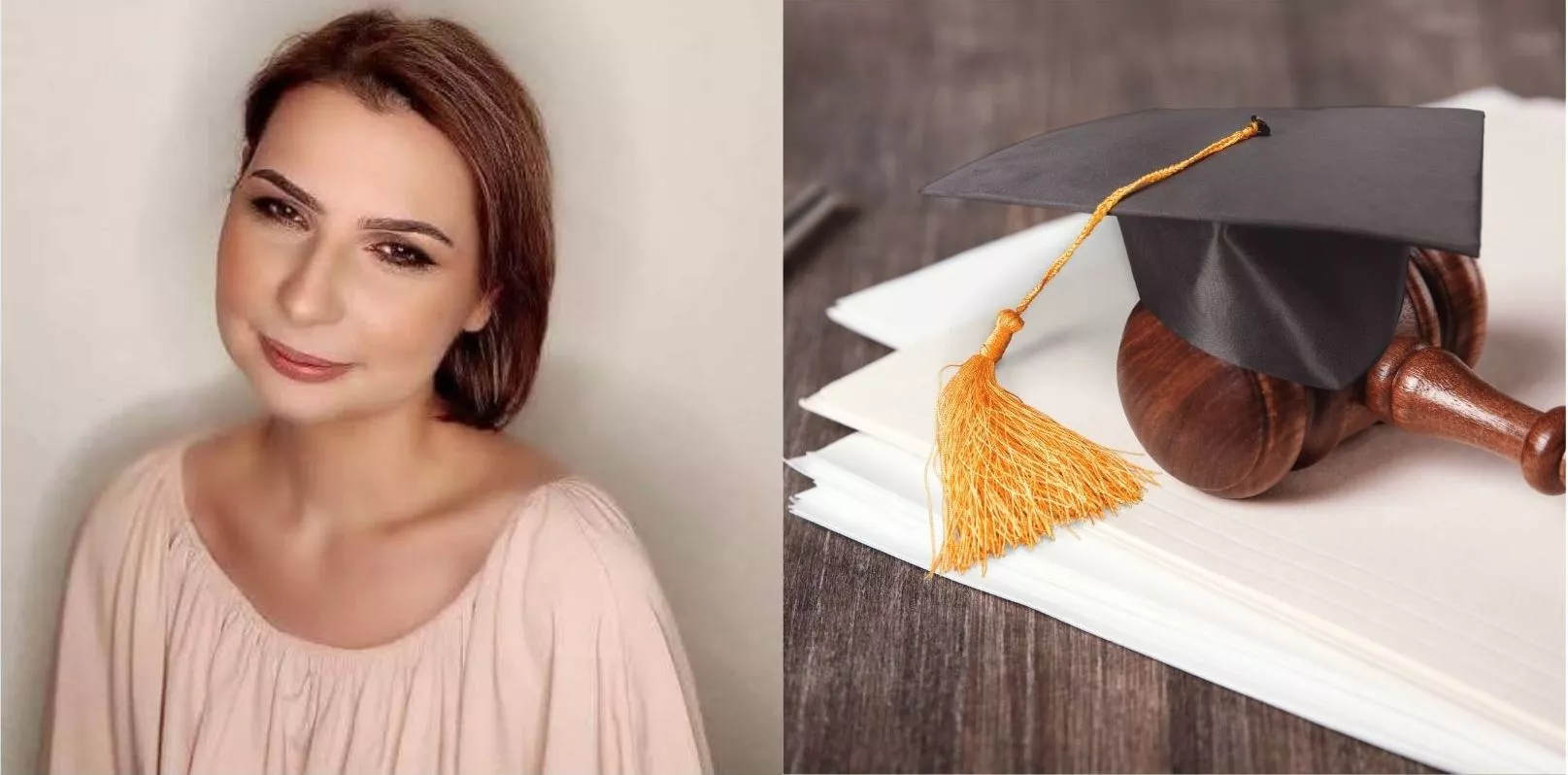
(Patria) - In Bosnia and Herzegovina, there is often talk about the departure of young and educated people, the deficit of experts, and the need for knowledge. However, reality often refutes these narratives. One of those who today testifies to this contradiction is Amila Dudo Alić, a doctor of state and law history, a person with a 100% disability, who, despite her highest academic title, is on the unemployment register.
Amila completed all three cycles of her studies at the Faculty of Law at the University of Travnik. She defended her doctoral dissertation two months ago, thus earning the title of Doctor of Science in the field of state and law history and becoming one of only five post-war doctors of this department in Bosnia and Herzegovina. This is an extremely rare and valuable academic profile, which is usually difficult to find and even harder to build.
Speaking about her education, Amila emphasizes that the academic path was a source of strength for her, not an obstacle.
"I experienced my education as personal and professional empowerment. I was satisfied with my own knowledge, as well as with the professors and staff of the Faculty of Law at the University of Travnik, where I completed all three cycles of my studies," she says.
Interestingly, as she states, she had almost no serious obstacles related to her disability during her studies.
"As far as education is concerned, I did not, thank God, have any obstacles. The obstacles came later, during employment," she adds honestly.
The Fund for Professional Rehabilitation and Employment of Persons with Disabilities played a significant role in her educational journey, financially supporting her education through professional rehabilitation programs.
"I heard about the Fund six years ago and I am immensely grateful for that support. The Fund is of great benefit to persons with disabilities, and I sincerely think they are one of the few who truly listen to us," Amila emphasizes.
That support, she says, was not just financial.
"What meant the most to me was the feeling that someone believed in my potential and that my effort made sense. That gives you the strength to continue, even when it's difficult," she points out.
However, upon completing her academic path, a new phase began, one that proved to be significantly more challenging. Today, Amila is on the unemployment register, facing continuous rejections.
"I am currently registered. I am actively looking for a job, but I mostly get rejections. That is, honestly, the hardest part of my journey," she says without bitterness, but aware of the uncertainty that accompanies the job search.
Her specific field, the history of state and law, is of exceptional importance for understanding the development of legal systems, institutions, and social relations. However, knowledge and expertise often remain in the shadow of prejudice.
"Disability, unfortunately, often overshadows everything a person knows and can do. It's as if they first look at what is missing, and only then at what you offer," she explains.
Amila emphasizes that she does not seek privileges or special treatment. Her expectations are simple.
"What would mean the most to me right now is to get a permanent job. It is important for me to resolve my status, to work, to be active and useful," she says.
Despite everything, she has not lost faith in the value of education and personal effort.
"Becoming a doctor of science, despite my disability, means to me a confirmation that disability does not define the limits of knowledge and success. It is my personal victory, but also a message to others not to give up," she emphasizes.
And while her personal success is undeniable, the broader picture raises the question of how much society recognizes and utilizes such potential.
Her story is a story of untapped potential, of a system that knows how to support education but often fails when knowledge needs to be translated into work and contribution to the community.
"I am ready to learn, work, and adapt. I just need an opportunity," she emphasizes. Therefore, it is important for all of us, as a society, to ask ourselves: do we recognize knowledge when it is available to us, and do we have the courage to give a chance to those who have already earned it through their work?
Her story remains a testament that knowledge exists, but also that the space for its application is still not equal for everyone. Why? Let's ask ourselves.
Komentari (0)
Prijavite se za komentiranje
PrijavaJos nema komentara. Budite prvi!
Minuta
Sve →Iz drugih kategorija

High Representative Not Elected: Germans, French and British Sabotaged Americans, New Attempt at End of June

ČOVIĆ WITHOUT MERCY: How Those Who Brought Ademović to Office Created a Political Hell for Him



Sunny Saturday, quite warm



Tragedy in Albanian resort: Two minors drown












