
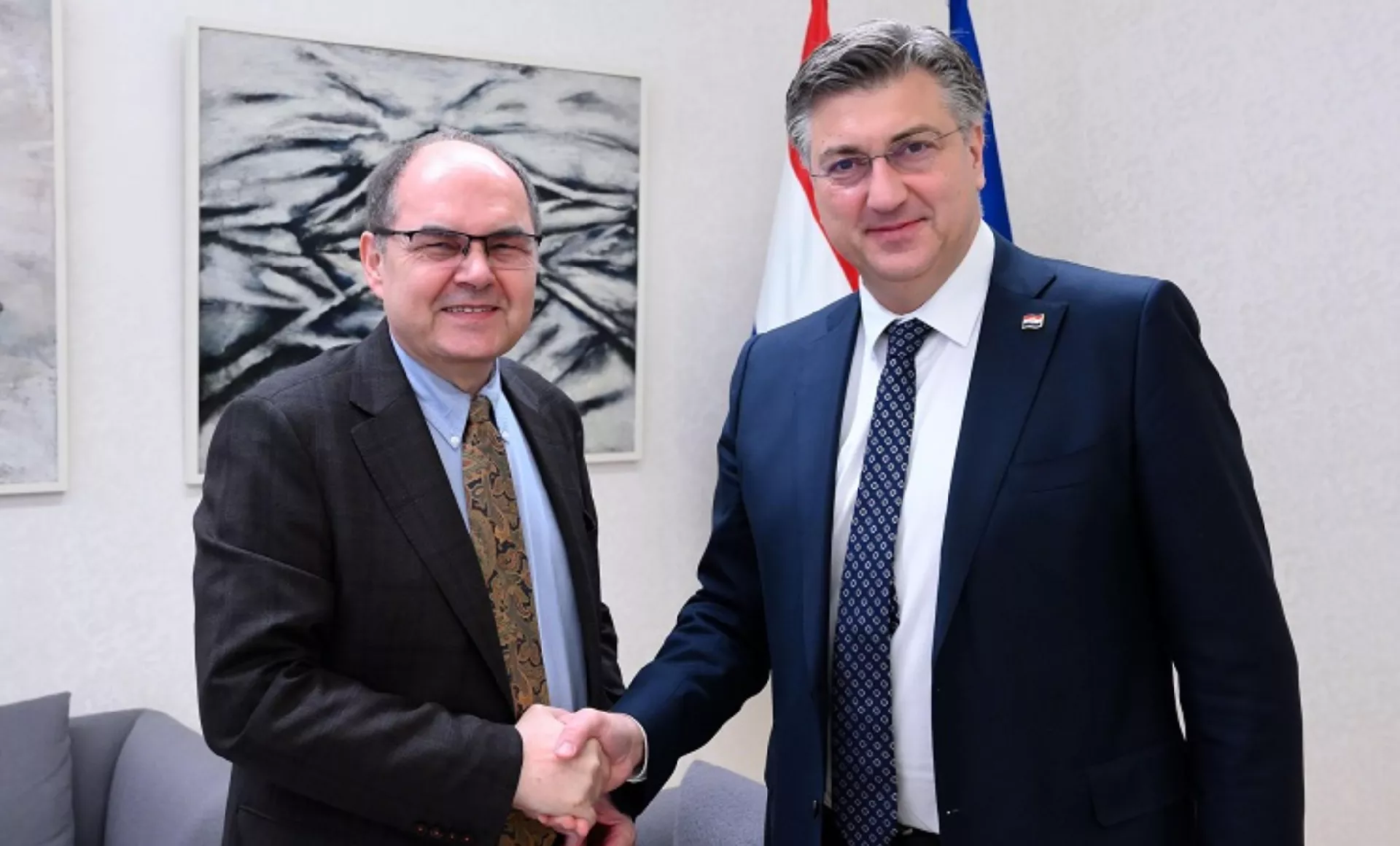
(Patria) - High Representative Christian Schmidt recently rightly reacted to the primitivism and chauvinism of the President of the Assembly of the Herzegovina-Neretva Canton, Džafer Alić (SDA), who called Serbs and Croats "tenants" in BiH, writes Istraga.ba.
Alić stated in his address on BHRT that Bosniaks are the owners of Bosnia and Herzegovina, who have very unpleasant tenants.
- We always have to clean up after them, sweep, repair, make, build, upgrade - said Alić, superficially reducing the politics of the strongest Serbian and Croatian parties in BiH to hatred among its peoples, probably causing enthusiasm among those political forces that feed on the same in an effort to prove that the existence of BiH is meaningless, in which he undoubtedly helped them.
In reaction to Alić's outburst, the High Representative said that the idea of tenants is very offensive and indicates a deep ignorance of the country's history.
- Instead of making unacceptable statements, whether of a unitarist or secessionist nature, political representatives are expected to work on the equality of all, including returnee and minority communities, and on a common and prosperous future for a unified BiH - said Schmidt.
Nothing in the statement would be controversial if in one part Schmidt had not used the political language that Croatian politics has been using towards BiH for years, which reduces all misunderstandings in BiH to a conflict between "unitarism and separatism", justifying the policy of further ethnicization of society and institutions in an already deeply decentralized country, which can ultimately lock institutions and lead only to the victory of secessionism, and not any phantom unitarism.
Although Schmidt referred to "statements" whether of a "unitarist or secessionist nature", it is clear that the position refers to his view of political relations in the country, given that conceptually it fully corresponds to that used for years by Croatian officials in an effort to explain their policy towards Bosnia and Herzegovina.
Here we will list several examples from dozens of statements in which "unitarism" is placed on the same level as "separatism" in the political vocabulary of Croatian officials.
President of the Croatian Democratic Union of BiH Dragan Čović said in May 2021 that he believes that only the Croatian people want BiH because other policies, "whether unitarist under the guise of civic society, or the other separatist, lead to the same - the disappearance of BiH".
A year later, he said that unitarism and separatism are two major problems in BiH.
- One is that pronounced unitarism that often borders on irrationality of chauvinism, I would even say pronounced ultranationalism of Bosniaks, on the other hand separatism and this what we are trying to do, which has created an absolute division, that is, complete non-functioning (of the system)", said Čović.
Croatian Prime Minister Andrej Plenković stated in an interview for Večernji list in December 2021 that Croatia is "resolutely against separatism in BiH, but also against any unitarism, that is, centralism".
A month earlier, Croatian government minister Gordan Grlić Radman emphasized that "in BiH we have the strengthening of unitarism and separatism and the growth of instability. The key is a solution for respecting the principle of equality of constituent peoples".
Schmidt, just like those mentioned, as a response to "unitarism and separatism" mentions "equality" of all, a key concept that official Zagreb uses to defend the policy of constant pressure on BiH in an attempt to reduce the votes of the majority of citizens to a third of political power in the state.
Croatian politics acts strategically in this regard. First, it masters the political vocabulary in the public space, and then practically acts in implementing the policy hidden behind the imposed concepts, as we saw in the example of "legitimate representation" and the "Ljubić" ruling of the Constitutional Court of BiH. The OHR, after everything we have witnessed in the previous three years, is only an extended arm of such efforts.
Komentari (0)
Prijavite se za komentiranje
PrijavaJos nema komentara. Budite prvi!
Minuta
Sve →Iz drugih kategorija

High Representative Not Elected: Germans, French and British Sabotaged Americans, New Attempt at End of June

ČOVIĆ WITHOUT MERCY: How Those Who Brought Ademović to Office Created a Political Hell for Him



Sunny Saturday, quite warm



Tragedy in Albanian resort: Two minors drown












