
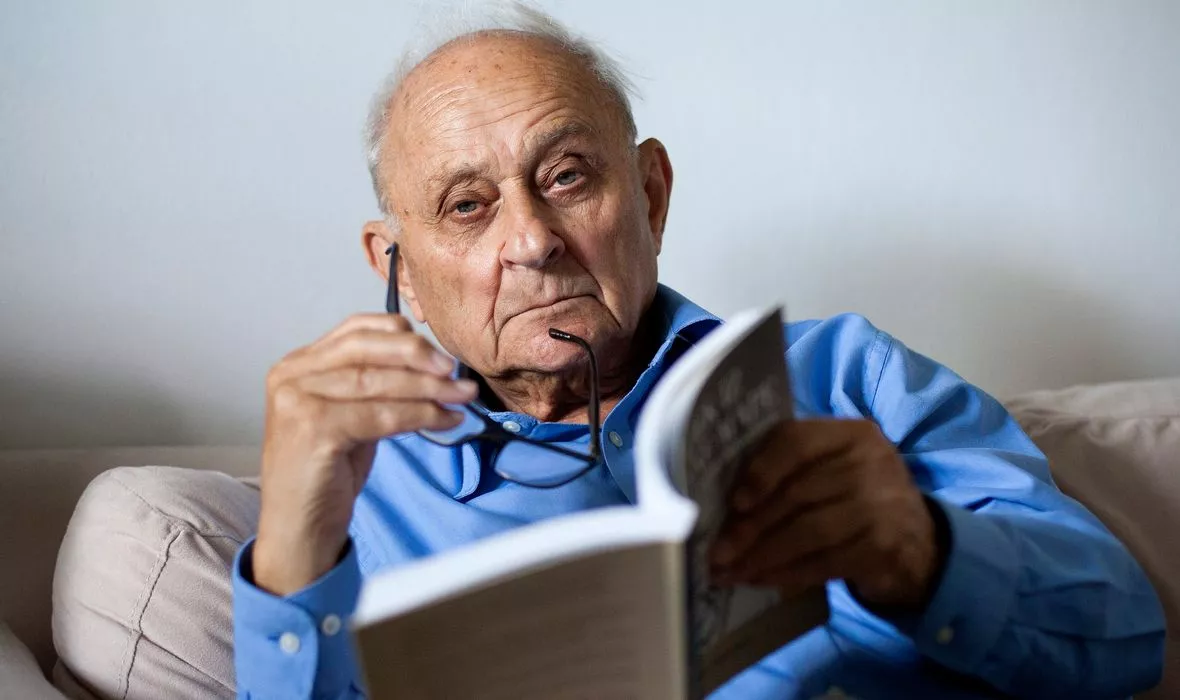
Slavko Goldstein, a renowned Croatian and Yugoslav intellectual, historian, politician, screenwriter, and writer, has died, reports the Patria agency.
Born on August 22, 1928, in Sarajevo, to the Jewish family of Ivo and Lea Goldstein. Slavko was born while his parents were traveling through Sarajevo, and he spent his childhood in Karlovac with his brother Danko, where his father was a respected bookseller.
During World War II and the occupation of the Kingdom of Yugoslavia on April 13, 1941, the Ustaše arrested his father, and he fled Karlovac to Banski Kovačevac, where he was taken in by the Đerek family. From the spring of 1942 to 1945, he was active in the field and combat units of the NOVJ (National Liberation Army of Yugoslavia). He finished the war at the age of not quite 17, with the rank of lieutenant.
His mother Lea spent the war in the medical service, and his brother Danko was a courier for the Agitprop department of the Central Committee of the Communist Party of Yugoslavia (KPJ). Slavko's father died in the Jadovno concentration camp in late July or early August 1941. In addition to his father, Slavko also lost his relatives from Tuzla during the Holocaust, all of whom perished in the Jasenovac and Auschwitz concentration camps.
In 1989, together with his brother and several colleagues from "Cankarjeva založba", where he was then employed (Vlado Gotovac and Božo Kovačević also worked there), he founded HSLS, the first Croatian political party, and served as its president until February 1990, when he was succeeded by Dražen Budiša.
For a time, he was the president of the Jewish Community of Zagreb and the "Miroslav Šalom Freiberger Cultural Society", and together with his son Ivo, a historian, he advocated for the reconstruction of the Zagreb Synagogue. He launched the magazine for the culture of democracy "Erazmus", where he also served as editor-in-chief.
During the 1990s, he was an open opponent of the authoritarian policies of Croatian President Franjo Tuđman, the then-prominent hate speech, and the privatization process. Together with several other Croatian intellectuals, he was a signatory to the demand for President Tuđman's resignation published in the magazine "Erazmus" in 1993. However, Slavko also stated that Tuđman was more of a politician than a historian, and that he interpreted history according to his political views.
Slavko considered Tuđman a strong figure who did not accept Ustaše ideology, meaning he flirted with some Greater Croatian ideas, but not with Ustaše ideology. In 2007, he published the book "1941. - The Year That Returns", for which he received the Kiklop award for the non-fiction work of the year. He founded the publishing house "Novi Liber" and edited more than 150 books, and as a publisher, he worked on about 400 other titles.
Slavko was the first president of the Jewish religious community "Beth Israel" from Zagreb, founded in 2007 after an internal conflict within the "Jewish Community of Zagreb", which was led by Ognjen Kraus. In 2008, although he had stated he would visit Bleiburg with the president of SDP, Zoran Milanović, he withdrew from attending Bleiburg because he "did not want to hurt the feelings of people from his closest circle who appealed to him not to go to Bleiburg".
After the victory of the SDP, i.e., the Kukuriku coalition, in the 2011 parliamentary elections, he became a special advisor for culture to the Prime Minister of Croatia, Zoran Milanović. He served as the president of the Council of the "Jasenovac Memorial Area". In 2011, together with his son Ivo, he published the book "Jasenovac and Bleiburg Are Not the Same". In this book, he opposes those who believe that "...Jasenovac and Bleiburg are simply two identical crimes with different ideological connotations.".
In 2012, he supported his brother Danko's initiative to abolish the parliamentary commemoration of the victims of the Bleiburg crosses. In 2015, Slavko opposed the initiative to introduce the greeting "Za dom spremni" (Ready for the Homeland) as the official greeting in the Armed Forces of the Republic of Croatia.
On that occasion, he stated that he could not live in Croatia if that greeting were introduced into the army, schools, or other state institutions, and that he would immediately seek political asylum in one of the European countries.
Komentari (0)
Prijavite se za komentiranje
PrijavaJos nema komentara. Budite prvi!
Minuta
Sve →Iz drugih kategorija

High Representative Not Elected: Germans, French and British Sabotaged Americans, New Attempt at End of June

ČOVIĆ WITHOUT MERCY: How Those Who Brought Ademović to Office Created a Political Hell for Him



Sunny Saturday, quite warm



Tragedy in Albanian resort: Two minors drown












