
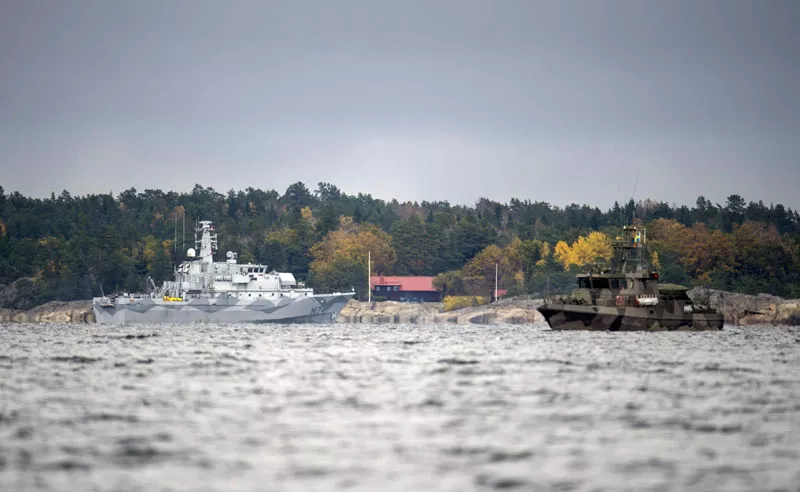
The Cold War cat-and-mouse game that has been unfolding for the past ten days between a suspected Russian submarine and the Swedish Royal Navy in the Baltic Sea has captured the world's media and mobilized one of the largest naval search operations in the Baltic in the last 30 years.
All Submarines in Swedish Waters
This is not the first time a foreign submarine has appeared in Swedish territorial waters. During the Cold War, 16 incidents involving the detection and tracking of then mostly Soviet submarines were recorded in Swedish territorial waters.
The most famous incident involved the Soviet submarine U-137 of the Whiskey class, which ran aground in Swedish coastal waters on October 27, 1981. After a major media frenzy dubbed "Whiskey on the rocks", the Swedish government returned both the ship and the interned crew to the USSR.
As history tends to repeat itself, since the night of October 18, 2014, the Swedish Royal Navy has been on full combat alert, as communication between the still "unidentified vessel" and Kaliningrad, the largest base of the Russian Navy in the Baltic, was intercepted. The message was encrypted, and according to media reports, it was a distress call sent to Kaliningrad from the surface of the water in a coastal area deep within Sweden's territorial waters.
Just 14 hours after the signal was detected, the unidentified vessel was sighted in a bay, only 40 km from Stockholm. There is also amateur footage of the vessel, which clearly shows it to be a submarine, as only the periscope was protruding from the water surface. All six available capital combat vessels of the corvette class of the Swedish Royal Navy, along with four other submarines and several dozen helicopters and patrol aircraft, are engaged in the search for the alleged Russian submarine, which is believed to be hiding in one of the 30,000 bays and islets along the Swedish coast.
In addition to these naval capabilities, the Danish and Dutch navies have also deployed some of their resources to search for the Russian submarine.
Far from Public Eye
It should be borne in mind that intelligence and other covert military operations between Russia and its Western allies are in full swing, taking place, as is the old custom, far from public view, in a zone known during the Cold War as - Dark Side of the Moon. Even during the Cold War, submarines were lost in suspicious accidents that occurred under circumstances that were never fully clarified.
The most representative such case is the sinking of the Soviet submarine K-129 of the Golf II class, which sank in 1968 northeast of the Hawaiian island of Oahu in the Pacific Ocean. A large search and rescue operation was launched by the Soviet Navy, but the submarine was not found. On the contrary, the US Navy found the wreckage of the K-129 submarine in 1974 and, in the super-secret operation "Azorian" led by the CIA, managed to recover part of the optical-electronic equipment, all codes, ciphers, and encrypted communication devices, new Soviet torpedoes with nuclear warheads, and, at that time, the latest Soviet SS-N-5 SERB nuclear cruise missiles from the wreckage.
The importance of this operation is best illustrated by the following example. After a thorough inspection of the SS-N-5 SERB missiles, it was concluded that the Soviets, thanks to a unique system of launch tubes, could fire missiles, as well as other types of ballistic nuclear missiles, in salvos, unlike the Americans and Western allies, who fired their nuclear ballistic missiles from submarines at intervals of 50-55 seconds. Therefore, it is no wonder that the Russian Navy, after the catastrophic accident and sinking of the Oscar-class submarine Kursk in August 2000, refused Western aid until it had "secured" sensitive optical-electronic equipment and other secret devices and part of the weapons from the submarine's wreckage.
It is precisely that operation, which lasted less than 48 hours, that many believe sealed the fate of the surviving sailors who died during that period.
American media speculated at the time that the CIA had carried out this secret search operation, but until 1992, official Washington never admitted that the operation had been carried out. In 1992, CIA Director Robert Gates presented Russian officials with part of the video material showing the secret burial of six bodies of dead Soviet sailors found in the submarine's wreckage. It is assumed that the Americans took 20,000 photographs and recorded several hours of video footage of the submarine wreckage, which lies at a depth of 4,900 meters. Soviet, and later Russian, submarines have always attracted particular interest from military and intelligence circles in the West, as they represent unique weapon systems of strategic importance capable of rapid redeployment to operational areas and remaining hidden in the vast expanses of the ocean.
This capability has given nuclear weapons a key strategic and operational advantage, and submarine carriers of these weapons have been modernized over time and transformed into the primary naval weapon system for delivering a first strategic strike.
Even more of a rarity and a true submarine trophy are the so-called attack submarines, designed to find, track, and destroy submarines carrying nuclear ballistic missiles.
If the submarine in Swedish territorial waters is indeed a Russian submarine, it is likely one of two types: a Kilo-class diesel-electric submarine or the latest Russian Lada-class submarine. Both types are designed for hunting submarines carrying nuclear missiles and are designed to operate in so-called small seas with their dimensions.
Lada-class Submarine
The latest Russian Lada-class submarine is particularly interesting, as it is fully adapted for the use of AIRJET propulsion based on the latest technology of Stirling engines using liquid oxygen as fuel. These are super-secret propulsion systems that give the submarine a very low acoustic signature in the water, which sonar can hardly detect. Furthermore, this system allows the submarine to remain submerged for weeks, as it can produce the oxygen necessary for the crew's normal functioning using special equipment and systems taken from nuclear submarines.
If these super-secret systems fall intact into NATO's hands, it will certainly force the Russian Navy to change its entire strategy and all its operational measures and actions. At the same time, it will call into question the latest modernization program of the Russian submarine fleet and the introduction into service of the new class of super-modern nuclear submarines K-550 Yasen class, which carry 16 new-generation nuclear ballistic missiles, have the same AIRJET propulsion system, and cost 1.6 billion US dollars each.
No one knows what drama is unfolding in the Baltic, nor can it be foreseen whether US Navy submarine flotillas are involved in the search operation for the Russian submarine. What is certain is that on October 22, 2014, a Russian Il-38 patrol aircraft, NATO codename MAY, violated Estonian airspace and entered the Baltic Sea airspace, where it was detected by Swedish interceptors and escorted back into the airspace of the Russian Federation along with Danish fighters.
Additionally, the Russian oil tanker NS Concord has been circling the Baltic Sea near Stockholm for several days. Based on this data, one can speculate that the Russian submarine was on a training mission and experienced some mechanical difficulties, forcing it to request assistance and compromising its location. At the same time, the Russian patrol aircraft, by intentionally violating Estonian airspace to shorten its route to the Baltic airspace, likely established a coded contact over the sea as a mobile transmitter with the submarine and issued new orders, as it is an aircraft designed for TACAMO (Take Charge and Move Out) operations for constant contact with the submarine fleet.
What happens next remains to be seen, but it is certain that the search capabilities for the alleged Russian submarine will increase almost immediately, because if the submarine is captured, Western allies will obtain top intelligence data on new Russian submarine weapon, electronic, and propulsion systems.
Putin's Radical Moves
After reactivating the "Cold War," Russia under Putin has rehabilitated an aggressive approach to dispute resolution, which can be called PUTINSTROIKA, and in this context has made several radical military moves (Georgia, Syria, Ukraine) in the new chess game of neither war nor peace with the West.
According to media reports, in 2014 alone, Russian aircraft violated Finnish airspace five times in the Baltic region, and Swedish and Danish airspace had over 40 unauthorized visits by Russian fighter and patrol aircraft in 2013. Latvia, Lithuania, and Estonia, which are under NATO protection, have had 180 airspace violations this year.
All these and other military activities carried out by the Russian Federation and its armed forces in the Baltic, Ukraine, and elsewhere in the world clearly signal to everyone that Russia is ready to continue where the Soviet Union stopped in 1991. With these moves, Putin is openly showing that he wants to take Europe back 30 years, to a Europe where eight million soldiers, 15 million military reservists, with 10,500 nuclear warheads, 39,000 tanks, 10,000 combat aircraft, and 3,000 warships circled its shores, awaiting orders to charge at each other in a final showdown that would end in a nuclear holocaust.
Peace under the burden of arms, in which the world trembled 30 years ago at every move of Soviet troops, is the goal Putin is striving for. He is aware that a final confrontation between the US and Russia is impossible and unnecessary, and in the new circumstances of mutual military buildup, it still seems unclear how far both superpowers can go. This is why the war in Ukraine and other demonstrations of force, such as the Belgrade parade or the alleged submarine incident in the Baltic that half of the NATO Baltic fleet is searching for, are happening.
All these developments, on a global scale, represent more of a thermometer of the level of political pressure Russia can exert that the West can tolerate, rather than a real threat to world peace. However, the barometer of political pressure that Russia can create with its military presence is constantly rising, and the West is reacting very slowly and sluggishly to the increased military presence of Putin's military forces and their allies worldwide. This could lead to a shift in the strategic balance and endanger the factor of power dominance that the Western alliance has carefully cultivated since the fall of the Berlin Wall. Be that as it may, Uncle Sam is now on the move in this global strategic chess game.
Author: Nedžad Ahatović, Professor of Defense and Security
Komentari (0)
Prijavite se za komentiranje
PrijavaJos nema komentara. Budite prvi!
Minuta
Sve →Iz drugih kategorija

High Representative Not Elected: Germans, French and British Sabotaged Americans, New Attempt at End of June

ČOVIĆ WITHOUT MERCY: How Those Who Brought Ademović to Office Created a Political Hell for Him



Sunny Saturday, quite warm



Tragedy in Albanian resort: Two minors drown












