

If Croatia adheres to the Extradition Treaty signed with Bosnia and Herzegovina in 2012, and ratified on 7 August 2013, the fugitive Deputy Director of SIPA Zoran Galić could be extradited to the BiH judiciary. Because, according to this treaty, dual citizenship is not an obstacle to extradition, Istraga.ba reports.
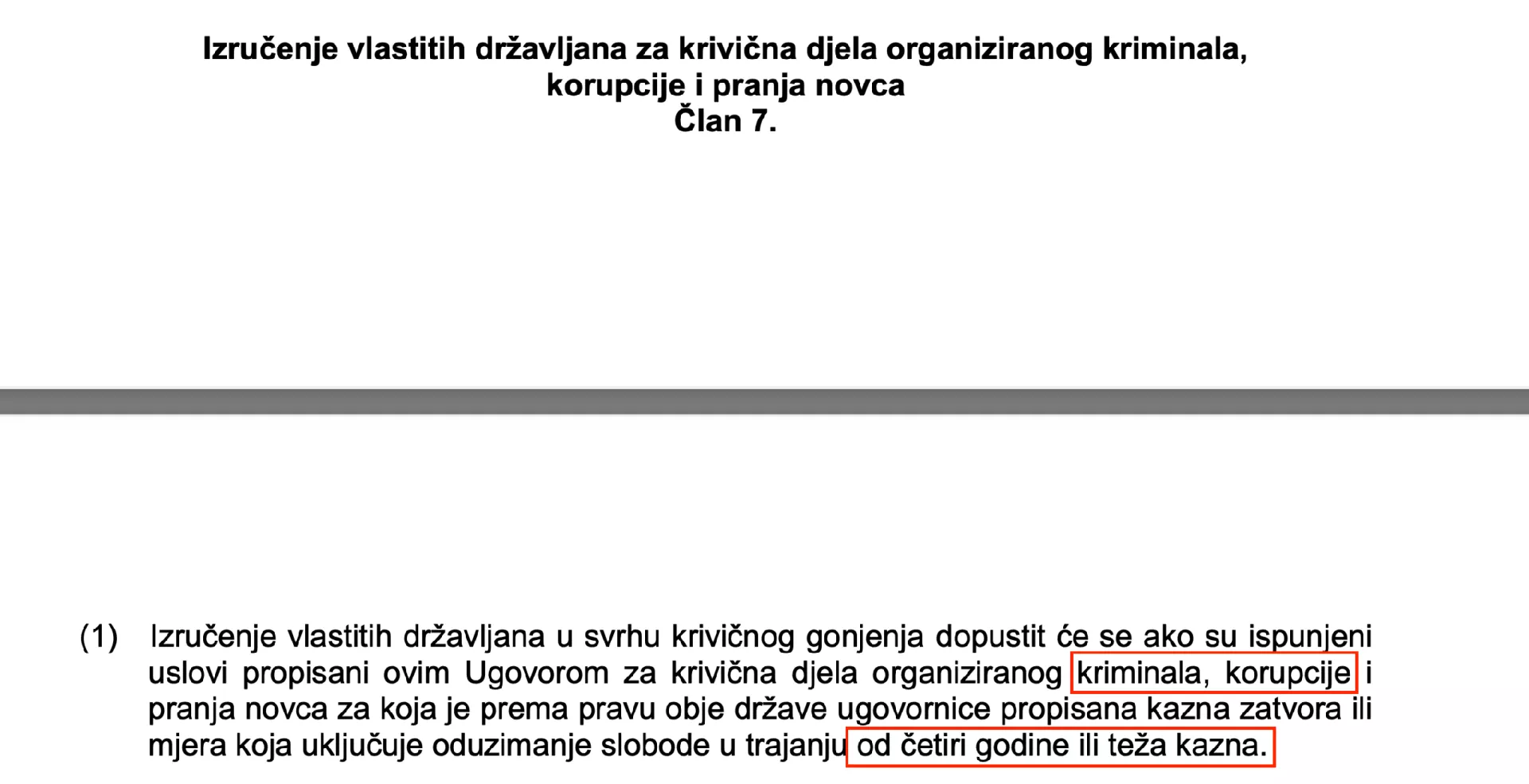
“Extradition of own nationals for criminal acts of organised crime, corruption and money laundering” is the title of Article 7 of the Treaty, which is available on the websites of the Ministry of Justice of BiH and the Ministry of Justice and Administration of the Republic of Croatia.
Here is what that article of the Treaty stipulates.
“Extradition of own nationals for the purpose of criminal prosecution shall be permitted if the conditions prescribed by this Treaty are met for criminal acts of organised crime, corruption and money laundering for which, under the law of both contracting states, a prison sentence or a measure involving deprivation of liberty of four years or a heavier penalty is prescribed,” states paragraph 1 of Article 7 of the treaty between BiH and Croatia.
Zoran Galić is, officially, suspected of having committed the criminal act of receiving gifts and other forms of benefit under Article 217 of the Criminal Code of BiH.
“An official or responsible person in institutions of Bosnia and Herzegovina, including a foreign official or an international official or an arbitrator or a juror, who demands or receives a gift or any other benefit for themselves or for another person, or who receives a promise of a gift or any benefit for themselves or for another person, to perform within their function what should not be performed or to fail to perform what should be performed, or who mediates in such bribery of an official or responsible person, shall be punished by imprisonment for a term of one to ten years,” states the Criminal Code of BiH.
Therefore, for the criminal act of corruption in BiH, a penalty of one to ten years is prescribed, which means that in the case of Zoran Galić, concerning BiH legislation, the condition for extradition is met.
“An official or responsible person who demands or receives a bribe, or who accepts an offer or promise of a bribe for themselves or another to perform, within or outside the scope of their authority, an official or other act that should not be performed, or to fail to perform an official or other act that should be performed, shall be punished by imprisonment for a term of one to ten years,” states the Criminal Code of the Republic of Croatia.
Therefore, the prison sentence for the act of which the fugitive Deputy Director of SIPA is suspected is one to eight years. That condition for the extradition of Zoran Galić is also met.
The treaty between BiH and Croatia was, as we said, signed in 2012 and entered into force in 2013. The criminal acts of which Zoran Galić is suspected were committed during 2021 and 2022. This means that the acts were committed after the Extradition Treaty entered into force, which means that this condition for extradition is also met.
To avoid confusion, the case of Zoran Galić cannot be equated with the cases of Zdravko Mamić (fled to BiH) and Ante Jelavić (fled to the Republic of Croatia).
Namely, the first verdict under which Zdravko Mamić was convicted was based on criminal acts committed in the period from 2004 to 2015. Since the majority of the criminal acts were committed before the Treaty entered into force, the provisions of Article 7 cannot be applied.
Furthermore, Ante Jelavić, the former leader of the HDZ BiH, was convicted in 2005 for the case of “Croatian self-governance” in BiH, i.e., eight years before the Extradition Treaty entered into force. Therefore, the provisions of this Treaty cannot be applied to the Jelavić case. However, the case of Zoran Galić meets all conditions. And now it is all up to the Croatian and BiH judiciaries. That is, up to the Government of the Republic of Croatia, headed by Andrej Plenković.
Komentari (0)
Prijavite se za komentiranje
PrijavaJos nema komentara. Budite prvi!
Minuta
Sve →Iz drugih kategorija

High Representative Not Elected: Germans, French and British Sabotaged Americans, New Attempt at End of June

ČOVIĆ WITHOUT MERCY: How Those Who Brought Ademović to Office Created a Political Hell for Him



Sunny Saturday, quite warm



Tragedy in Albanian resort: Two minors drown












