
By Rasim BELKO
SREBRENICA, February 21, 2021.
As wolves still howl from the hills above this Bosnian town, their descendants calmly await the night. The night they will celebrate victory. Because, for the descendants of wolves, celebrating is most important. Mitomania has returned.
The deeds of their wolf ancestors still testify today in the white of how bestial the wolfish savagery in human form can be. More bestial than wolves.
Down in the town, silence. A silence that echoes like the groans of tombstones, under which lie those who were denied the right to fight. A silence in which all of Srebrenica's suffering is most clearly visible and which best draws the line of division.
Elections are a celebration of democracy, they taught us in school. Besides everything being empty in Srebrenica, there is nothing else to celebrate.
Caravans from Serbia came to immortalize the story of "Serbian Srebrenica." Buses and cars with Serbian license plates from Užice, Šabac, Čačak, Zrenjanin, and Belgrade alternated in Srebrenica on February 21.
The day passes slowly in the city of ghosts. Because time stands still in Srebrenica. It stopped the day a neighbor slaughtered his neighbor's child. It stopped the day a mother cried over her raped daughter.

Photo: Patria
And it stands still. Not just time. Life has also stopped. Stuck in that timeless state of "we are Serbia, they are Bosniaks."
And how to talk and write about democracy. Not at all. There is no democracy in Srebrenica. There never was. Civilizational values are leaving Srebrenica. Those who cannot escape remain. Those who profit from Srebrenica's suffering are also somewhere around.
Monuments of evil speak far more than people in the silenced city. Monuments of suffering, damaged by wartime destruction, but also by the ravages of time.
With my colleague photojournalist Armin Durgut from Pixel, on this election day without an election, I set out to visit someone's home, which today bears witness to the horrors of Srebrenica, devastated by genocide.
And while we were trying to understand from the viewpoint why everything is standing still in Srebrenica, even time, wishing for something normal to happen that we could record, the most interesting event occurred.
Children, Njegoš, Pavle, Lazar, and a few others, climbed up the hill below the viewpoint. They started a strange game in the ruined building above the facility. In a city of strange games, even the children have lost their childhood joys.
That's probably why they decided on a game where they wrap two of them in tape from head to toe, but literally. And then one of the free ones pushes them, and they end up on the floor of the facility dominated by fragments of stone, glass, and who knows what else.
And so, two bad ones took down Njegoš. He fell on the wrong side, hitting his head on a piece of concrete. Fortunately, he wasn't seriously injured. Lazar was fine, he says he's learned how to fall.
That was the most interesting event we could record on election day in the divided city.
From the viewpoint, we observed all the destroyed buildings and headed towards one on the other side. On the walls of a building almost destroyed in the whirlwind of war, leaning due to the whirlwind of time, was the only word that has been missing in Srebrenica since the war and genocide until today. It read DIALOGUE. And above the letters, a Star of David was drawn. As if someone wanted to say that another religion is missing from the Srebrenica mosaic of ethnic and religious divisions.
Perhaps everything would be different if that dialogue were written in our languages. Perhaps this week in Srebrenica, we would be writing about the birth of a new, better, and successful democracy and common life instead of coexistence, separated by a line that no one sees but everyone knows where it is.

Photo: Patria
We then went to a house below the former Domavija hotel. Instead of concrete slabs, bushes are growing, indicating that life is struggling to emerge in the city burdened by genocide. You can't get into Domavija. Someone tried to fix something, but...
We return to the center of Srebrenica. Vehicles from Serbia, a few grandparents with escorts, mostly everything is calm. The city is covered by members of the RS Ministry of Internal Affairs. Security is all okay.
In one of the three catering establishments, about 50 square meters in size, it's crowded. Sunny day, outdoor seating. When you isolate that establishment with your gaze, you get the impression that you are in any normal city in the world. When you move a few dozen meters away, it becomes clear that you are in a city without people.
We will have lunch in Bratunac, unaware that in that municipality, about fifteen minutes' drive from Srebrenica, we will find a story that makes sense.
We arrive at the main promenade in Bratunac and enter from the city without people into a city where, at first glance, you realize it doesn't have that Srebrenica line of division. There are more outdoor cafes here and many people. As if they were light-years away from Srebrenica.
The owner of the establishment where we had lunch wasn't very forthcoming, but he told us a story that serves as a guide for all Srebrenicas of Bosnia and Herzegovina. He returned to his Bratunac five years after the war and genocide. Until then, he worked for SFOR as a cook.
And he decided to stay and live in a city that he says is "the best in the world, in terms of location, people, and everything else." He opened a catering establishment like you would see in any major city in our country. All are his guests, and he has no problems with that. He says he also has no problems with the local government, especially since the independent candidate Srđan Rankić is at the head of Bratunac. He tells us that there is work and life in Bratunac. And, importantly, there are young people who work and don't want to leave. That's why Bratunac has 20, and the cook says actually 15 thousand inhabitants according to the census. That's why people live in Bratunac. From their own work, not from charity. He says that besides the military industry that produced the "Despot" vehicle for the RS Ministry of Internal Affairs, there is also a wood processing company that exports its products worldwide. There are other companies, he says, and everything is getting better.
I feel transformed, somehow happy because of a story that refutes, indeed kills, all those stories about the impossibility of common life for all of us whom God has blessed with the land of Bosnia.
It's almost dark, time to return to Srebrenica. The polling stations, which are not really polling stations, close at 7 PM. The last citizens of Srebrenica are performing their civic duty. The doors of a rarely seen election are closing. A drunkard in front of the Cultural Center, imagining he's a TV star, says he wishes a Serb would win. He doesn't even know who he will defeat. He probably forgot to mention Turks, but there are no Turks in Srebrenica either.
The day is finally over. Mladen Grujičić remains. The mayor who won without a fight. In the SNSD headquarters, or rather, a house with an entity flag hanging, there is singing and shouting. You would think they were watching a football match inside.
Outside, freezing journalists and media workers are waiting for Grujičić to appear. "He said half past 7," they tell each other, aware that it's already 8 o'clock. Mladen Grujičić appears on the balcony, in a staged performance for the cameras of Dodik's regime, ATV, and RTRS, talking about what he will do.
Below the balcony, a cloud of smoke, nervousness is growing. He finally came down and announced that he would provide a better life for all citizens of Srebrenica, that he would complete all projects, and so on. He didn't say anything to those from Šabac, Zrenjanin, or Belgrade. They got their share after the job was done.

Photo: Patria
In the end, he said that Bosniak politics from Sarajevo sold out the Bosniaks in Srebrenica, just like in the genocidal year of 1995. And that's the only thing I agree with the new-old mayor of the city of silver, which has long since corroded.
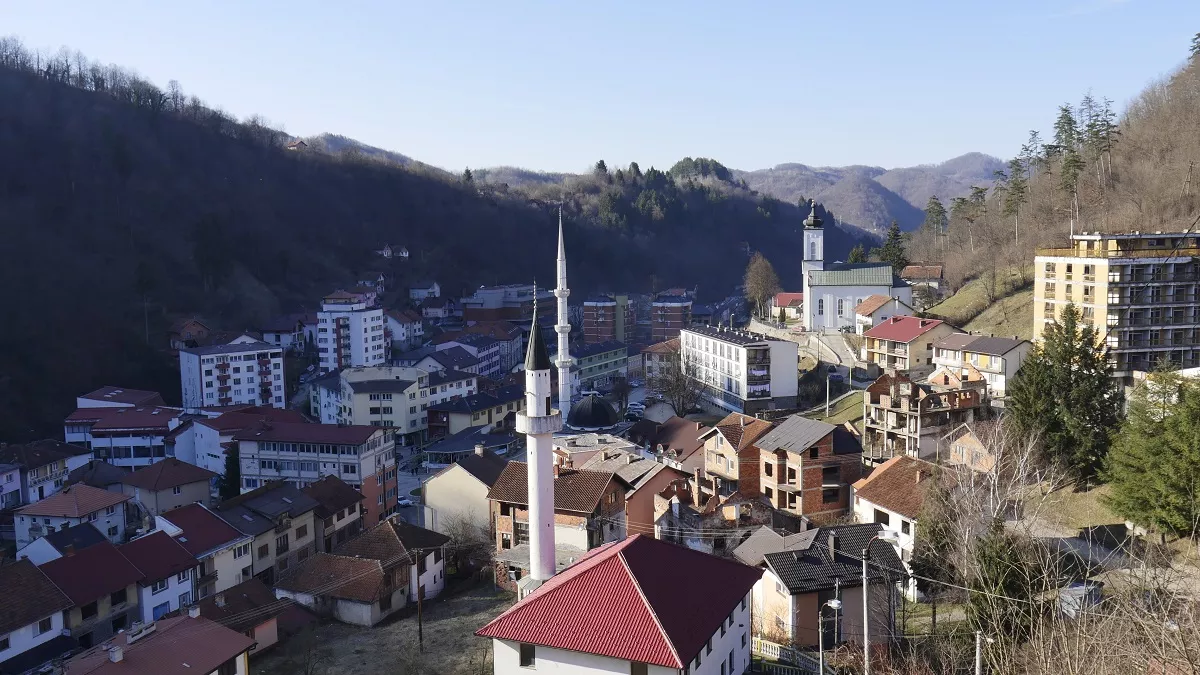
I return to the center of Srebrenica. Just before leaving, a colleague shows me a status from a Bosniak who calls the boycotter Alija Tabaković a true Bosniak because he often comes for evening prayers. At that moment, the call to prayer for night prayer begins. I raise my head and see that only two minarets and one church are shining in Srebrenica.
And I realize. While they fought for religion, they lost the strength, will, and feeling to live and love each other like minarets and a church. However, as long as minarets and churches are above the human spiritual and life state, Srebrenica will be a city of loud silence, occasionally interrupted by the call to prayer and the church bell.
Srebrenica has sunk into deep darkness. And besides the hope that a better day will dawn, they have nothing left from the elections, the boycott, and politics.
We will return to Srebrenica again, but in July, we write about those who are no longer here. This was a story about those who are here, but are invisible...
It's time to go home.
Komentari (0)
Prijavite se za komentiranje
PrijavaJos nema komentara. Budite prvi!
Minuta
Sve →Iz drugih kategorija

High Representative Not Elected: Germans, French and British Sabotaged Americans, New Attempt at End of June

ČOVIĆ WITHOUT MERCY: How Those Who Brought Ademović to Office Created a Political Hell for Him



Sunny Saturday, quite warm



Tragedy in Albanian resort: Two minors drown












