
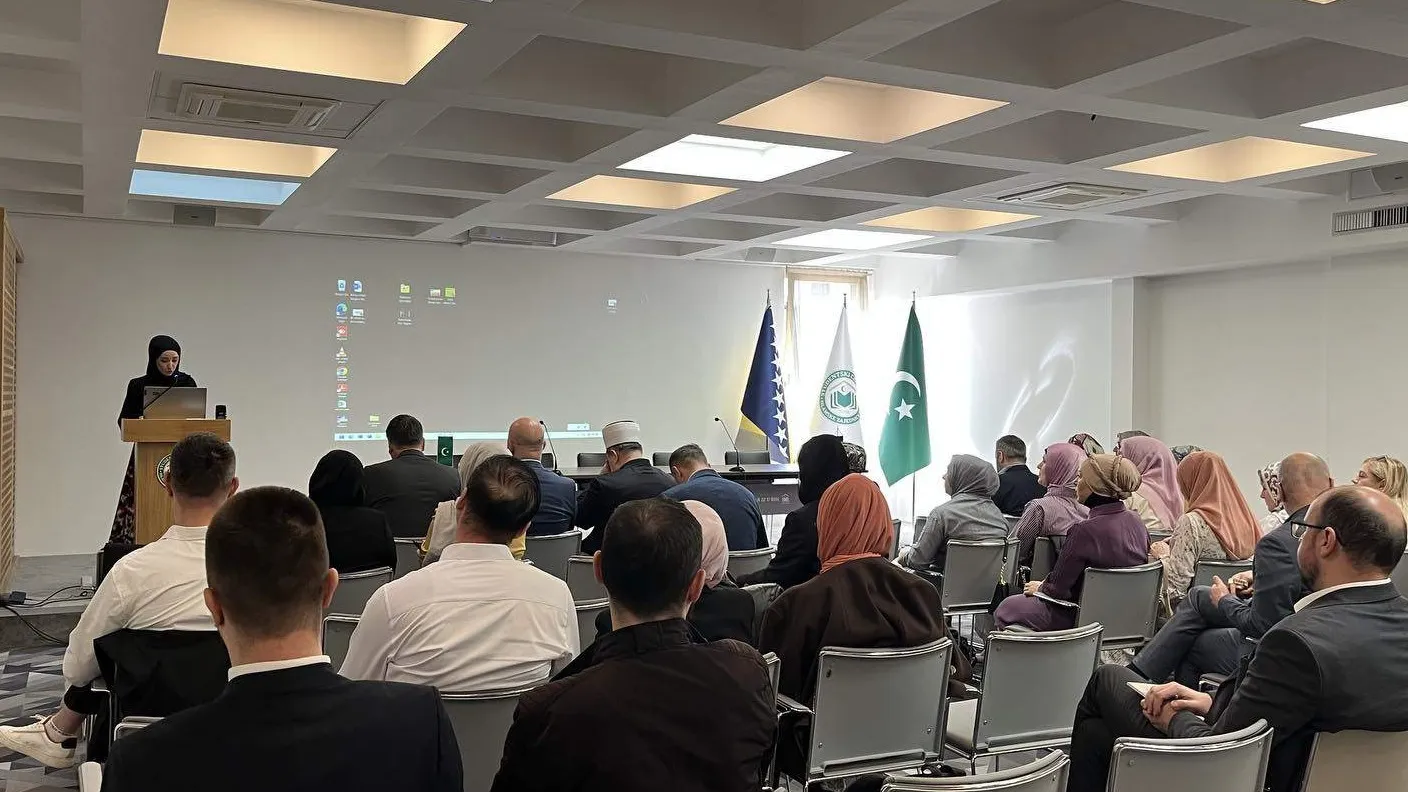
(Patria) - As part of the 14th "Waqf Days" event, a roundtable discussion on the topic "The Role of Women in the Development of Waqfs: From Historical Heritage to Contemporary Practices" was held at the Student Center of the Islamic Community in Bosnia and Herzegovina in Sarajevo.
The event was organized by the Directorate for Religious Affairs of the Islamic Community's Riyaset in Bosnia and Herzegovina and the Waqf Directorate of the Islamic Community in Bosnia and Herzegovina.
The gathering brought together representatives of the Islamic Community, researchers, and experts from various fields, with the aim of examining women's contributions to the development of waqfs throughout history and in contemporary social circumstances.
In the opening addresses, the importance of the continuous development of waqfs as one of the key pillars of social solidarity was highlighted, with a special emphasis on the role of women as active participants in this process.
The Director of the Directorate for Religious Affairs of the Islamic Community's Riyaset in Bosnia and Herzegovina, Prof. Dr. Hafiz Mensur-ef. Malkić, emphasized the significance of preserving and enhancing waqf awareness within the community.
– I hope that today certain issues regarding the role of Bosnian, Bosniak, and Muslim women as waqifs will be further illuminated. We know that our homeland, Bosnia and Herzegovina, is deeply immersed in endowments, i.e., waqfs. We know that our tradition, our civilization, is indeed connected with waqfs – stated Director Malkić.
He also explained that by the names of cities in Bosnia and Herzegovina, we know that some cities originated from waqf properties, such as Gornji and Donji Vakuf, Varcar Vakuf, Kulen Vakuf, Skender Vakuf, and many others.
– These endowments, waqfs, were established by waqifs – men, but certainly also by our mothers and sisters. Therefore, the contribution of women, generally Muslim women, to Islam, our culture, and civilization is immense, especially in the establishment of waqfs in our homeland, Bosnia and Herzegovina. I hope that today, at this roundtable, some new questions will be opened and new information will be presented on this matter – added Malkić.
The Director of the Waqf Directorate of the Islamic Community in Bosnia and Herzegovina, Huso Salihović, emphasized that contemporary waqfs increasingly include women as waqifs, which confirms the continuity of their historical role.
– The goal of the roundtable is actually to point out the significance of women in the affirmation of waqfs, then their contribution to development and preservation, and to show through concrete examples and case studies how much women contribute, primarily in establishing waqfs, and later in their development. We want to show that women have endowed real estate, movable property, but also written words, i.e., works – said Director Salihović.
During the first session, the focus was on the historical presence of women in the waqf system, where it was emphasized that archival sources testify to the significant, but insufficiently researched, contribution of women waqifs. Special attention was paid to their role in the development of educational institutions, through the financing of madrasas, mektebs, and other forms of education.
Issues of contemporary understanding of waqfs were also raised, pointing to the need for further education and strengthening awareness of waqf opportunities, especially among women.
Dr. Safija Malkić, speaking about women waqifs in the contemporary context, emphasized the need to strengthen awareness of waqfs among women, noting that there is potential, but also a need for additional information and inclusion.
– Women, over the years, have actually helped realize major projects. They help realize great charitable deeds and significant projects within the Islamic Community. This roundtable is an opportunity to remember and highlight the examples of Muslim, Bosniak women who have endowed part of their property, and for their example to be an encouragement and motivation for today's women who have a certain part of their property and are thinking about how to use and utilize it in the best way, i.e., for the common good – emphasized Dr. Malkić.
The second session was dedicated to the legal and social aspects of waqfs, including the issue of endowing marital property as well as historical examples that continue to serve as inspiration for waqifs today.
Examples of women's waqfs from the Ottoman period were particularly highlighted, as well as the continuity of this practice in Sandžak and the wider region.
Presentations at the roundtable were given by: Hafiz Mr. Hamza Lavić, Dr. Sumeja Ljevaković-Subašić, Dr. Safija Malkić, Director of the Waqf Directorate Huso Salihović, Mr. Amela Trako-Mahmutović, Zehrudin-ef. Hadžić, and Mr. Denisa Međedović.
Presentations by Prof. Dr. Senad Ćeman and Dr. Hafiz Senaid Zajimović were also planned for the program, but they were unable to attend today, and their papers will be published in the proceedings.
Participants agreed that the contribution of women to the development of waqfs is significant, but insufficiently researched and affirmed, and that there is a need for a more systematic approach to documenting and presenting this segment of cultural and historical heritage.
Komentari (0)
Prijavite se za komentiranje
PrijavaJos nema komentara. Budite prvi!
Minuta
Sve →Iz drugih kategorija

High Representative Not Elected: Germans, French and British Sabotaged Americans, New Attempt at End of June

ČOVIĆ WITHOUT MERCY: How Those Who Brought Ademović to Office Created a Political Hell for Him



Sunny Saturday, quite warm



Tragedy in Albanian resort: Two minors drown












