
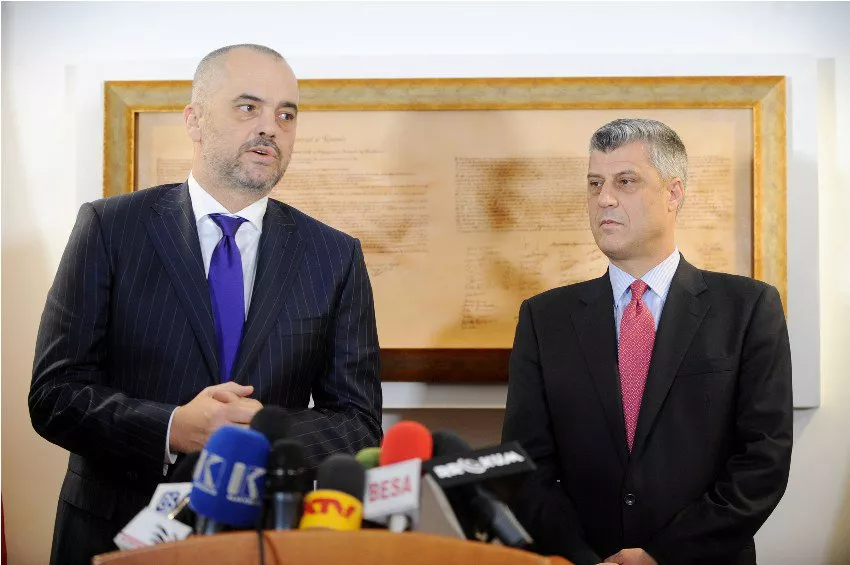
(Patria) - The International Institute for Middle Eastern and Balkan Studies (IFIMES) from Ljubljana, Slovenia, regularly analyzes events in the Middle East and the Balkans. IFIMES has prepared an analysis of the current political situation in Kosovo, Albania, and North Macedonia in light of the announced early parliamentary elections in Kosovo, which will be held on October 6, 2019. From the extensive analysis "Kosovo – Albania – North Macedonia 2019: Awaiting the Fall of the 'Siamese' Regimes of Thaçi - Rama?", we highlight the most important and interesting parts.
The Western Balkan region has been an epicenter of instability in recent years. Geopolitical changes in the world have largely shaken the restless Western Balkan region, which is still unable to recover from the recent wars in the region and their consequences.
The confrontation of superpowers and important regional players still leaves strong consequences in this region. The region operates on the principle of "connected vessels", meaning that instability quickly spreads to other parts of the region, but stability does as well.
The most difficult situation is in Kosovo and Albania, where we have two long-standing regimes in power, led by Hashim Thaçi (PDK), President of Kosovo, and in Albania by Prime Minister Edi Rama (PS).
Events in Kosovo and Albania cannot be viewed in isolation, as they are two Siamese-connected regimes that regularly generate crises.
Why are the early elections in Kosovo in 2019 important?
Early parliamentary elections in Kosovo will be held on October 6, 2019. It is expected in Kosovo that the current regime will suffer a defeat in the elections, which will be an impetus for accelerating the fall of Edi Rama's regime in Albania.
For this reason, Albanian Prime Minister Edi Rama was actively involved in attempts to persuade opposition parties in Kosovo to avoid early elections and form a new government, but in the end, this was ignored. Rama is aware of the fact that Thaçi's defeat in the elections will mean not only the end of Thaçi's regime but also his own end.
The fall of Hashim Thaçi's regime will begin to expose the criminal and corrupt octopus of Edi Rama, of which the Kosovo branch is an integral part. The modus operandi of Thaçi and Rama is almost identical. The concept of operation is the plunder of public resources, intimidation of citizens and political opponents, electoral fraud, vote buying, deceiving the international community, and constantly producing crises and confrontations with the opposition in order to rule with an enormous amount of "dirty" money in such an atmosphere of "controlled chaos". In doing so, crime and corruption have become not only a way of ruling but also a way of life. The upcoming early parliamentary elections will expose Thaçi's network of mercenaries. It will be revealed who among high-ranking international officials and officials of certain countries will visit Kosovo during September 2019, thus showing who is working and who are the "mercenaries" of Hashim Thaçi's regime. Thus, it will become clear who is part of the political/diplomatic corrupt octopus that keeps Thaçi in power.
Analysts warn of a very strong link between politics, crime, and tycoons (business), which has shown its strength during the formation of coalitions for the upcoming early elections. Namely, political-criminal circles prevented the formation of an electoral coalition between the Self-Determination Movement (LVV) and the Democratic League of Kosovo (LDK). Within LDK, political-criminal circles prevailed, who closely cooperate with the Democratic Party of Kosovo (PDK) and Hashim Thaçi, symbolized in LDK by Lutfi Haziri and Agim Veliu. Therefore, a vote in the upcoming elections for LDK will actually be a vote for PDK and Hashim Thaçi. Unfortunately, Germany, or rather the Christian Democratic Union (CDU), has actively interfered in these events. The goal of all these activities is to prevent the Self-Determination Movement and Albin Kurti (LVV), who is a convincing favorite for the position of Prime Minister of Kosovo, from coming to power.
Analysts warn that political parties and politicians in Kosovo see elections as an opportunity to come to power and openly plunder public resources, not as an opportunity to work responsibly for the interest and well-being of citizens and the country. Kosovo's foreign policy has been a complete failure, as Kosovo's citizens still do not have visa liberalization, and the Kosovo Police is not part of the international organization Interpol. More than ten countries have since withdrawn their international recognition of Kosovo, which Serbia highlights as a major success.
Coincidence of introducing tariffs on goods from BiH and Serbia – the beginning of protests by the Serbian opposition?
The fact is that crime and corruption know no borders. This has been particularly evident in the Western Balkans over the past 30 years, producing almost constant crises, and even armed conflicts at one point.
The current ruling political structures in Kosovo are wartime and political-criminal, who ensure their hold on power by producing crises and engaging in criminal-corrupt activities. High-ranking officials from certain countries, as well as the top leadership of the European Union (EU), are even participating in this.
Analysts believe that political-criminal structures and regimes do not want to build strong institutions, because they are inherently against institutions. If strong and built institutions existed, there would be no political-criminal structures, at least not to this extent and intensity.
On November 21, 2018, the Government of Kosovo introduced illegal tariffs on the import of goods from Bosnia and Herzegovina and Serbia, thereby directly violating the Central European Free Trade Agreement (CEFTA), of which it is a signatory. Before that, the dialogue between official Belgrade and official Pristina, mediated by the EU, had been interrupted for several months. The gross violation of the CEFTA free trade agreement is justified by the demand that Serbia recognize Kosovo's independence, while on the other hand, the dialogue between official Belgrade and Pristina has not yet concluded with the signing of a legally binding agreement. Nevertheless, the violation of the CEFTA agreement served as a cover for other intentions of the regime in Pristina. The question arises whether there is a coincidence between the date of November 21, 2018, when the Government of Kosovo officially decided to introduce 100% tariffs on imports of goods from Bosnia and Herzegovina and Serbia, and the date of November 30, 2018, when the first protests of the Serbian opposition began. Why did Hashim Thaçi's regime not disclose its meetings with representatives of the Serbian opposition to the public?
Analysts believe that there is a coincidence between the introduction of 100% tariffs on imports of goods from Bosnia and Herzegovina and Serbia and the start of protests by the Serbian opposition on November 30, 2018. Why was the dialogue between official Belgrade and Pristina interrupted if the parties to the dialogue committed to concluding the dialogue by signing a legally binding agreement? Are the meetings of Kosovo-Albanian politicians with the Serbian opposition related to the possibility of weakening the position of Serbian President Aleksandar Vučić (SNS), and consequently his overthrow from power? Why did the regime in Pristina sacrifice the lifting of visas for Kosovo citizens for this reason? Probably the most interesting question is whether Hashim Thaçi's regime is involved in financing opposition protests in Serbia? The Serbian List, which is the absolute favorite in elections among the Serbian electorate and enjoys the support of Serbian President Aleksandar Vučić, will be particularly targeted in the election campaign. Tensions and warmongering rhetoric will increase during the election campaign in Kosovo.
Past experiences in the Balkans show that political-criminal structures produce permanent crises not only in their own countries but also in other countries, primarily neighboring ones, with the intention of achieving certain interests or influence.
However, the question arises as to who benefits from provoking an additional crisis in the region, if, after resolving the situation in North Macedonia and its imminent full membership in NATO, the issue of Kosovo is to be addressed, followed by the stabilization and resolution of the situation in Bosnia and Herzegovina.
Attack on North Macedonia similar to the attack on Montenegro before NATO membership
The Republic of North Macedonia signed the NATO accession protocol on February 6, 2019. The ratification of the protocol by NATO member states is currently underway. So far, 19 ratifications have been carried out by NATO member states. Full membership of North Macedonia is expected to be confirmed at the NATO summit in London in December 2019.
Attacks on North Macedonia, or attempts to discredit its leadership and the institutions of the Macedonian state, will continue. Experience shows that similar things happened to Montenegro until it became a full member of NATO. The international intelligence operation "Racket" was prepared and skillfully designed outside North Macedonia for a long time. Actors for specific roles were carefully chosen/recruited. North Macedonia lacked adequate counter-intelligence protection for Prime Minister Zoran Zaev (SDSM) and other leaders of the country. Therefore, it is necessary to accelerate the reform of the security-intelligence and defense sectors, as cadres from the former Prime Minister Nikola Gruevski (VMRO-DPMNE) and the former head of the Macedonian secret service Sašo Mijalkov (VMRO-DPMNE) still dominate in this sector. Cadres from the previous regime are still in key positions in the Macedonian army. The vetting that began within the Ministry of Internal Affairs of the Republic of North Macedonia is the first step towards the full professionalization of security structures. In the international intelligence operation "Racket" aimed against the Republic of North Macedonia and its leadership, in addition to intelligence officers, politicians, individuals from state institutions, journalists, celebrities, businessmen, professors, media, and a number of individuals who have been (un)consciously drawn into this intelligence operation, are participating. The goal of the intelligence operation "Racket" is the discrediting, criminalization, elimination, and consequently the overthrow of Zoran Zaev and his Government, causing chaos, and taking power with or without early elections.
Analysts believe that the current events in North Macedonia are the result of a comprehensive, planned, coordinated, thorough, and skillfully prepared intelligence operation by external and internal factors aimed at stopping the country's Euro-Atlantic path. Thanks to the timely reaction and efforts of the security-intelligence sector, the dissolution of the country, which was ready for implementation, was nevertheless stopped. According to estimates, Nikola Gruevski's regime illegally took over five billion euros from North Macedonia, and 50 million euros were allocated for the operation to overthrow the current authorities.
Therefore, it is of utmost importance to accelerate North Macedonia's Euro-Atlantic path and help the country, in addition to full NATO membership, to get a date for the start of negotiations with the EU in October 2019. Based on Montenegro's experience, attacks on the Republic of North Macedonia, especially on the country's prime minister Zoran Zaev, but also on the key institutions of the Macedonian state (especially the judicial system), will continue with even greater intensity, as the doctrine of shock is being used to destabilize the country, cause chaos, prevent its membership in NATO, and illegally take over institutions or come to power. Therefore, it is of particular importance for the Macedonian authorities to reach an agreement among key political actors as soon as possible and adopt the law on the Special Public Prosecutor's Office (SPO), as this will confirm the commitment to fighting crime and corruption and establishing the rule of law.
Analysts believe that it is important for strong state institutions to be formed and developed in North Macedonia, rather than individuals being synonymous with institutions or the slogan "the state is me" as was the case in the recent Macedonian past. The EU has also warned about this. It is particularly important that with the establishment of the rule of law in the country, there are no longer untouchable individuals and legal entities. Therefore, it will be necessary to carry out the police-judicial operation "Sablja" in North Macedonia, modeled after Serbia's in 2003, which means making a turning point and a complete reckoning with crime and corruption. Any other partial solution will further complicate relations in North Macedonia, which in the past two years has gone from being a country of concern to a country of hope for other countries in the region.
Where did the two billion euros of European money go?
The EU has fundamentally neglected the Western Balkans, while other countries and power centers are already capillarized in the Balkans. Two billion euros of EU taxpayer money have been wasted or disappeared in Kosovo. It is expected that the new European Parliament (EP) will launch an investigation and determine responsibility for the spending of EU taxpayer money in Kosovo.
It is also necessary to review the work of EU Delegations in the countries of the region, and EU member states should review the work of their diplomatic missions in the countries of the region. It is concerning that EU Delegations in the countries of the region have become hotbeds of crime and peculiar centers of power within the states.
Analysts believe that the European Anti-Fraud Office (OLAF) must launch investigations due to well-founded suspicions that EU taxpayer money has been wasted or has disappeared.
Decriminalization of Albanians
Socialist Prime Minister Edi Rama came to power in Albania in 2013 with the help of "strong-arm men – from the underworld", including several regional bosses who provided "muscle and money" for the elections. Many of them were included in the candidate lists of the Socialist Party (PS) and became members of parliament. Rama is the longest-serving politician in Albania, holding various positions for 20 years: two years as minister (1998-2000), 11 years as mayor of Tirana (2000-2011), and seven years as prime minister (2013-2019). The current President of Kosovo, Hashim Thaçi, has almost identical political experience.
Between 2014 and 2017, Albania became the main country for illegal cannabis production and human trafficking in Europe, as confirmed by the EU, Europol [1], the US State Department [2], and the United Nations [3]. During this entire period, the opposition accused the socialist government, especially the then Minister of Internal Affairs Saimir Tahiri (PS), of being directly involved in drug trafficking. After the public release of official wiretaps on January 30, 2019, it was revealed that dozens of socialist MPs, socialist mayors, and other high-ranking officials were caught collaborating with organized crime in vote buying, voter intimidation, document forgery, and other criminal activities before and during the 2017 General Elections. Now, there is clear evidence of high-level collusion between the socialist government and drug/human traffickers, which enabled the flourishing of drug production and trafficking.
The illegal local elections held on June 30, 2019, confirmed the allegations about the criminal nature of Edi Rama's regime. The newly elected mayor of Shkodra in the illegal elections, Valdrin Pjetri, was found to have a criminal record in Italy.
The mayor of Vora Agim Kajmaku was previously arrested in Greece on charges of counterfeiting money. Agim Kajmaku used the false name Jorgo Toto and forged personal documents. There are numerous other examples of crime, as we have written in previous analyses, such as the case of the Albanian Power Corporation KESH, which is the core of crime in the energy sector.
Analysts warn that a perception has gradually been created in Europe that Albanians are a criminalized nation, largely thanks to Edi Rama and Hashim Thaçi, but also other criminalized Albanian leaders. Therefore, the new authorities in Kosovo and Albania will have to make significant efforts to improve the perception and image of Albanians, which has been seriously damaged, and present a completely different picture.
Although Albania became a full member of NATO in 2009, it has been shown that the country, or rather its state leadership, does not uphold NATO values. NATO is much more than a military alliance. NATO represents an entire system of values characteristic of democratic states.
Why do ideas about creating a so-called Greater Albania or the unification/annexation of Albania and Kosovo come from Edi Rama and other high-ranking officials of Albania when Albania is a full member of NATO, and that military alliance protects the territorial integrity of each of its members? Why has the level of crime and corruption in Albania enormously increased with Edi Rama's rise to the position of prime minister? Why does NATO remain silent about Prime Minister Rama's destructive actions, or why does NATO not react sharply?
Analysts believe that with his actions so far, Albanian Prime Minister Edi Rama has defeated NATO and the entire system of NATO values. Who in the NATO alliance bears responsibility for approving the unacceptable behavior and destructive actions of Edi Rama, given that Albania is, after all, a full member of NATO?
Edi Rama and Hashim Thaçi generate crises in Kosovo, and the crisis from Kosovo generates a crisis in Bosnia and Herzegovina. Therefore, it is crucial that the new US Special Envoy for the Western Balkans, Matthew Palmer, first stabilizes the situation in Albania and Kosovo, or rather with the Albanian political leadership, because until it is stabilized, no serious progress can be expected in the Balkans.
Therefore, the recent announcement by France, the Netherlands, and Denmark that they oppose the expansion of the European Union, or the start of EU membership negotiations with Albania, despite the European Commission's recommendation to proceed with this process, is (not) surprising.
What can US Special Envoy Matthew Palmer do?
US Secretary of State Mike Pompeo appointed Deputy Assistant Secretary of State Matthew Palmer as his special envoy for the Western Balkans. Palmer's appointment comes at a time of very complex and tense relations in the Western Balkans, largely a consequence of the long-standing absence of the United States in the region.
The key problem for the West in the past period has been that it has primarily built partnerships with political-criminal structures in the region. Therefore, the US will have to engage American anti-crime and anti-corruption agencies to help combat the mafia in the Balkans, just as the US helped Italy after World War II in combating the mafia. Initially, it will be important to identify individuals and policies that represent a disruptive factor. Therefore, it is expected that the names of new individuals/entities from the region will soon appear on the "blacklist" of the US administration.
Without combating crime and corruption, or decriminalizing the region, it will not be possible to implement any serious political process, enable economic development, or ensure lasting peace and long-term stability. Therefore, it is important that these processes are coordinated and harmonized with the EU, as the largest source of funds in the region are EU funds, which are often subject to crime and corruption.
Analysts believe that if the US administration's special envoy for the Balkans, Matthew Palmer, does not initiate processes in individual countries or strengthen and encourage institutions to combat crime and criminals, no serious results can be expected from his engagement as a US special envoy in the region. The dismantling of the "Siamese" regime of Thaçi-Rama is perhaps the best starting point/example for the beginning of his work as a US special envoy for the Balkans.
Komentari (0)
Prijavite se za komentiranje
PrijavaJos nema komentara. Budite prvi!
Minuta
Sve →Iz drugih kategorija

High Representative Not Elected: Germans, French and British Sabotaged Americans, New Attempt at End of June

ČOVIĆ WITHOUT MERCY: How Those Who Brought Ademović to Office Created a Political Hell for Him



Sunny Saturday, quite warm



Tragedy in Albanian resort: Two minors drown












