
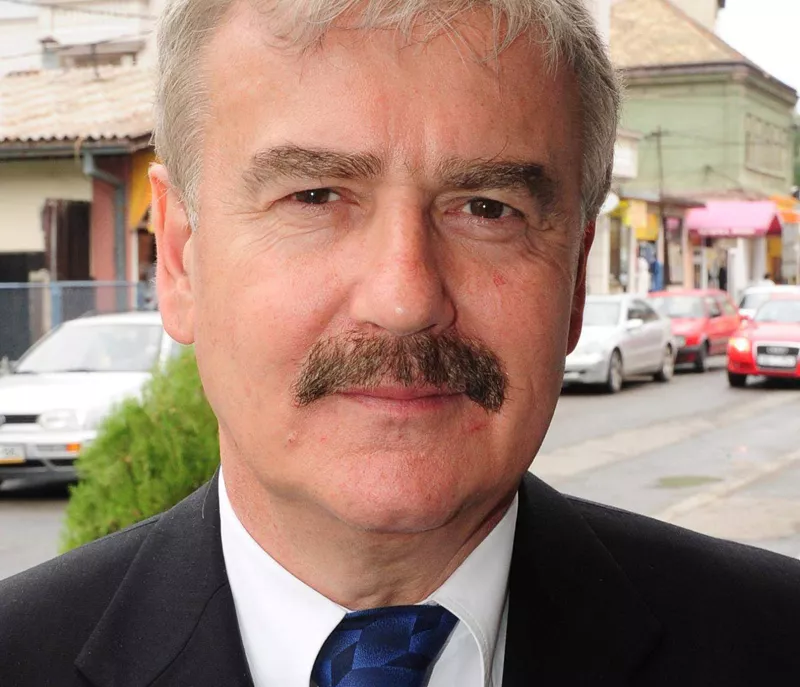
Jusuf Trbić was a well-known journalist even before the war. During the war, he survived severe torture and miraculously remained alive. His book “Masters of Darkness” became world-renowned. Trbić is today in his city, bravely fighting for the truth about committed crimes and for the equality of Bosniaks. He is the president of the Bosniak Cultural Community “Preporod”. Today he writes for many media outlets in BiH and abroad. He is strongly supported by the Bosniaks of Semberija, both at home and abroad.
PATRIA: Bijeljina in April 1992 was a kind of sobering experience for all of BiH. When people saw the attack on your city on television, it was known that it was war and that horrors were coming. You barely survived those first days. You were subjected to terrible torture. One cannot help but admire your courage. You are still here with your fellow citizens and neighbors. After being severely beaten, you were taken in by the family of Đojo Krstić, who showed you their integrity.
TRBIĆ: Bijeljina was a dress rehearsal for the Greater Serbian criminal project, and everything we later saw in Bosnian cities occupied by Karadžić's fascists was tested there. It was a shock for all of us, because it wasn't about any war, it was a cold-blooded, long-prepared execution of helpless civilians, women, and children. At the same time, it was a demonstration exercise - for Serbs, to see how it was done and what they should do, and for Bosniaks - to know what awaited them. I miraculously survived, so I felt I owed something to someone, to the people, to my homeland, to my country... That's why I returned, although I didn't have to, and I try to do what I can. In those days, Đojo Krstić and his family helped me, and I am immensely grateful to them for that. Others helped too, but most of them are reluctant to talk about it because fear has gripped people, and it hasn't let go even today.
PATRIA: Does the truth about these crimes reach the younger Serb neighbors? Are there human, even individual, acknowledgments of these crimes, not to mention repentance?
TRBIĆ: That is a question that delves into collective responsibility, into Greater Serbian patriotism, into faith, into identity, into the politics that prevail here and in Serbia, into that entire ideology that led to wars and crimes and has not stopped even today. Nobody here needs the truth, nobody speaks of their guilt, and there is no confrontation with what happened. On the contrary, a culture of denial of crimes prevails here, and everything remains as it was. Children in schools are taught falsified history, crimes and criminals are celebrated, the media support it, and ordinary people turn a blind eye to everything. Republika Srpska has become an Orthodox quasi-state where there is no place for others. Peace here is understood as the continuation of war by political means.
PATRIA: After the brutal attack on the Atik Mosque in Janja, how did your Serb neighbors react to these attacks, were there any condemnations? Were there any attempts at rapprochement, at reducing animosity? Is there a dialogue between the two nations, two confessions, are there attempts at intermingling of cultural communities?
TRBIĆ: No one reacts to such things; it has become part of the political folklore here. You can talk about it with people on the street, but politics and the media ignore everything. The Church supports everything directed against the unwanted people, and there is no talk of intermingling or blending of cultural activities. On this occasion, we only received a statement from the Interreligious Council, and nothing else. But we are already used to that.
PATRIA: How do Bosniaks live in Bijeljina and Janja today? What is their position in society, and what is their economic situation? Are they represented in public companies and municipal administration?
TRBIĆ: Bosniaks in Bijeljina and Janja live somewhat more freely than in other cities in RS, thanks primarily to Mayor Mićo Mićić and some people around him. About ten percent of Bosniaks work in the municipal administration, which is a real miracle for RS. There are no employed Bosniaks in the public sector under entity administration, and the entity government creates the overall environment. The economic situation is difficult, legally established discrimination prevails here, children are taught in schools that Bosnia is an enemy and foreign country, crimes are celebrated here, streets and institutions bear the names of Chetniks and religious figures, and everyone has slavas, from the entity and municipalities to kindergartens. Here, Bosniaks are made to feel unwelcome every day. And it is not easy for any of us to live here. All that remains is to fight, and see how far we get.
PATRIA: As far as I know, you have written books about crimes. “Masters of Darkness” is a harrowing account of the crimes in Bijeljina. And the recent book “Truths and Lies” is said to be the real answer to the crimes of 1992. In “Deaf Time” you showed some murders and described the arrival of the “Great Evil”. You were arrested by your neighbor Mirko Blagojević.
TRBIĆ: I have published four books about crimes in my region. “Masters of Darkness”, parts one and two (published in 2007), were even included in the evidentiary proceedings against Karadžić in The Hague. They contain accounts of a large number of crimes in Bijeljina and Janja, with names, dates, witness statements, and no one has disputed a single word to this day. Unfortunately, the judiciary is so slow that I fear we will not live to see the criminals arrested. I was taken from my home by Duke Mirko Blagojević and handed over to Arkan's men, and I am not the only one, and he still lives peacefully today and even works as a lawyer. Vojkan Đurković also lives peacefully, and so do many others. And all this has been going on for too long.
PATRIA: What is the exact number of murdered Bosniak civilians in Bijeljina? Have they all been buried with dignity?
TRBIĆ: Several hundred people were killed in Bijeljina, more than a hundred in the first three days of April alone, and this in a city where there was no war, no fighting. Most were killed or taken away in front of witnesses, but that was not a reason for the Bijeljina District Prosecutor's Office to independently initiate even a single case. Many bodies were found in cemeteries in Sremska Mitrovica and Šabac, and dozens of people are still missing.
PATRIA: Are the prosecutor's offices doing their job? Five police officers who committed crimes were recently arrested. What about that process? What about the brutal murder of 16 Bosniaks, who were picked up from the street, one by one, slaughtered on the banks of the Drina, and pushed into the water? Are there investigations?
TRBIĆ: For now, there are no investigations, not even in cases where everything is known. In “Masters of Darkness”, I published all the details of the great crime against the members of the Sarajlić, Sejmenović, and Malagić families, when 24 of them were killed, including seven children and eight women. I published the names of all those who participated in it, from Toma Kovač to those who shot, organized, guarded, and planned it all. And to this day - nothing. The arrest of former police officers from Janja gave us hope that something might still be applied in the future. However, Novak Kovačević, a former Mladić military judge, is at the head of the District Prosecutor's Office in Bijeljina, and he has been avoiding doing anything to shed light on war crimes for years. And how long it will continue like this is unknown.
Bishop Kačavenda was the inspirer and leader of the crimes
PATRIA: The Bosniaks of Bijeljina had difficult times with Bishop Kačavenda, who regularly raised nationalist tensions, spread hatred, and usurped Bosniak property? Where is he today?
TRBIĆ: Bishop Kačavenda was the inspirer and leader of the crimes; testimonies speak of his dirty role, from direct cooperation with Karadžić to that famous speech on the eve of the attack on Srebrenica. Minor Bosniak girls were brought to him to be raped, and everything is known about his homosexual activities. He would not have been harmed even slightly if that affair had not erupted within the Serbian Orthodox Church, due to which he was removed. There he is, living luxuriously in a magnificent building of a new Russian-style church, as if he had never done anything wrong.
Killing of children
PATRIA: I once spoke with a foreign investigator who told me that he was investigating the murders of the Sarajlić, Maglajlić, and Sejmenović families. He was exclusively interested in the murder of seven children and their eight mothers. He suspected pedophilic rapes of young victims, after which they were brutally murdered along with their mothers. Do you have any information about these horrific killings of children?
TRBIĆ: Almost everything is known about the killing of children. A few years ago, the Children's Embassy and our “Preporod” organized a conference on crimes against children, in the hall of the Municipal Assembly. We also organized commemorations on the anniversary of the murder of the Sarajlićs and others, but the local public and media do not want to know about it. I think the investigator's suspicions in this specific case are not justified, because we have statements from people who had to throw the bodies of those children into the water. However, it is possible that this happened in other cases. After all, if Kačavenda was there, and he was always the most influential and powerful among the local Serbs, nothing would be surprising.
Arkan had a special task in Bijeljina
PATRIA: Although things are moving slowly. Arkan is no longer here, many criminals and leaders of criminal politics have been punished, and the truth is inevitably coming. What is your experience with that leader of the crimes in Bijeljina? You spoke at one time about that meeting with Arkan.
TRBIĆ: Arkan had a special task in Bijeljina - to channel the crime and to show domestic patriots how it was done. And he was an absolute authority, to whom everything was subordinate - politicians, the army, the police, the court, the territorial defense, everything. General Marijan Praščević saluted him, everyone obeyed him without question. It is interesting that he and his men did not hide at all; television filmed them, he enjoyed bloody fame. Nevertheless, only in recent days, and at the initiative of Nataša Kandić, has a timid investigation into the crimes of that unit begun. Imagine the situation, anywhere in the world, that a special police unit from one country comes to another, kills dozens of civilians, does whatever it wants publicly, and no one finds it strange, not the judiciary, not the politicians, not the media, not the ordinary people. Not then, not now. And no one wants to talk about it. I asked Prosecutor Novak Kovačević about this at a meeting. He had no answer.
About Vojkan Đurković
PATRIA: Vojkan Đurković, one of the members of Arkan's units, was recently written about by Sarajevo media. He was publicly accused as the man who completed the ethnic cleansing in Bijeljina, yet he is not even remotely considered by the judiciary. How is it possible that such mass expulsions, as occurred in 1993, have never been dealt with by the judiciary?
TRBIĆ: As far as I know, Vojkan Đurković was detained once, but, under circumstances unknown to us, he was released and lives freely, like any honest citizen. And this is a man who is a symbol of ethnic cleansing, not only in Bijeljina, a man who expelled, robbed, humiliated, and cost the lives of thousands upon thousands of innocent people, and he did all this on the orders of Momčilo Krajišnik and with the approval of Radovan Karadžić. He lives comfortably today and walks the streets of Bijeljina. How is this possible - that should be asked of the judiciary, primarily the District Prosecutor's Office in Bijeljina and the Prosecutor's Office of BiH.
I have been left by the state of BiH to fight for the truth on my own
PATRIA: Have you been left by the state of BiH to fight for the truth about the crime in your city on your own? Many people feel alone and continue to fight for the truth.
TRBIĆ: Unfortunately, the answer is yes. But there is someone who will not allow crimes to go unpunished. I am not asking for help from anyone; I am doing what I think is my duty, I am writing, speaking publicly, helping anyone who is interested in crimes and criminals. But it is sad when you see that no one else is writing about it, that everyone is turning a blind eye, that Bosnian and Bosniak politicians are fighting for positions and only see as far as the last houses of their voters, that there is no state strategy for preserving Bosnia, and that everyone is sticking to their own flock. The ethnic division, forged in war, has become our sad everyday reality, and I fear that the situation is getting worse, especially in the smaller entity. And that all of this together might be leading us to a new catastrophe.
Komentari (0)
Prijavite se za komentiranje
PrijavaJos nema komentara. Budite prvi!
Minuta
Sve →Iz drugih kategorija

High Representative Not Elected: Germans, French and British Sabotaged Americans, New Attempt at End of June

ČOVIĆ WITHOUT MERCY: How Those Who Brought Ademović to Office Created a Political Hell for Him



Sunny Saturday, quite warm



Tragedy in Albanian resort: Two minors drown












