
By: Nela Bajić
In the area of the Una-Sana Canton, there are four temporary transit centers for migrants and refugees under the auspices of the IOM. While three camps are located in Bihać, one is in Velika Kladuša, the temporary migrant center Miral. Migrants have been temporarily housed there for two years. Although the initial agreement between the IOM and local authorities was to house 700 migrants and refugees in Miral, the number is increasing daily. Today, around 800 migrants are housed in Miral. Most are "singles", i.e., adult men traveling alone, about 700 of them, and a smaller number of unaccompanied children.
An equal number, about 700 migrants, are estimated to be on the streets, outside the camp. They find shelter and refuge from the elements in "squats". Abandoned buildings they make their temporary home. Their daily lives are occupied by thoughts of logistical preparations for the 'game'. Jackets, boots, socks, money, mobile phones, new maps, new routes. Where the police are equipped with tasers, where with batons, where with trained anti-migrant dogs.
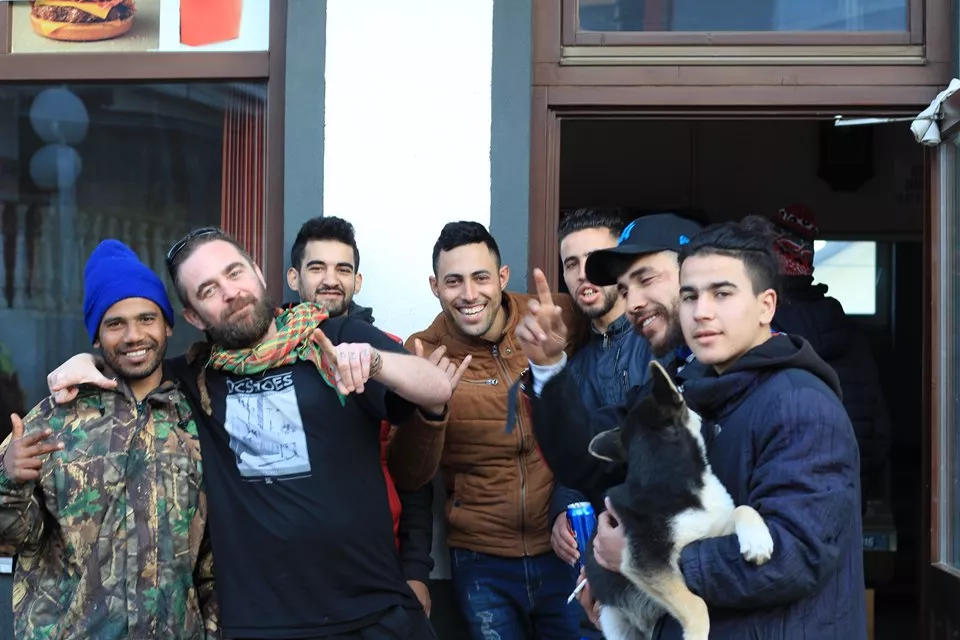
Members of the Croatian Border Police release dogs on migrants attempting to cross the border illegally, hit them with batons, strip them naked, fire into the air, sometimes "accidentally" at them. It is incredible that they will recount with laughter the beatings and the struggle through the bushes in the Bosnian wilderness with the inevitable "kroejša polis no gud" (Croatian police not good), people good, police not good. While about fifty local and international humanitarian organizations are grabbing their piece of the pie in the distribution of the large migrant cake, the Patria team traveled to Velika Kladuša in search of a different, happier, and more humane migrant story. A story about migrants whose laughter is contagious, where there is no room for pity or pathos.
Social Caffe is now the established name for the restaurant Badem, located in a side street at the entrance to Velika Kladuša. The only cafe in Velika Kladuša where migrants are the sole clientele. Zuhdija Hodžić, a retired police officer, is the owner of the restaurant Badem, the only commercial catering facility that has open doors for migrants, without prejudice. No one calls the restaurant Badem anymore; they call it Social Caffe, Come Back, Social Center.
"We have different tariffs. One for the local population. Another for migrants. A slice of pizza for our people is 1.5 KM, for them it's one mark. And I often give it to them on credit," says the owner of the establishment modestly, while our cook is humming a popular tune.
The owner of the Social Caffe restaurant has accumulated about 2-3 thousand euros in debt on credit. He justifies it by saying, "well, they do that sometimes. I don't doubt for a moment that they will pay it back." He tells us how it all began when a Syrian family entered his restaurant during the first wave of migrants that reached Velika Kladuša.
He fed them, drawing on his own experiences, and to this day, he says, he has free advertising. Whoever comes to Kladuša, everyone knows about me and comes straight to my restaurant. They know that no one will bother them there, and if they don't cause problems, they can eat something and socialize. They are suffering, they sometimes just need to laugh. The police are there occasionally, but they come as friends, to check if everything is okay. Several times they tried to shut me down, sent inspectors, wrote petitions, complaints, and so on. People are afraid, and I understand them to some extent. But I see them the same as our people. Some are good, some are not. I can't see them all the same," Hodžić tells us.
In the immediate vicinity of the Social Caffe restaurant is the elementary school "25. novembar", which is appealing to the local authorities to close the restaurant. They are concerned about the safety of their students. In the same street, there is also a kindergarten, so the pressure to close the restaurant is growing day by day.
"They closed me once," Zuhdija continues, "for 8 days. I wasn't worried; I knew everything would turn out well. I understand everything, but the problems migrants cause are among themselves. I have never seen them attack the local population. People are afraid because they pass by them and live next to them. They haven't even tried to get to know someone, to approach them. And then it's normal for them to be afraid."
About a hundred migrants pass through the establishment daily. They come for a meal, tea, and sometimes just to socialize. The cook Lejla, the only paid employee of Social Caffe besides Zuhdija, says she has no fear.

"When I started working here, it was a normal restaurant; our people used to come. Then they started coming. Our people stopped coming; we only have delivery. They are afraid. I've been alone with 200 of them. When the World Cup was on, there were 200 inside and 500 outside, and I was alone. Nothing. Not a hair on my head was harmed. Once there was a general fight outside the restaurant, during which my car was damaged. That's when they really annoyed me," she says as if she doesn't believe what she's saying herself.
"That was the only time they caused me any damage, but even then, they collected money to fix my car. I could never have imagined doing this, being surrounded by these people who come from who knows where, but the experience is indescribable, and I have never regretted it."
Social Caffe is a safe place for migrants; it is often a gathering place for local activists who provide them with medical or logistical assistance within the premises. Both call it their free territory.
Where activists are just activists, and migrants are nothing more than people.

Komentari (0)
Prijavite se za komentiranje
PrijavaJos nema komentara. Budite prvi!
Minuta
Sve →Iz drugih kategorija

High Representative Not Elected: Germans, French and British Against Americans, New Attempt at End of June

ČOVIĆ WITHOUT MERCY: How Those Who Brought Ademović to Office Created a Political Hell for Him



Sunny Saturday, quite warm



Tragedy in Albanian resort: Two minors drown












