
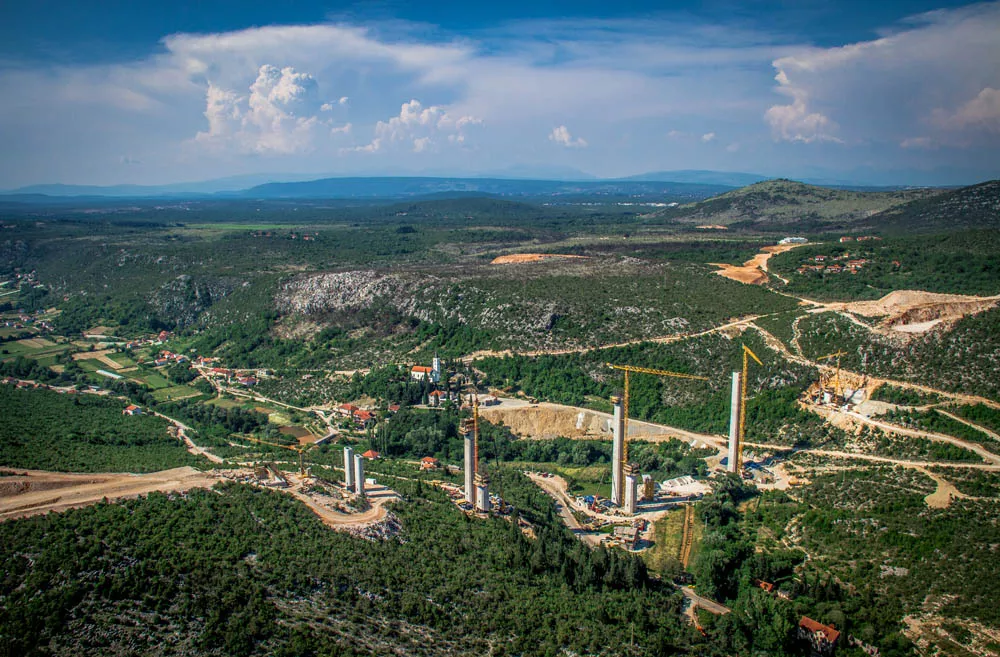
Central and Southeastern Europe have become hotspots for new road infrastructure projects using technologically advanced formwork solutions, writes the world-renowned portal specializing in highway construction, “World Highways”, which published an article focusing on solutions on the highway on Corridor 5c in the Federation of BiH, objective problems on this section, and the most modern solutions on it, reports the BiH news agency Patria (NAP).
Author of the text, Guy Woodford, notes that travel time between the Hungarian capital Budapest and the south of Dalmatia is reduced thanks to the pan-European Corridor 5c – European Route 73.
The vast majority of these works are under the jurisdiction of the Public Enterprise “Highways of the Federation of BiH”, which has started and completed numerous sections, and it is estimated that by the end of the year, the total number of kilometers of highway built will exceed one hundred.
- Due to the difficult terrain, a large number of tunnels and bridges have been built on 397 km of European Route 73 in Bosnia. The Austrian company Doka is participating in the construction, and the issue of the Studenčica and Trebižat bridges is being resolved using a total of ten cantilever cranes. European Route 73 covers a total length of approximately 702 km. A1 is an important part of this route, and in Bosnia and Herzegovina, it connects the northern border with the Adriatic Sea via Zenica, Sarajevo, and Mostar. There are also two bridges, Studenčica and Trebižat, which are intended to connect valleys near the municipality of Čapljina – describes the professional magazine “World Highways”.
The author of the text presents the technical characteristics of Studenčica and Trebižat. He reminds that with a length of 555 meters from one retaining wall to another and a maximum height of 81 meters above the valley, Studenčica is the longer and higher bridge. Four superstructures are placed on a total of five pillars, each 12.4 meters wide, with a mutual distance of 120 meters.
Trebižat, with its length of 365 meters and a maximum height of 59.5 meters, is a smaller bridge and requires only three pillars. For the construction of these bridges, Doka uses a total of ten cantilever cranes, of which eight are used on the Studenčica bridge and two on the Trebižat bridge.
- By concreting segments of five meters per week, the total number of segments is reduced, which speeds up work and saves time – describes “World Highways” the work on the two bridges being built in the Federation of Bosnia and Herzegovina.
Thus, thanks to Doka’s cantilever cranes, the completion of the works with eight fewer segments is enabled, which means the project can be completed eight weeks earlier.
Doka’s materials were also used for the construction of the support pillars. The pillars were built using an MF240 crane, while the support frames were placed horizontally using hammerheads.
Doka Croatia and Bridge Competence Centre participated in lifting the construction wagons to a height of exactly 81 meters.
The slabs on the cantilever crane are carefully and slowly lifted using a mobile crane, and can only be connected to the main structure once they are at the top of the hammerhead.
The contractor Doka ensures proper construction and optimized use of materials, reports NAP.
Komentari (0)
Prijavite se za komentiranje
PrijavaJos nema komentara. Budite prvi!
Minuta
Sve →Iz drugih kategorija

High Representative Not Elected: Germans, French and British Sabotaged Americans, New Attempt at End of June

ČOVIĆ WITHOUT MERCY: How Those Who Brought Ademović to Office Created a Political Hell for Him



Sunny Saturday, quite warm



Tragedy in Albanian resort: Two minors drown












