
By Hasan Nuhanović/istraga.ba
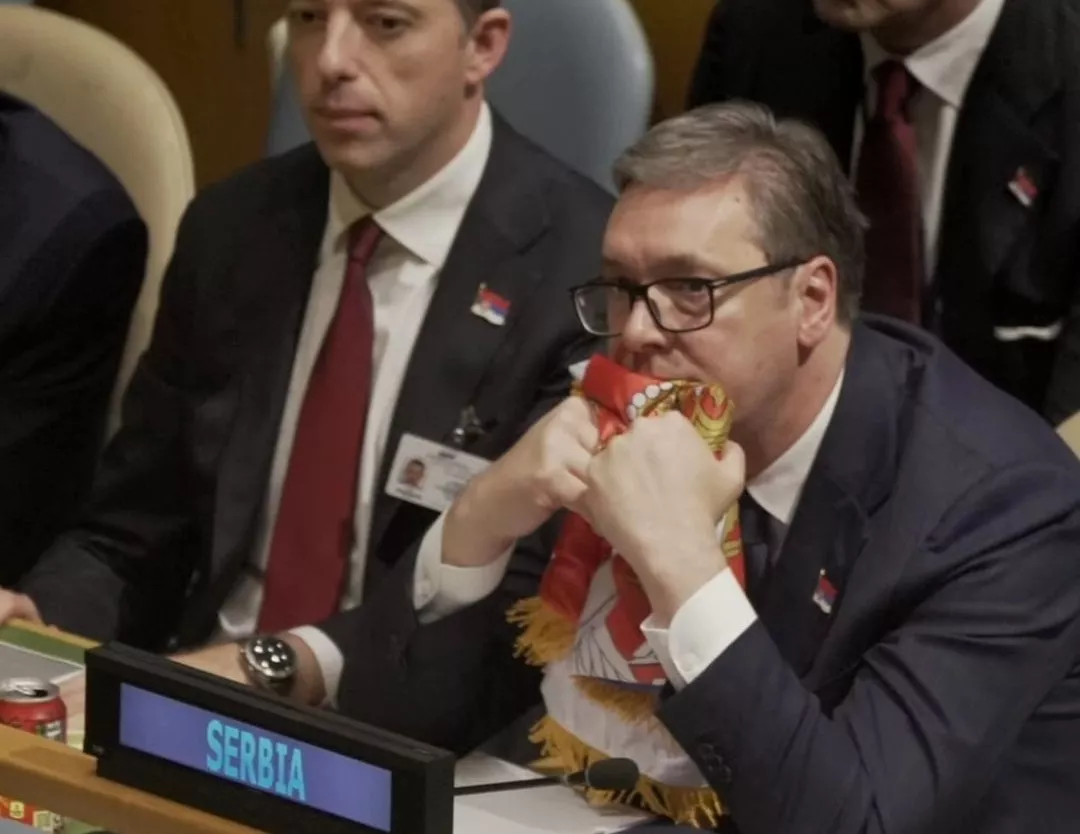
As I expected, in a fan-like manner, counting the abstentions and those who were against, with a flag over his shoulders (and mouth, which I didn't quite expect) as if the fact that genocide was committed is a matter of some provisional arbitration and the number of votes that ambassadors of 193 UN member states give at the General Assembly session, with all the political and diplomatic calculations that each of those states has on this or any other issue, Vučić, with a smile on his face, sitting at that session, commented on his country's debacle.
Vučić described this debacle as a “moral victory for Serbia”.
The Chancellor of the Federal Republic of Germany, Willy Brandt, knelt on December 7, 1970, in Warsaw and paid homage to the victims of the Holocaust.
They say that even his closest associates did not know he would do it, and that some of them even expressed displeasure afterwards. We will never know what Willy Brandt was thinking in that moment: did he make this gesture for the Jews, the victims of the Holocaust, for the Germans who for 25 years carried the enormous burden that German Nazis had placed on the shoulders of the German nation, or did Willy Brandt kneel and ask for forgiveness for both – for the victims of the Holocaust and for the Germans, to lift at least part of that historical burden from their shoulders.
The images and videos from our media, which are shown in the offices of associations and the homes of Srebrenica mothers, where the camera captures their every grimace, reaction, and look in their eyes after it is announced that Karadžić was convicted, Mladić was convicted, and in this case, that the Resolution was passed in New York, are terribly ugly.
And then comes the applause. Just as if one of our football or basketball teams were playing in the Champions League final, and it needs to be celebrated with flags on their backs on the big screen.
Nothing that happened two days ago in New York has anything to do with any euphoria when, eventually, one of “our” teams wins on the world stage. This team that voted for the Resolution is a group of states that recognized the importance of that Resolution, by which the world will remember Srebrenica – Bosnia and Herzegovina every July 11th. First for themselves and for the future of the world, and then for the victims. If only the world could remember us for something good.
If only the Srebrenica genocide had not been committed.
When the Hague Tribunal delivered verdicts for genocide, which was later reconfirmed in 2007 by the judgment of the International Court of Justice in the same city, in the lives of the mothers whose children were killed, the children whose fathers and grandfathers were killed in July 1995, the women whose brothers, fathers, and husbands were killed, in their lives, in my life after my father, mother, and brother were killed in July 1995, nothing changed.
Our lives gained a little more meaning because we learned that our pain was recognized and acknowledged, that the truth was judicially established, and that no one would ever be able to question it again.
It is precisely this historical and judicial truth that Vučić and Dodik are trying to question in the most grotesque way these days, perhaps hoping that a part of Serbs on both sides of the Drina, as was the case in 1992 or 1995, will blindly and obediently follow their negating and revisionist ideology, just as a part of Serbs followed the ideology of Karadžić, Mladić, and Milošević – all of whom ended up in the dustbin of history.
We who survived the Srebrenica genocide were left breathless these past few weeks, repeating the mantra that the Serbian people are not and cannot be responsible for genocide, and that there is no collective responsibility for this or any other genocide for any people.
Genocide, by definition, is a crime against a collective on an ethnic, religious, racial, or national basis (UN Convention from 1948), but if we were ever to think that an entire people could be responsible for genocide, we would ideologically align ourselves with those who committed the genocide.
Then there would be no ideological difference between the victims of genocide and those who committed it.
And that is what, I claim and believe, both Vučić and Dodik are counting on: to equate the victims of genocide with the ideology that produced genocide, and then, post festum, to put an equal sign between the perpetrators (whose criminal responsibility is individualized in the verdicts) and those against whom the genocide was committed.
This national homogenization, in line with the political and ideological orientation of “all Serbs under one flag,” is the goal of both Dodik and Vučić, both these days regarding the Resolution and any other day – as the only modus operandi by which they can rule on the wings of Serbian nationalism.
This political modus operandi could be and can still be recognized today in national parties from other policies/peoples/countries/sides in the former Yugoslavia, but with one huge difference: none of the other policies/sides committed genocide in the period 1991-1999.
In Republika Srpska, everything is Serbian: the entity is Serbian, the roads are Roads of Srpska, the forests are Serbian forests, the waters are Serbian waters, the railway is Serbian railway, etc. – only genocide is not “Serbian”.
But, while we, who survived that genocide, have been constantly repeating for 29 years that genocide is not Serbian, that no people is and can be genocidal, leading Serbian politicians on both sides of the Drina claim that through the verdicts of international tribunals (in The Hague) and the Resolution adopted two days ago in New York, the Serbian people are being declared genocidal.
Serbian or any other people is not and cannot be genocidal. I repeat this for the umpteenth time.
If that were the case, and it is not, my life in Bosnia and Herzegovina would no longer be possible. Because I would not be able to share a neighborhood with a genocidal people: because I would consider every person of Serbian nationality to be genocidal.
Do people understand the consequences of such a claim, even if it were posed hypothetically.
Serbia fought Germany twice. In Kragujevac, over 2,000 Serbs were shot on October 21, 1941, many of whom were high school boys.
Munich is perhaps the second city with the largest number of Serbs outside Serbia and the Balkans after Vienna. In Vienna, from where General Lehr, who commanded the bombing of Belgrade, came, they say there are 200,000 Serbs living. When talking about Mussolini's crimes, one talks about fascists, not Italians. When talking about Hitler's crimes, one talks about Nazis, not Germans.
The former High Representative in BiH (until 2007), German politician and diplomat Christian Schwarz Schilling, said in one of our TV shows, which I remember well (paraphrasing): Denazification in Germany would not have been possible without the Americans who were omnipresent in Germany, including their military bases.
Vučić/Serbia clearly needs outside help to confront its recent past.
Perhaps this UN Resolution will initiate that process.
No matter how many Serbian flags Vučić wraps himself in, nothing will be able to erase the verdicts of the International Criminal Tribunal for the former Yugoslavia and the International Court of Justice which stated that in July 1995, “in and around Srebrenica…genocide was committed against the Muslims of Bosnia and Herzegovina”.
Nothing more, not even all of Serbia's friends, of whom Vučić claims there are plenty on all continents of the planet, will be able to erase the UN General Assembly Resolution to commemorate July 11th every year as a Day of Remembrance and Reflection on the Srebrenica Genocide.
For those who may not have understood well what was voted on 05/23/2024: the vote was to commemorate the Srebrenica Genocide on July 11th.
The vote was NOT on WHETHER “in and around Srebrenica…genocide was committed against the Muslims of Bosnia and Herzegovina” on July 11, 1995.
That legal fact was established in several verdicts by the International Criminal Tribunal for the former Yugoslavia, and then by the International Court of Justice in 2007.
By the 2007 verdict, Serbia was found responsible for violating the UN Convention on the Prevention and Punishment of the Crime of Genocide of 1948, for failing to prevent genocide and for failing to punish the perpetrators.
People asked me what would happen after the UNGA passed the Resolution. I told them: The sun will rise in the east and the next day will dawn.
(Hasan Nuhanović was a UN translator in Srebrenica in 1995. His father, mother, and brother were killed in the genocide. He is the author of the book “Under the UN Flag”)
Komentari (0)
Prijavite se za komentiranje
PrijavaJos nema komentara. Budite prvi!
Minuta
Sve →Iz drugih kategorija

High Representative Not Elected: Germans, French and British Sabotaged Americans, New Attempt at End of June

ČOVIĆ WITHOUT MERCY: How Those Who Brought Ademović to Office Created a Political Hell for Him



Sunny Saturday, quite warm



Tragedy in Albanian resort: Two minors drown












