
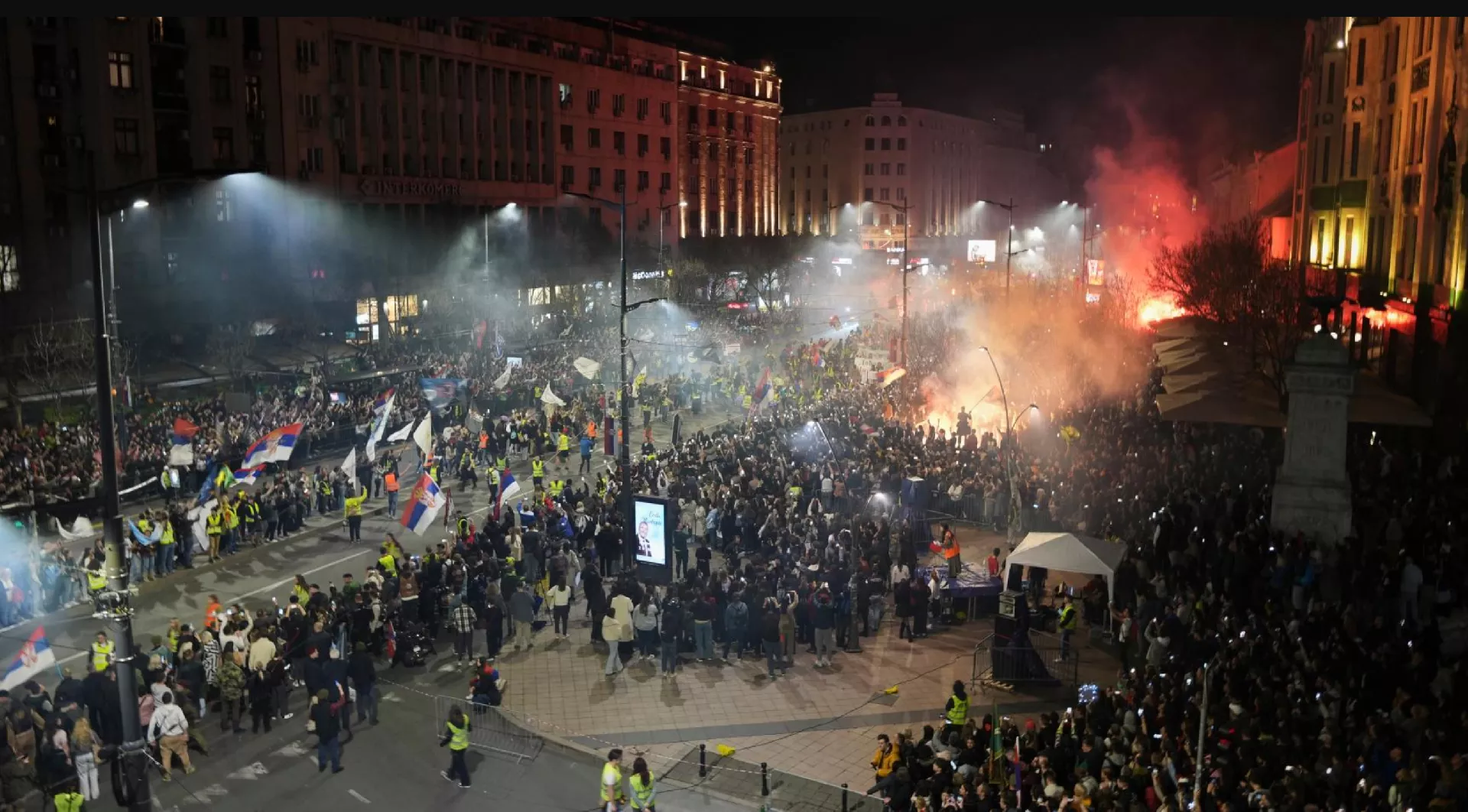
(Patria) - Seven days have passed since the mass protest in Belgrade, but the students' fight against Vučić's government is not over.
There are suspicions that his security forces used special weapons. If it turns out that this is true, it could completely change the situation, writes Die Welt, as reported by Deutsche Welle.
The German newspaper provides a detailed analysis of the events in Serbia, authored by journalist Tatjana Ohm. She herself was an immediate witness to what happened in Belgrade during the tribute to the victims from Novi Sad. She describes it as follows:
"But then the silence is suddenly broken by a sound, a hundred meters away, on Kralja Milana Street. A sound that forces hundreds to flee in panic. They run towards Slavija Square, through the crowd standing there.
People are crushed, pressed against the walls of buildings, falling. After a few minutes, the situation slowly calms down, partly because many managed to keep their nerves. We constantly hear calls not to panic."
The article recalls that this moment was captured on numerous video recordings and that "those directly affected by the sound describe it as a jet flying low towards them, causing pain."
It is assessed that "there are suspicions that sound weapons were used either to disperse the crowd or to cause mass panic" and recalls that "the use of such weapons is banned in Serbia."
The German journalist also notes that all this has sparked major public debates. She then concludes:
"The students and their protest are currently somewhat overshadowed by this discussion. Last Saturday was the peak of their fight against Vučić's system, but it is not over yet. 'This is not a sprint, this is a marathon,' said one of the speakers last week.
However, if it is proven that security forces used sound weapons, the situation could change faster than many currently believe. The marathon could become a half-marathon."
The fact that the protests in Serbia and North Macedonia are now triggered by corruption is the reason the movement is so broad, assesses Die Tageszeitung.
"Corruption sounds harmless. A few banknotes here, a small favor there. But corruption in the former Yugoslavia has long been on a massive and violent scale, even without the two deadly events in Novi Sad and Kočani.
Politicians of the successor states of Yugoslavia wanted to eliminate political corruption from the communist era, but they themselves became corrupt politicians and officials. For years, one could watch trust in the state melt faster than glaciers during climate change.
At the same time, trust in the European Union has also declined. Frustration and fear are piling up not only in Serbia and Macedonia but also in Croatia, because the lack of judicial independence continues to thrive almost unhindered, even in an EU member state.
The fact that corruption in Southeastern Europe is no longer ignored - despite the tragedy of the events - finally offers prospects for a livable future there. If the EU consistently confronted corruption, it could experience its Balkan spring," writes this German newspaper.
"State failure and corruption are mobilizing citizens of Serbia and Romania, but the images from the protests could not be more different: in Serbia, young people march across the country, cheerful and non-violent.
And just a few hundred kilometers to the east, in Romania, frustrated citizens gather around right-wing extremist parties," writes the Swiss Neue Zürcher Zeitung.
"If we look more closely, both phenomena have similar roots: it is a deep alienation of citizens from a political class that does not deliver what it was elected for and from institutions that can be bribed. Something is brewing in the Balkans," assesses the article's author, Andreas Ernst.
"What can Europe do? Not much. Above all, there are a few things it should not do. In Romania, it should not support the questionable exclusion of right-wing extremist Călin Georgescu from the presidential elections.
That non-transparent ruling further increased distrust in the judiciary and politics, and thus the influence of extremists. Neo-fascists should be eliminated at the ballot box," believes the Swiss journalist.
As for Serbia, the author states, the EU should abandon the idea that Vučić is a guarantor of stability in the region. Perhaps he once was, but now that he is in serious trouble, he could become a risk.
"With Bosnia and Herzegovina to the west and Kosovo to the south, Serbia borders two crisis areas. Vučić has direct influence through his allies in the Republika Srpska and northern Kosovo.
Europe and the USA (to the extent they still care) would have to be on alert there. An open crisis in the neighborhood could provide Vučić with an excuse to halt the process of the civic movement."
The Swiss newspaper concludes with the following: "The responsibility for greater democratization in Romania and Serbia lies with the citizens of those countries themselves. Recent years have shown that the EU's influence in the region is steadily declining.
This has increased political risks, but at the same time, personal responsibility and civic spirit have grown. The protests in the Balkans ultimately show that Romanians and Serbs are emancipating themselves."
Komentari (0)
Prijavite se za komentiranje
PrijavaJos nema komentara. Budite prvi!
Minuta
Sve →Iz drugih kategorija

High Representative Not Elected: Germans, French and British Against Americans, New Attempt at End of June

ČOVIĆ WITHOUT MERCY: How Those Who Brought Ademović to Office Created a Political Hell for Him



Sunny Saturday, quite warm



Tragedy in Albanian resort: Two minors drown












