
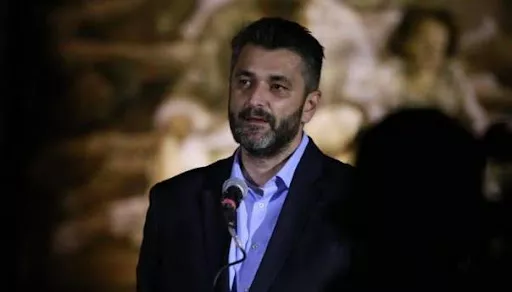
Written by: Emir Suljagić for Istraga.ba
Sometime late last year, a group of political activists, leftists, in a pub on Bjelašnica loudly joked about how I, Emir Suljagić, had finally become „civilised“ and „washed“, after the role in the film „Quo Vadis, Aida?“, loosely inspired by what I survived in Potočari between 11 and 21 July 1995, was played by Alban Ukaj. I got over that, as well as numerous insults I have suffered over the past 26 years, essentially because I survived and, unlike many survivors, did not fall silent. The celebration of the well-deserved success of Jasmila Žbanić's film, which I see on every corner, can only be compared to the deep contempt for the survivors. Genocide and champagne, sh...t.
Ever since Jasmila started working on the film, I stayed on the sidelines as much as was asked and helped as much as was requested. I don't know much about filmmaking, I have never written a screenplay in my life, and I could not help except by answering the questions put to me. Even then I thought, as I do today, that making this film was a pressing need. I did not want, by any action or word, to stand in its way. And I was right: the number of people who learned about the genocidal operation in Srebrenica – even if only one relatively small episode within the terrible saga of Srebrenica – in the last year is enormous. Thanks to Jasmila and her film, we survivors have also gained a platform to speak about events that were doomed to become a footnote in European history. In that sense, that in itself is an achievement for history.
However, I do not wish to participate in the „universalisation“ of the Srebrenica experience, and I have the right to say that loudly as well. Jasmila's acceptance speech upon receiving the European Film Academy award does not correspond to the truth and trivialises the Srebrenica experience. The genocidal operation in and around Srebrenica – to be completely precise, the entire experience of the Bosnian genocide – is unique in that it represents genocide as a „gendercide“.
From May 1992 until the autumn of 1995 – even in October, units of the Bratunac Brigade of the so-called VRS were conducting „terrain sweeps“ in a literal hunt for the few remaining survivors – there was only one guarantee of death: the wrong genitals. The dominant majority of victims in and around Srebrenica throughout that entire period were men: disarmed, bound, killed. The logic of the Serbian genocide was simple. Instead of the mass murder of women and children as well, the killing of men combined with the eradication of the rest of the community – through sexual violence against women, camps, destruction of cultural heritage, forced displacement, and the killing of authorities and elites, i.e., decapitating the community – guaranteed the physical disappearance of the community that was the target of violence. The men who were shot in the Cultural Centre in Pilica on 16 July 1995 were not responsible for any „mess“. Nor was what happened a „mess“.
The second thing in which I refuse to participate is the appropriation of the Srebrenica experience for „all victims“. Jasna Đuričić has the right, in her own name, as the best European actress for 2021, to dedicate the award to „all victims“. But not in my name. The Srebrenica experience is not universal. It is a Muslim experience. The experience of a rural, conservative community of Bosniaks from eastern Bosnia. And that story is only ours. That platform is only ours. No group of victims, or survivors, is subjected to such vilification, insults, contestation and denial – and that as a state policy in Serbia – as the victims and survivors of the Srebrenica enclave.
The awarding of the prize for best film, best director and best actress for „Quo Vadis, Aida?“ takes place in the context of the certainty that the army that committed the genocide – the army of Ratko Mladić – will be re-established. And that the European demand is that we allow that army to coexist with the Srebrenica Memorial Centre. A state for Serbs, Oscars for Muslims. To each what will satisfy them.
And to conclude, let me return to the beginning of the text. Maybe you don't like us as we are – we are not perfect victims, what can we do? – maybe we are a bit too rough, uncouth and loud, but this is a film about our people and our men. Today, as we were returning from town, my 15-month-old daughter fell asleep in the car. And as I was carrying her up the stairs and watching her sleep, I remembered Fehim Mašić, my neighbour, who was holding his child in the same way in the former battery factory on 13 July 1995, when I came to „sign him up“, put him on a list that I was convinced would save his life and the lives of everyone else. No one from my list survived. It was an anti-Schindler list. On it were only men.
(the author of the text is the director of the Srebrenica-Potočari Memorial Centre)
Komentari (0)
Prijavite se za komentiranje
PrijavaJos nema komentara. Budite prvi!
Minuta
Sve →Iz drugih kategorija

High Representative Not Elected: Germans, French and British Sabotaged Americans, New Attempt at End of June

ČOVIĆ WITHOUT MERCY: How Those Who Brought Ademović to Office Created a Political Hell for Him



Sunny Saturday, quite warm



Tragedy in Albanian resort: Two minors drown












