
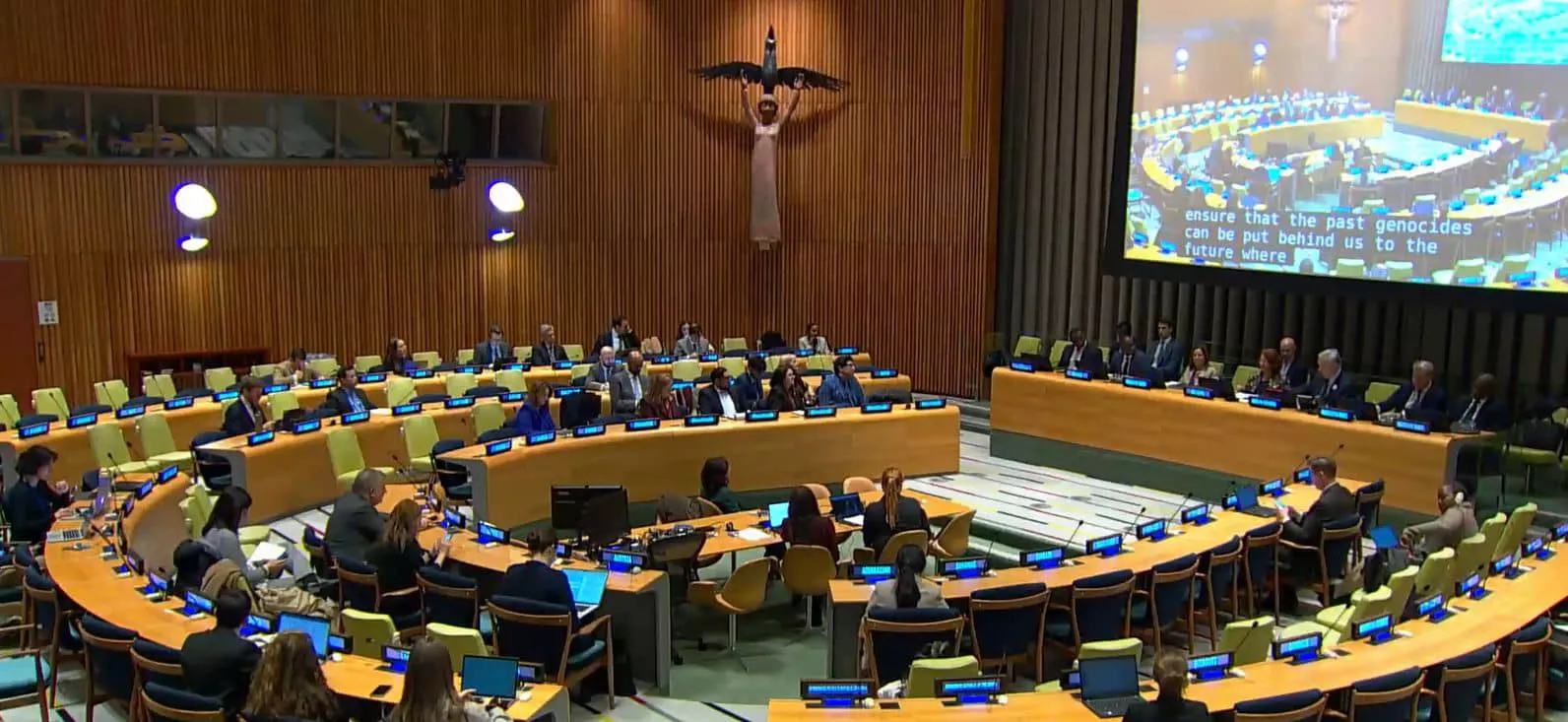
(Patria) - A panel discussion on the role of commemoration and remembrance in preventing genocide was held today at the United Nations (UN) headquarters in New York.
The occasion for this gathering was the commemoration of the 76th anniversary of the Genocide Convention and the International Day of Remembrance and Dignity of the Victims of the Crime of Genocide and of the Prevention of that Crime.
Among others, the Director of the Srebrenica Memorial Center, Emir Suljagić, and the Ambassador of Bosnia and Herzegovina to the UN, Zlatko Lagumdžija, addressed the gathering.
Suljagić: Commemorations accelerate dialogue
- I consider it a coincidence that we gathered here today at a time when thousands of people are being released from prisons in Syria. We are only beginning to gain insight into the true scope of what has been happening in Syria over the past 12 years.
I find it emotional that even those who do not remember a time when they were free are being released. I believe that commemoration and memorialization play a key role in honoring and remembering victims, as well as in preventing the recurrence of discrimination, violence, and genocide - said Suljagić.
He also stated that he believes it is the prerogative of every group of survivors to decide how and what they will remember.
- When we commemorate, we actively choose what is worth remembering, what is for history and what is not. It is important that survivors and victims are at the center of this process.
In the context of Srebrenica, where thousands of children and men were killed in 1995, there are numerous efforts we are undertaking in this regard. The first are efforts in education and raising awareness.
We believe that the role of remembrance and memory is to raise awareness of these events. Also, to remind of the social, political, and historical context that led to them - added Suljagić.
He emphasizes that personal and collective memory, or initiatives undertaken by the Srebrenica Memorial Center, are there to ensure that we remember the personal stories of the victims and to provide a platform and voice to those who are voiceless - the victims.
- It is also important that the experiences of survivors are preserved and recognized. This collective memory is a powerful legacy and remembrance not only of genocide but also of community resistance. It also fuels our commitment to preventing such events in the future - states Suljagić.
He adds that commemorations are important because they accelerate dialogue, and that they should recognize suffering, validate the experiences of survivors, and find ways to overcome trauma.
- The idea behind commemorations is to try to establish spaces for dialogue, reflection, and understanding between survivor groups and, hopefully, contribute to social cohesion. On a broader level, memorial institutions influence policies by promoting research into the causes and consequences of genocide and discrimination.
They also often advocate for policies that strengthen human rights protection and the rule of law, which we believe is fundamental in preventing future such cases - emphasizes Suljagić.
He adds that at the Srebrenica Memorial Center, they do this through educational programs and exhibitions that inform both the local population and the international public about mass killings and their implications.
- We do this by providing a dignified resting place for the victims and a dignified place where their families can come to remember them.
We also do this by simply being there as a symbol against denial and revisionism, which can be a dangerous form of secondary victimization and a barrier to healing and prevention efforts.
We do this with our international partners to advocate for justice and accountability, which we believe are fundamental components of prevention efforts - points out Suljagić.
By keeping the memory of the victims alive, nurturing and maintaining an environment of education and understanding, Suljagić says that efforts in commemoration and preserving memory not only honor those who suffered but also significantly contribute to creating a world that actively works to prevent similar tragedies.
- We believe that focusing on education and remembrance ensures that learned lessons are shared widely, fostering a culture of peace and societal understanding - concluded Suljagić, who joined the gathering via video link.
Lagumdžija: Verdicts cannot be erased
In his address, Zlatko Lagumdžija expressed regret that there is a need for a convention on genocide, and added that he regrets even more that some have violated it.
- Remembrance and commemoration prevent us from forgetting past mistakes and give us endless hope that they will never happen again. It is not about anger or passing judgment. It is about understanding evil, indifference, neutrality, reckoning, honoring lost lives, and education.
It is about transferring genocide verdicts from courtrooms to classrooms around the world. One of the most powerful lessons we have learned from the Srebrenica genocide is that memorialization is not just about the past; it is primarily about the future.
We have repeatedly stated that the Srebrenica genocide is not a matter of opinion, but a historical and judicial fact.
The verdicts of the International Court of Justice and the International Criminal Tribunal for the former Yugoslavia have confirmed that genocide was committed against Bosniaks in the UN safe zone of Srebrenica, and that judicial verdicts cannot be erased from human history, no matter how much someone tries - added Lagumdžija.
Komentari (0)
Prijavite se za komentiranje
PrijavaJos nema komentara. Budite prvi!
Minuta
Sve →Iz drugih kategorija

High Representative Not Elected: Germans, French and British Sabotaged Americans, New Attempt at End of June

ČOVIĆ WITHOUT MERCY: How Those Who Brought Ademović to Office Created a Political Hell for Him



Sunny Saturday, quite warm



Tragedy in Albanian resort: Two minors drown












