
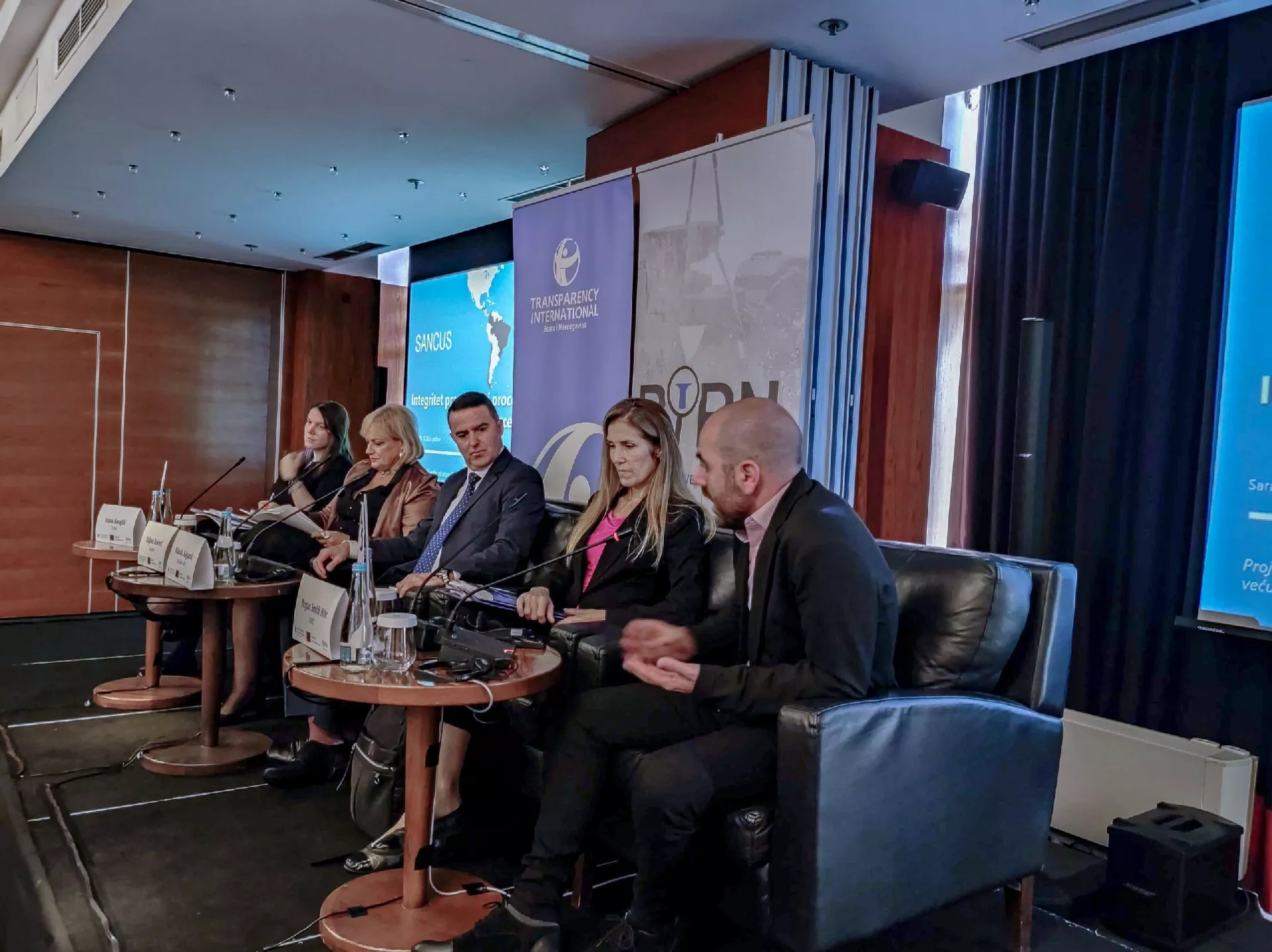
Lengthy court proceedings, insufficient quality of indictments, frequent changes in the composition of the judicial panels, and minimal sentences have characterized the majority of corruption trials in Bosnia and Herzegovina, which were monitored by Transparency International in BiH (TI BiH) in cooperation with the Balkan Investigative Reporting Network in Bosnia and Herzegovina (BIRN BiH) during the past year. Hearings were scheduled less than once a month on average, and it takes an average of 22 months from indictment to the first-instance verdict.
To present the findings of the trial monitoring, TI BiH and BIRN BiH, with the support of the European Union, organized a conference titled "Judicial Integrity and Prosecution of Corruption in BiH," during which a report on monitoring 35 of the most significant cases was presented, encompassing 170 individuals accused of corruption offenses. What is concerning in the work of the judiciary are the extremely lenient sentences based on plea agreements, which are often below the legal minimum, thus acting as an incentive for perpetrators of corruption offenses.
Thus, in the observed period, 7 cases were recorded where four defendants for corruption pleaded guilty and were sentenced to one year in prison, which they can commute to a fine. For 4 individuals accused of corruption offenses, courts in BiH covered by the research imposed sentences of less than one year, while 10 individuals were given suspended sentences that will not be executed if they do not re-offend.
An example that best illustrates how the judiciary fights corruption is the case of Zoran Jovanović, a customs officer who admitted to organizing a group that smuggled excise goods, causing damage to the budget of over 270,000 KM. Subsequently, the Court of BiH imposed a one-year and six-month suspended prison sentence, which he will not serve if he does not commit a new criminal offense within three years.
The dynamics of scheduling hearings, which were held less than once a month in the observed cases, also affect the prosecution of corruption in Bosnia and Herzegovina. The research showed that, on average, the District Court in Banja Luka scheduled 8.5 hearings per case annually, and the Basic Court in Banja Luka scheduled 6 hearings per case annually, while the Cantonal Court in Sarajevo scheduled 16.5 hearings per case annually.
Frequent changes in the composition of judicial panels, particularly the retirement of judges during proceedings, as in the cases against Selma Cikotić and Fadil Novalić, and frequent postponements of hearings, as in the case against Slavica Injac due to the collapse of Bobar Banka, further slow down and prolong the proceedings, diminishing the already shaken public trust in the integrity of the judiciary.
One of the reasons for the poor results in prosecuting corruption is the quality of the indictments themselves. In some monitored cases, criminal offenses were incorrectly stated, such as in the case against Zijad Mutap, whose indictment cited a criminal offense that has not existed in the law since 2016. In the indictment against the former Prime Minister of the Federation of BiH, Fadil Novalić, the prosecution did not even state the description of the criminal offense attributed to the defendants, specifically the offense of money laundering.
Monitoring of trials in selected corruption cases has been conducted from March 2022 to April 2023 in selected cases before the Court of BiH, the Cantonal Court in Sarajevo, the Municipal Court in Sarajevo, the District Court in Banja Luka, and the Basic Court in Banja Luka. The analysis provided a basis for the conference participants to confirm the general impression of the judiciary in BiH: that it is in a state of permanent institutional capture, susceptible to undue influence from political structures and external factors.
This assessment was confirmed by the Analysis of the Efficiency and Integrity of Disciplinary Proceedings against Judges and Prosecutors in Bosnia and Herzegovina, which showed that the mechanisms for ensuring disciplinary accountability of judicial office holders are insufficiently transparent, complex, and lengthy, and the method of punishment is relatively lenient and ineffective, considering the level of responsibility these positions entail.
Thus, in the observed period, 20 cases in disciplinary proceedings against 26 judges were covered, of which only eight were punished for omissions in their work: four by public reprimand, while four judges received salary reductions. A similar problem is visible with prosecutors, against whom 12 proceedings were conducted, in which only one prosecutor was transferred to a lower position due to negligence in their work, while four were punished with salary reductions, where it is important to emphasize that this measure, according to the Law on the HJPC, can last for a maximum of one year.
Analyses of disciplinary proceedings against judges and prosecutors, as well as trials in corruption cases, have shown, once again, that a lack of efficiency, a low degree of integrity, and insufficient transparency are the key shortcomings of the judiciary in Bosnia and Herzegovina. A fundamental reform is necessary regarding the planning and conduct of proceedings in court cases related to corruption and organized crime, along with more effective use of legal tools and a necessary tightening of sentencing policy, stated the conference participants.
Komentari (0)
Prijavite se za komentiranje
PrijavaJos nema komentara. Budite prvi!
Minuta
Sve →Iz drugih kategorija

High Representative Not Elected: Germans, French and British Sabotaged Americans, New Attempt at End of June

ČOVIĆ WITHOUT MERCY: How Those Who Brought Ademović to Office Created a Political Hell for Him



Sunny Saturday, quite warm



Tragedy in Albanian resort: Two minors drown












