
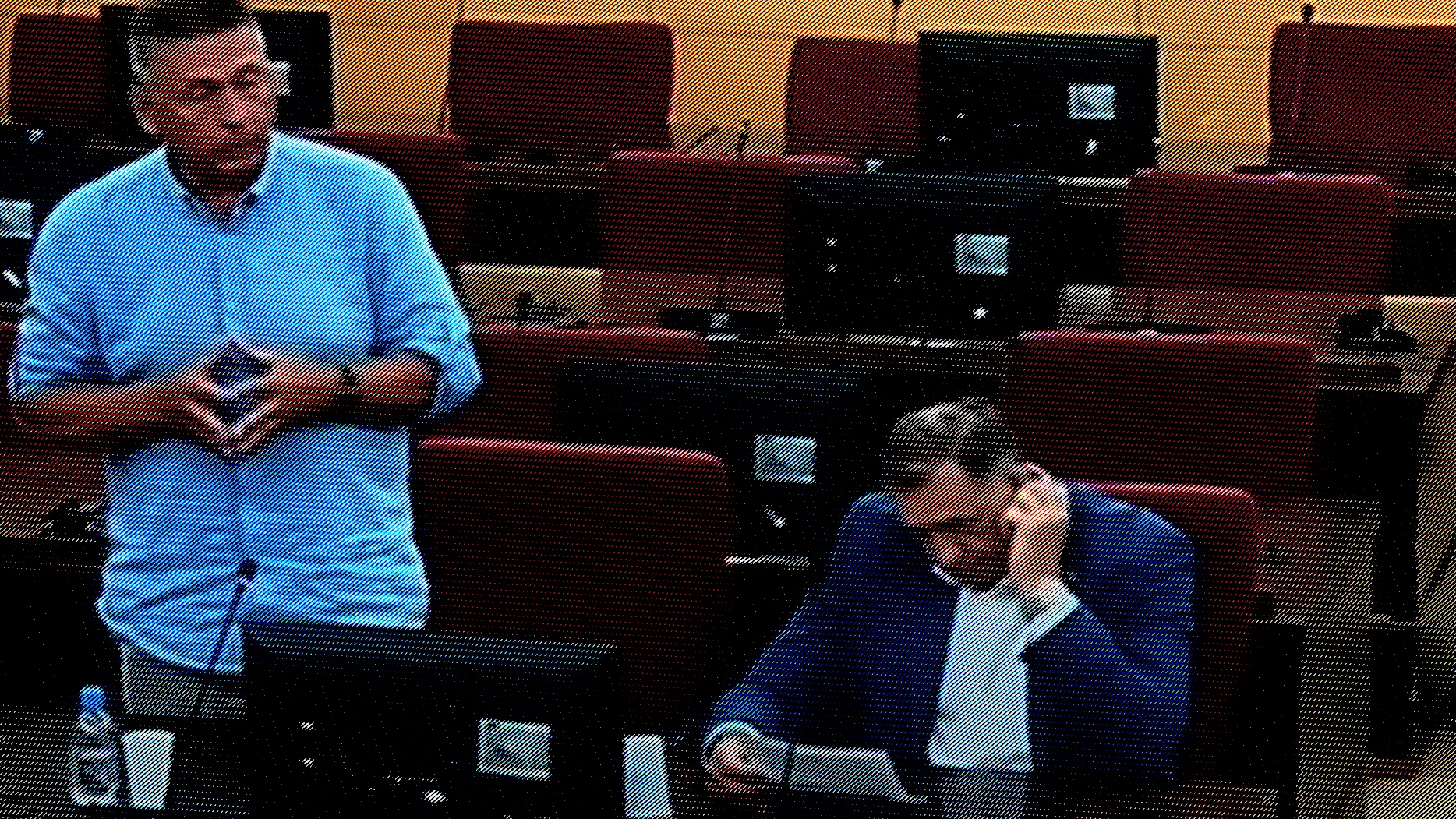
The Court of Bosnia and Herzegovina has denied Detektor's request to provide the complete recording of Milorad Dodik's hearing, which was held in early July without prior notice to the media and the public. Journalists and legal experts believe that by acting this way, the State Court risks increasing public distrust in the judiciary.
On Friday evening, July 4, media outlets in BiH received a joint statement from the State Court and the BiH Prosecutor's Office, informing the public about the lifting of detention for Milorad Dodik, the President of Republika Srpska, who is suspected of attacking the constitutional order.
From that moment on, Dodik ceased to be a fugitive from justice, after actively avoiding and preventing his apprehension for questioning for weeks, despite a warrant and imposed detention.
On Saturday, July 5, the Court of BiH provided the media with a link to a five-minute recording of the hearing, citing increased public interest, "in order to provide accurate, timely, and objective information".
The video is visibly cut in the middle section, during the judge's address, for an unknown duration, during which the position of the folder on the table changes. Also, the end is cut off during the speech of Dodik's lawyer and does not contain the conclusion of the hearing.
Therefore, Detektor sent a request for a copy of the entire recording.
The Court rejected this request, stating that they examined the conditions for determining an exception to the disclosure of information and found that the requested information is subject to restriction in order to conduct the proceedings.
"All information of BiH institutions is considered open and public, unless non-disclosure is fully justified and based on legally prescribed exceptions, on the basis of which the Court established an exception to the disclosure of the requested information," the decision states.
The Court did not explain in detail why they are refusing the request.
Lawyer Sabina Mehić believes that Dodik's hearing in this case was only formally public, but that this did not happen in practice. In an interview with Detektor, she adds that it was logical to provide the entire recording of the hearing after the Court failed to announce its holding.
"The reason the Court gave for not providing the entire recording, due to the stage of the proceedings and the fact that it is not justified by public interest, has no basis in law. There is no case that is more in the public interest than this one," she says.
In its decision, the State Court refers to the provisions of the Criminal Procedure Code, which prohibit the public display of recordings of actions taken during criminal proceedings.
Lawyer Mehić is not familiar with the provision of the law that prohibits the provision of audio recordings, as interpreted by the Court of BiH.
Vildana Kurtić Duran, a journalist from Nova BH who has been following court proceedings for a long time, believes that in this particular case, the State Court should have shown that it respects public interest, especially in a situation where numerous half-truths, unofficial information, and possible speculations about a political-judicial deal have emerged after that hearing.
"I know that the Court of BiH, in its practice, only releases ten minutes, which are often edited according to someone's discretion, but this was a situation where the public in BiH is losing confidence in the independence of the judiciary," she states.
Meldiana Mulaosmanović, the executive editor of the portal Faktor.ba, shares a similar opinion, believing that such behavior by the Court of BiH is another "own goal".
After asking the Court of BiH why they did not announce the hearing on the schedule on their website, Mulaosmanović received the answer that the service responsible for this does not work on duty.
"Precisely because of the increasingly evident suspicion that everything was agreed upon in advance, the least they could have done to dispel that suspicion was to provide a recording of the entire hearing. The justification about protecting the proceedings, personal data, and so on, absolutely does not stand, because the hearing was formally public, meaning open to the public, and journalists could have heard all of this in the courtroom if they had not been prevented from doing so precisely by the Court's withholding of information," she explains.
Dodik's detention was lifted at the hearing, after he voluntarily appeared at the State Prosecutor's Office accompanied by his lawyer for questioning as a suspect in an investigation due to the existence of reasonable suspicion that he committed the criminal offense of "attack on the constitutional order".
After that, he was immediately brought before the Court of BiH, where, at the proposal of the BiH Prosecutor's Office, a decision was made to lift his detention.
The State Court had previously, at the proposal of the BiH Prosecutor's Office, ordered detention for Dodik, the Prime Minister of Republika Srpska Radovan Višković, and the President of the National Assembly of RS Nenad Stevandić after they failed to respond to summons for questioning. This was followed by the issuance of an internal warrant.
Detektor asked the Court of BiH why the complete recording of the hearing was not provided to the media, after which we received the answer that each recording is "cut" in a way that it is available to the public for a maximum of ten minutes, but without personal data, and for the protection of the process itself and the parties involved.
The video provided by the Court to the media lasts just over five minutes.
"The hearing in the mentioned case was open to the public, however, the Court, when it comes to any case where the hearing is held after working hours, i.e., on duty, records the hearing through the trial calendar on the first working day after the hearing, because the service responsible for recording hearings does not operate on duty," the response states.
Mirjana Popović, deputy editor-in-chief of the Center for Investigative Journalism (CIN), believes that the public must know what is happening in such an important case. She states that transparency in this case would give the public the impression that the judiciary understands its demands and its position in society.
"Through such fundamentally important cases that should show that law and justice are present and accessible to everyone, the judiciary can prove that independence and professionalism can still be associated with it," she says, adding that selecting parts of the hearing that the public is allowed to see makes citizens and the media continue to feed their disappointment, distrust, and anger due to the actions of judicial authorities.
Journalist Kurtić Duran says that the Court of BiH was previously the most transparent court in its communication with the public and the media, and that she would not be surprised if lower courts now also adopt the practice of prohibiting or not allowing access to hearings and information at their own discretion and assessment of public interest.
Komentari (0)
Prijavite se za komentiranje
PrijavaJos nema komentara. Budite prvi!
Minuta
Sve →Iz drugih kategorija

High Representative Not Elected: Germans, French and British Sabotaged Americans, New Attempt at End of June

ČOVIĆ WITHOUT MERCY: How Those Who Brought Ademović to Office Created a Political Hell for Him



Sunny Saturday, quite warm



Tragedy in Albanian resort: Two minors drown












