
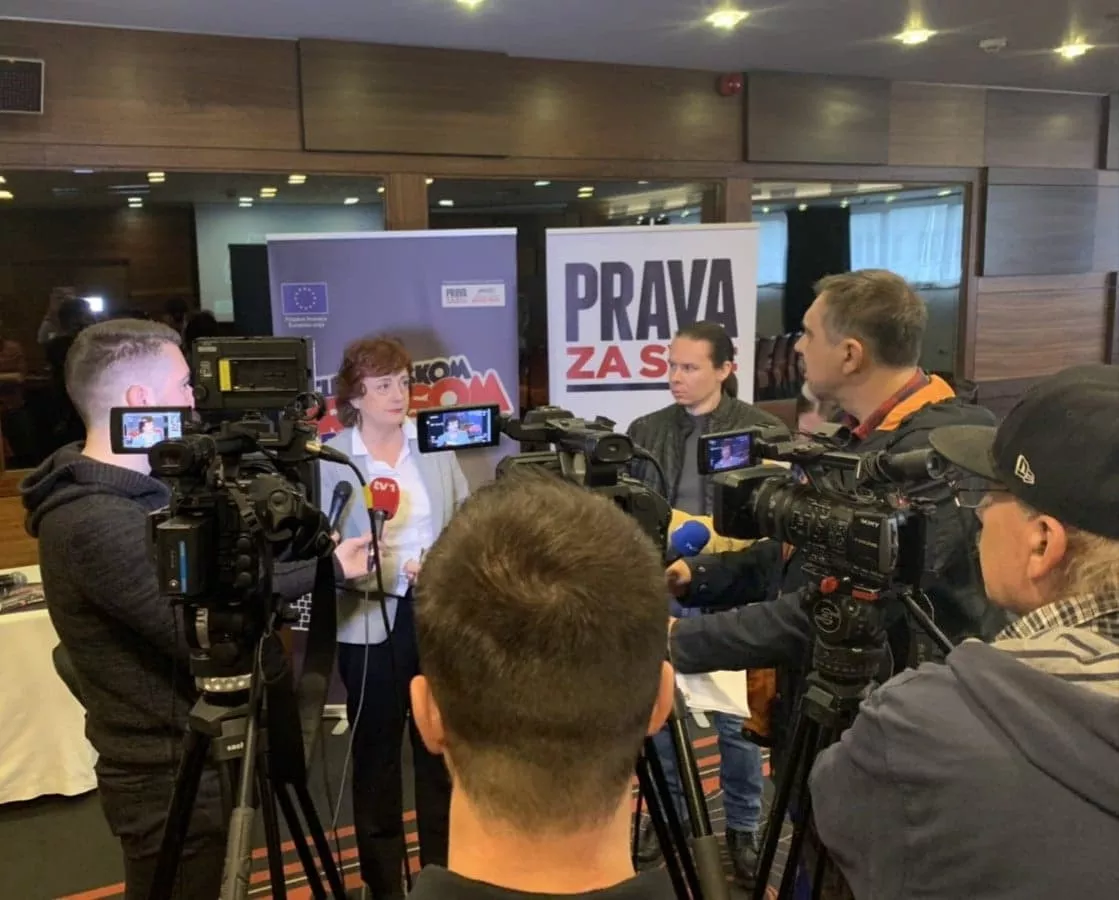
SARAJEVO, (Patria) - Employers, the academic community, students, and civil society organizations today at a meeting in Sarajevo titled "Student internships lead to jobs faster" discussed the necessity of introducing student internships as an incentive for better education and faster employment of young people in Bosnia and Herzegovina.
The meeting was organized by the associations "Prava za sve" (Rights for All) from Sarajevo and "Budućnost" (Future) from Modriča within the project of the same name, financed by the European Union:
"The European Union has allocated over 60 million euros for the support of the education sector in the past 20 years and will continue to do so in the future. Special attention will be paid to the reform of higher education and the transition of young people to employment, given that the connection between education and the labor market is essential for the professional development of young people," stated Ljiljana Pandžić from the Delegation of the European Union to BiH.
"What does the alignment of the labor market and education mean? Should we align education with the labor market or vice versa? How are our children employed in foreign markets? There is the so-called 'fah škole' (vocational school), i.e., education for a specific profession. In BiH, we have vocational studies, for example, in electrical engineering and natural sciences and mathematics – these are professionals who are immediately ready for the labor market. But in principle, we provide academic education. Universities cannot take on the role of the state, employers, and other segments of society. But they can participate in developing the labor market. This is an area where we all must work together," emphasized Prof. Dr. Aida Hodžić, Vice-Rector for Teaching and Student Affairs at the University of Sarajevo.
Saša Aćić, President of the Union of Employers' Associations of Republika Srpska, emphasized that young people must have greater chances of employment: "On average, our young person gets their first salary at 27 and their first child at 29. In other countries, this cycle is much shorter," stated Aćić.
Haris Čapelj, student dean, president of the IEEE Association, pointed out that the basis for solving this problem is networking, i.e., connecting all segments: universities, employers, and students: "Not all statistics are discouraging. We constantly point out how many companies are open to certain professions and what the labor market is actually like. We want to show that there are opportunities for young people, as companies have capacities and expensive laboratories where students can gain practical knowledge, given that universities lack these resources," said Čapelj. On the other hand, Daniela Marić from SPARK Mostar emphasized that a Law on Student Work is necessary to motivate employers to provide internships to interested students.
According to Dijana Šehić, director of Prava za sve, this meeting is an initial activity of the project which, with the financial support of the European Union, opens the way for cooperation between the academic and business communities with student and civil society organizations in the segment of higher education reform related to the introduction of regular student internships into the educational system.
Komentari (0)
Prijavite se za komentiranje
PrijavaJos nema komentara. Budite prvi!
Minuta
Sve →Iz drugih kategorija

High Representative Not Elected: Germans, French and British Sabotaged Americans, New Attempt at End of June

ČOVIĆ WITHOUT MERCY: How Those Who Brought Ademović to Office Created a Political Hell for Him



Sunny Saturday, quite warm



Tragedy in Albanian resort: Two minors drown












