
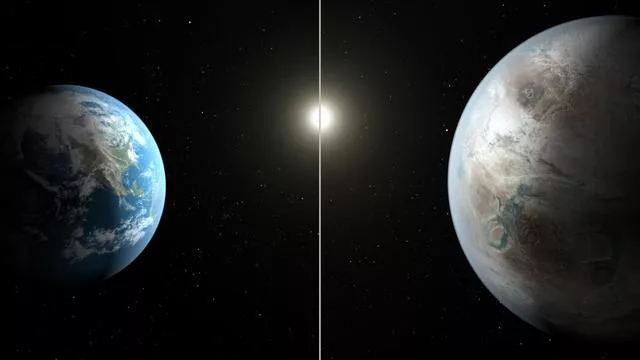
NASA scientists have announced the discovery of Kepler-452b, since yesterday known as "Earth 2.0", an Earth-like planet in our galaxy, reports the Patria news agency.
After years of analyzing data collected by Kepler and even more analysis and work here on Earth, scientists have confirmed the existence of this distant exoplanet, which is the most Earth-like of all discovered so far, writes The Independent.
Although Kepler-452b is too far away to be imaged, the advanced technology of the American space agency has allowed us to learn a surprisingly large amount of information about this "new Earth".
The most Earth-like planet
At the beginning of the conference, John Grunsfeld from NASA said:
-Today we announce the discovery of an exoplanet that is, as far as we can tell, a distant cousin of Earth. The most similar so far. It is Earth 2.0. Everything about Kepler-452b, from its size, length of year, estimated surface conditions, is very similar to Earth.
Years on Kepler-452b are almost the same length as on Earth
A year on the newly discovered planet, the time it takes to orbit its star Kepler 452, lasts 385 days, only 20 days longer than here on Earth.
This greatly distinguishes it from years on other planets closer to Earth. A year on Venus lasts 88 Earth days. A year on Neptune, the farthest in our system, lasts 185 Earth days.
It has spent billions of years at an optimal habitable distance from its star
Kepler 452, the planet's star, is approximately 1.5 billion years older than the Sun. If a planet is too close to its star, it will be too hot for life. If it is too far, it will be too cold. Kepler-452b has been at the perfect distance from its star for billions of years. According to John Jenkins, a data analyst from Kepler, this means it is possible that life exists on its surface or existed at some point in history.
It could have volcanoes and water on its surface
Kepler-452b likely has a temperature that allows water to exist in liquid form on its surface, and as far as the human race knows, that is key for the development of life. The Kepler team collaborated with geologists to determine the planet's appearance. Given its size and age, there is a high possibility that the planet is rocky, meaning it may also have a system of volcanoes beneath its surface.
Humans could potentially survive the stronger gravity of Kepler-452b
The new planet is slightly larger than Earth, and it is estimated to have twice the gravitational force. However, according to scientists, this does not mean that life cannot exist there. John Jenkins said that humans could "adapt" to the gravity and become "stockier over a few generations".
"Humans already adapt to heavy loads. The human body has an incredible ability to 'repair' itself, so we could definitely adapt over time."
The atmosphere is favorable for plants
The planet's star, Kepler 452, is slightly larger than our Sun. The additional light and heat the planet receives from its star not only means the planet is warmer than Earth, but also that plant life is likely more developed. And since photosynthesis produces the air we breathe, this means there is a basis for the development of life.
Unfortunately, it is currently impossible to visit
Kepler-452b is warm, possibly humid, but it is 1,400 light-years away. If a spacecraft carrying humans traveled at the speed of the New Horizons probe, it would take about 25.8 million years to reach the newly discovered "twin" of our planet.
Komentari (0)
Prijavite se za komentiranje
PrijavaJos nema komentara. Budite prvi!
Minuta
Sve →Iz drugih kategorija

High Representative Not Elected: Germans, French and British Sabotaged Americans, New Attempt at End of June

ČOVIĆ WITHOUT MERCY: How Those Who Brought Ademović to Office Created a Political Hell for Him



Sunny Saturday, quite warm



Tragedy in Albanian resort: Two minors drown












