
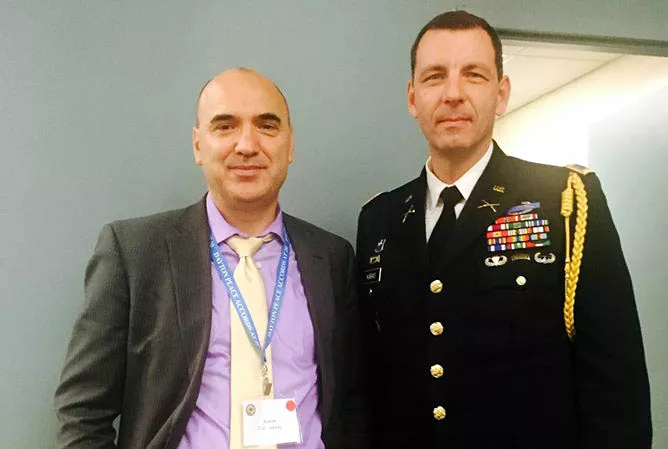
Interview by: Nihad Krupić, special for Patria
Azem Dervišević, known as Zenga, is a hero from the war and a hero in peace. Both then in Bosnia and now in America. He was photographed in the hell of wartime Sarajevo under the American flag, wanting to see that great America even then... Then he came to Boston wounded, on crutches, started a family, got educated, started a successful business, got involved in BH organizations in America, and recently went to Dayton and stood bravely, resolutely and proudly before those who were sent to represent Bosnia, but in reality say that there is no state of Bosnia, but rather two entities that have state competencies, powers, and legal and political authority.
While waiting for his flight to Boston yesterday, he told me in a long conversation:
- Many wishes have come true in my life, and I fought for them, I didn't wait, but I still have one special, big wish, and that is to see Bosnia and Herzegovina as a modern, democratic country, equal to its neighbors in reality. A country where all its peoples and citizens will have equal rights throughout its territory. He told me that we Bosniaks want to be equal to all other peoples in the region and do not want anything for ourselves that we would not want others to have.
- I fought for that with a rifle in the war, and in peacetime I continue the fight using political and economic means. Thank God I am not alone, there are thousands of us in the homeland and all over the world, from Australia to North America. God willing, when I educate my children, I will return to the Drina River because I believe that Bosnia is defended everywhere, and most of all at the Drina River.
Why and wherefore in Dayton?
- To see firsthand where my homeland and my people are, what we can hope for, what those who love and those who do not love Bosnia and Herzegovina and Bosniaks in it are saying. Especially to show those who do not love Bosnia and Bosniaks that I am still a soldier of the homeland and that I am not alone. And that, by becoming a member of American society, I have learned why a free and democratic state is important for every inhabitant in it and why one should not falter on the path that leads to the community of democratic and economically developed countries of the world.
Of course, I am also here to see who is hindering us on this path and to tell such people to their faces, find another country if you don't love Bosnia, and you will never carry it with you anywhere, never divide it, and never abuse or occupy it again. It is much easier for me now than for many in Bosnia, because no one tells me what to say or how to behave. I am a patriot from my own pocket.
Were you also an official member of the delegation of the Congress of Bosniaks of the World at this event?
- Yes, and that was an honor for me. I am a member of the Steering Committee of the Congress of Bosniaks of the World (KBS), which was founded in Sarajevo on July 16, 2011. Here, in North America, we worked for years to prepare for the founding of KBS. You were with me in that team from the beginning, and you know it wasn't easy. KBS prepared for months for the commemoration of the 20th anniversary of Dayton and, in a special Resolution, promoted a few days ago, on November 19, 2015, at the Europa Hotel in Sarajevo, adopted its position and attitude towards the Dayton Agreement.
In parallel with the activities in Sarajevo, a large delegation of KBS, led by me, came to Dayton. Besides me, there were Suad Tica, a member of the KBS Steering Committee from Jacksonville, Ahmed ef. Cerić, a member of the KBS Main Board from Jacksonville, Mujko Erović, a member of the KBS Steering Committee from Chicago, and Emina Cerić, the first business secretary of the KBS General Office.
How could one generally attend this event?
- America is a very organized country, and everything is planned in detail months in advance. Every event has organizers who, regardless of the importance of the event, do not want to spend money from the federal budget but are financed from the profit of that event. Otherwise, finance is my profession, so I know how it works in the USA.
There were several organizers, led by the University of Dayton, who prepared the plan and program and sent it to the officials of the participating countries in these negotiations, journalists, as well as organizations. Those invited to hold panels have a special status; journalists and others had to register and pay to attend the panels where Dayton itself was discussed.
Registration cost $300, and the central dinner where former US President Bill Clinton spoke was $700. The delegation of the Congress of Bosniaks of the World, of course, paid all costs with their own money, while our politicians spent from the budget, the money of the citizens of BiH, and in the end, given how most of them performed, they shouldn't have come to Dayton at all. Especially Igor Crnadak, the Minister of Foreign Affairs of BiH, who talked extensively about how we (as BiH) must have closer ties with Russia, after which I asked who he represented; his party or the political direction of the people he comes from, or the country of BiH, when he does not speak on behalf of the majority of its citizens who know that the European Union and NATO are the ultimate goal of the country's transition and integration.
After my words, he fell completely silent, he often eyed me as I did him, and the next day he didn't even show up for the other panel discussions. I asked for the BiH diaspora to have the same treatment as the diaspora of neighboring Croatia and Serbia. We Bosniaks, displaced around the world, even after 20 years of Dayton, are made to be unequal in our homeland. Due to the complicated process of obtaining BiH documents and participating in elections, the diaspora has been placed in a completely subordinate position and cannot politically influence the decisions made in BiH itself. But I believe that will also change when many from the diaspora realize that they must get involved in the political process in their homeland and be an honest and honorable alternative to the current political and economic despair.
Who else from BH officials was at this event?
- America is the center of political power, and for that reason, we based our activities on cooperation with our BiH officials in New York and Washington, as well as with American senators and congressmen who have supported our resolutions in the Senate and Congress so far.
Ambassador of BiH Haris Hrle came from Washington, a fine and capable diplomat who has a successful mission behind him. He is also the brighter side of our diplomacy in the USA.
Otherwise, in our diplomacy, as well as in other parts of the political structures of power in BiH, there is a significant number of politicians who receive high salaries from BiH citizens and represent only the interests of political or business elites. And they were not appointed to these positions due to their abilities but due to their suitability and because they will blindly follow the directives of their party leaders. The citizens themselves are partly to blame for this because they do not fight more aggressively for the general interest. Such politicians have brought us to the emergency state in which our country finds itself, and we can only get out of this by mobilizing a large number of citizens into more active political action and uniting all BiH patriots into a common front in the fight for BiH.
Who came from BiH?
- Besides Igor Crnadak, there were Ivo Komšić and Ljubo Bešlić, the mayors of Sarajevo and Mostar, and the mayor of Banja Luka, Slobodan Gavranović. These three mayors agreed on cooperation between the three cities at a conference, which is very positive that cities in Bosnia and Herzegovina have good cooperation. Ivo Komšić gave a fantastic lecture. He said everything that needed to be said from the position of a Bosnian man, a true Sarajevan and a Bosnian, and I give him full credit for his performance.
Muhamed Šaćirbey's address also attracted great attention because he was a participant in these negotiations 20 years earlier. Muhamed brilliantly explained the details related to our side's agreement, as well as the blackmail under which the BiH delegation was. He emphasized that Dayton cemented ethnic divisions and legalized a system based on ethnicity and the results of war conquests, primarily by Serbs. It was expected that someone from the BiH Presidency would come, but I personally think they wouldn't have said anything significant and would have understood this gathering as a ceremony where the Dayton Agreement should be celebrated, not buried. For the representatives of the Congress of Bosniaks of the World, this gathering was primarily a place where we would begin to bury the Dayton Agreement and move towards the birth of a normal civil constitution for the state of Bosnia and Herzegovina.
We explicitly emphasized this in our Resolution.
I was also very pleasantly surprised by the speech of Valentin Inzko, who pointed out many flaws in the Dayton agreement and particularly emphasized that it is not sacred and that it is time for a better solution. He specifically addressed the very complicated bureaucracy, the corruption that prevails in all spheres of BiH society, the blocking of decisions aimed at strengthening central state institutions by representatives of the RS, and the uncompromising media war between different politicians and political parties. Through his words, I could sense that the international community is also ready for a major cleanup in BiH, while only our Bosniak politicians are still wisely silent about all of this and are unnecessarily wasting their energy on mutual settling of scores.
Did American diplomats in BiH also speak?
- Maureen Cormack, the US Ambassador to BiH, emphasized that many reforms are being implemented in BiH but that it is going slowly. According to her, BiH has a future, and any attempt at separatism will be sanctioned. Otherwise, knowing how American diplomacy works, it is enough information that Ambassador Cormack has not wanted to meet with Milorad Dodik for a long time, which is the best sign of what official Washington thinks of Dodik and his referendum. I am of the opinion that our political representatives are pointlessly wasting their efforts in vetoing the decision of the RS Assembly on holding a referendum. One should be wise here and let the separatists corner themselves, because as far as I can see, Dodik is doing the most to abolish what he is currently president of, which we true patriots call the genocidal creation, Republika Srpska.
The other American representative in BiH, the military attaché, Colonel Mark Karas, spoke with such enthusiasm about the professionalism of the BiH soldiers that it was a pleasure to listen to him. He said that they achieve excellent results in exercises, much better than many soldiers from NATO member states. He particularly noted that in any war, he would always want our soldiers by his side.
What moment can you say marked your stay in Dayton?
- Certainly, it was the lecture by American analyst and Balkan expert Edward P. Joseph, who mercilessly presented facts related to the aggression against Bosnia and Herzegovina and the genocide against Bosniaks, particularly emphasizing that RS is a product of unprecedented ethnic cleansing and genocide against Bosniaks and that it is certainly a genocidal creation. After his lecture, a representative of the Banja Luka "Nezavisne novine" asked why he calls RS a genocidal creation and when it will stop. He replied:
"When you accept the truth and stop deceiving your people." When I saw the face of that journalist after Edward answered why he calls RS a genocidal creation, I realized that the world is very well aware of what happened in BiH and that it has had enough of Serbian lies and deceptions. After that, Edward added that it would be best for the Serbian political elite in BiH to admit the genocide and crimes they committed and, like the Germans after the Holocaust, free new generations from any responsibility. It is certainly worth mentioning the appearance of Bill Clinton, who says that Dayton has fulfilled its purpose and that he met many young people in Srebrenica this summer who can and know how to overcome the current political despair. He also mentioned that the US government is opening a fund to help small businesses in BiH.
Was there any talk about the performance of BiH officials in Dayton 20 years ago?
- Many American panelists, some of whom created this agreement and were in Richard Holbrooke's team, noted that Alija Izetbegović got the most out of these negotiations. Peter Galbraith, former US ambassador to Croatia, went particularly far. He said: "Franjo Tuđman was completely uninterested in any outcome. He didn't care what was decided and was impatiently waiting to go home. Slobodan Milošević wanted to pull Serbia out of that mud unstained and was not concerned with the fate of Bosnian Serbs, but he wanted them to have their territory. Alija Izetbegović was in a position to negotiate with his hands tied behind his back. His victory was for Brčko to be a district and Goražde to be part of the Federation, Sarajevo indivisible... His biggest defeat was the name Republika Srpska, and he was aware of it immediately... Very sad and barely on his feet, he accepted that decision and pleased Richard Holbrooke, who could go home to celebrate the American family holiday, Thanksgiving." Galbraith particularly emphasized that the biggest mistake of the American administration was not allowing the Army of RBiH to continue its advance and liberate Banja Luka. After that, there would have been no Dayton, and BiH would have been a much better country than it is today. Peter also said something that was not reported in the media: "Slobodan Milošević ended up in The Hague and would have been convicted if he hadn't died. Franjo Tuđman, if he hadn't died, would certainly have ended up in The Hague and been convicted, and Alija Izetbegović would never have been in The Hague, because he was, after all, a man who had special democratic principles, and if he hadn't been there, it's questionable whether the state of BiH would exist at all..."
Finally, what was the final conclusion of the meeting?
- The officials, or those who make decisions, were diplomatically veiled; those who shape decision-making were open and said that Dayton needs to be changed. Everyone agrees that young and new, unblemished people in Bosnia and Herzegovina should get involved in the political process, put forward their candidacies in elections, their platform of action, and change the perception that no politician in BiH is honest anymore. As a member of the Steering Committee
of the Congress of Bosniaks of the World, I repeat the conclusion of our resolution on the occasion of the 20th anniversary of the Dayton Peace Agreement:
"We call on all decisive factors of the international community to prepare and immediately convene a special International Conference at which an agreement would be reached on replacing the Dayton Peace Agreement with a higher quality and more functional solution for the internal organization of Bosnia and Herzegovina, which will be fully implementable and in accordance with all European standards. We call on international factors, especially the United States of America, Great Britain, Germany, and France, to support the adoption of a civil constitution based on the constitutions of these countries. This solution would protect the sovereignty of Bosnia and Herzegovina and enable the rule of civil, not ethnic or national, rights. The Congress of Bosniaks of the World does not accept any ethnic division of Bosnia and Herzegovina and advocates for a state of Bosnia and Herzegovina in which citizens live, not opposing ethnic communities."
This is the position of the organization I represent, and I expect all those who share our opinion and platform of action to join us in a common front for a better and more prosperous BiH. I will just mention one more detail: Before leaving Boston for Washington, I received a message from Sarajevo that my friend and comrade-in-arms... wartime commander, General Ahmet Sejdić, who is also the vice-president of the Congress of Bosniaks of the World, had been arrested. I came to Dayton worried, sad, and angry. After he was released, he told me in a conversation the next day:
"Don't worry about me. I wasn't afraid then, and certainly not now. I am ready to answer for every action I took as a commander. It is always worth fighting for Bosnia and Herzegovina, our homeland."
Komentari (0)
Prijavite se za komentiranje
PrijavaJos nema komentara. Budite prvi!
Minuta
Sve →Iz drugih kategorija

High Representative Not Elected: Germans, French and British Sabotaged Americans, New Attempt at End of June

ČOVIĆ WITHOUT MERCY: How Those Who Brought Ademović to Office Created a Political Hell for Him



Sunny Saturday, quite warm



Tragedy in Albanian resort: Two minors drown












