
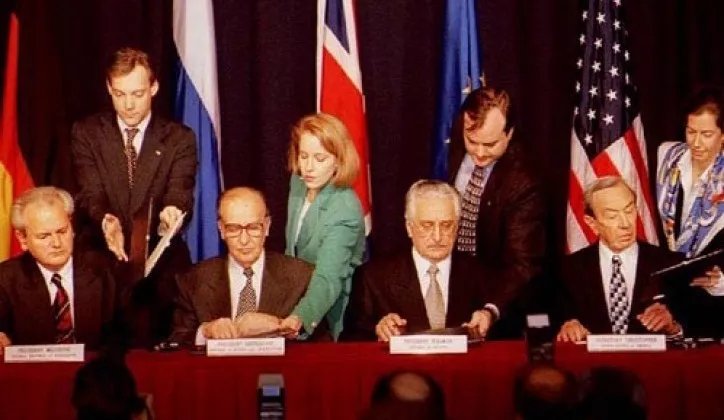
Russian Foreign Minister Sergey Lavrov claimed that Republika Srpska is not violating the Dayton Agreement, but that the other side is the problem. He reacted identically now to Bosnia and Herzegovina's filing of a genocide lawsuit against Serbia before the International Court of Justice. Is that really the case? One could say that Lavrov and his Russia are violating the Dayton Agreement by gifting powerful weapons to Serbia.
What does the gift of a small fleet of MiG-29s mean, what do Buk and Krasnopol, the most modern anti-aircraft systems and long-range missiles mean? What if it is a serious violation of the military part of the Dayton Peace Agreement. This violation became more apparent when Belarus, a military ally of the Russian Federation, added new MiG-29s and numerous missile armaments to Serbia's military arsenals. According to Articles 4 and 5 of the Military Annex of the Dayton Agreement, controls on the regional balance of armaments for Serbia and Croatia are required.
Article 1 of the General Obligations of the Military Annex of the Dayton Agreement states that the "Parties agree that... arms control is of essential importance for the creation of stable peace in the region. To this end, the Parties agree that it is important to establish new forms of cooperation in the field of security with the aim of building transparency and confidence and achieving balanced and stable levels of defense forces." And all this is prescribed "to avoid an arms race." The military annex of the agreement was signed by Serbia, Croatia, and the Federation and RS in Bosnia and Herzegovina. There are precisely defined percentages of armaments that certain states can possess in order to preserve regional stability. Croatia is in NATO, which is a guarantor of the military segment of Dayton. The question is, is there regular and precise control over Serbia's armaments?
The public should be informed about this. Who today has data on the actual, not media-driven, quantities of armaments that the Russian bloc has brought and is bringing into Serbia? Before the media campaign about the procurement of Russian weapons began, Serbian media, as usual, were preceded by Croatian media, writing about the procurement of missiles that could reach Belgrade. Debates were initiated, and everything was taking on the appearance of a complete fabrication and an agreed-upon escalation of tensions. Perhaps someone could explain this paradox to us: Can Croatia, as a NATO member, create tensions against another country and act arbitrarily in exchanging alleged threats? In Sarajevo, they well remember the loyal and sincere wartime cooperation between Tuđman and Milošević at the expense of Bosnia and Herzegovina.
Today, provocations such as the march of the Blackshirts in Zagreb, Ustasha inscriptions in Jasenovac, those "Serbian family trees" in Vukovar, etc., are treated as traditional agreements. Many believe that tensions are being raised to give brotherly Serbia an alibi for better relations with Russia.
What are the motives behind these tensions between Croatia and Serbia when every quarrel between them ends with the leaders of those countries claiming that the situation in Bosnia and Herzegovina is bad and that conflict could erupt there? Why are their mutual threats neatly relocated to Bosnia and Herzegovina? Why, if Dodik and Čović are in loyal embraces and have not exchanged kisses only in some rear parts. Is there an arms balance in Bosnia and Herzegovina? Medium-range missiles have been spotted in Banja Luka. Photographs were shown in the media. In one broadcast on Banja Luka television, the warmongering military analyst Miroslav Lazanski confirmed that Republika Srpska possesses 28 such missiles.
Did NATO or the OSCE react to this weapon? Perhaps there were reactions, but they were hidden from the public. Therefore, it is evident that there are no public reactions to the military violation of the Dayton Agreement. MiG-29s are powerful equipment even by NATO standards. The same applies to long-range Buk and Krasnopol missiles. Serbia did not purchase this equipment from the Russian Federation and Belarus. It received everything for free, and that is a serious problem. If it didn't pay, what does Serbia owe that military bloc? We have the experience of a kind of insane attempted coup in Montenegro. Unfortunately, international officials outside and within Bosnia and Herzegovina are treating these problems casually. They have the same attitude towards the essentially legal issue of Bosnia and Herzegovina filing a genocide lawsuit against Serbia.
By submitting this request, Sarajevo did not violate the Constitution or procedures, but acted lawfully. In addition to respecting procedures, this revision also has some moral dimensions that should be respected. Some international representatives are exclusively concerned with political relations, which are regularly followed by pressure to create problems for this country. Dodik's and Ivanić's parading of units in Banja Luka on January 9th was a formality compared to this suspicious attitude towards the evident violation of the military part of the Dayton Agreement. The public is perhaps the word most frequently mentioned in the text of the Dayton Peace Agreement. Today, we stand in ignorance and before a wall of secrets. What is brewing over the horizon?
By: Sead Omeragić
Komentari (0)
Prijavite se za komentiranje
PrijavaJos nema komentara. Budite prvi!
Minuta
Sve →Iz drugih kategorija

High Representative Not Elected: Germans, French and British Sabotaged Americans, New Attempt at End of June

ČOVIĆ WITHOUT MERCY: How Those Who Brought Ademović to Office Created a Political Hell for Him



Sunny Saturday, quite warm



Tragedy in Albanian resort: Two minors drown












