
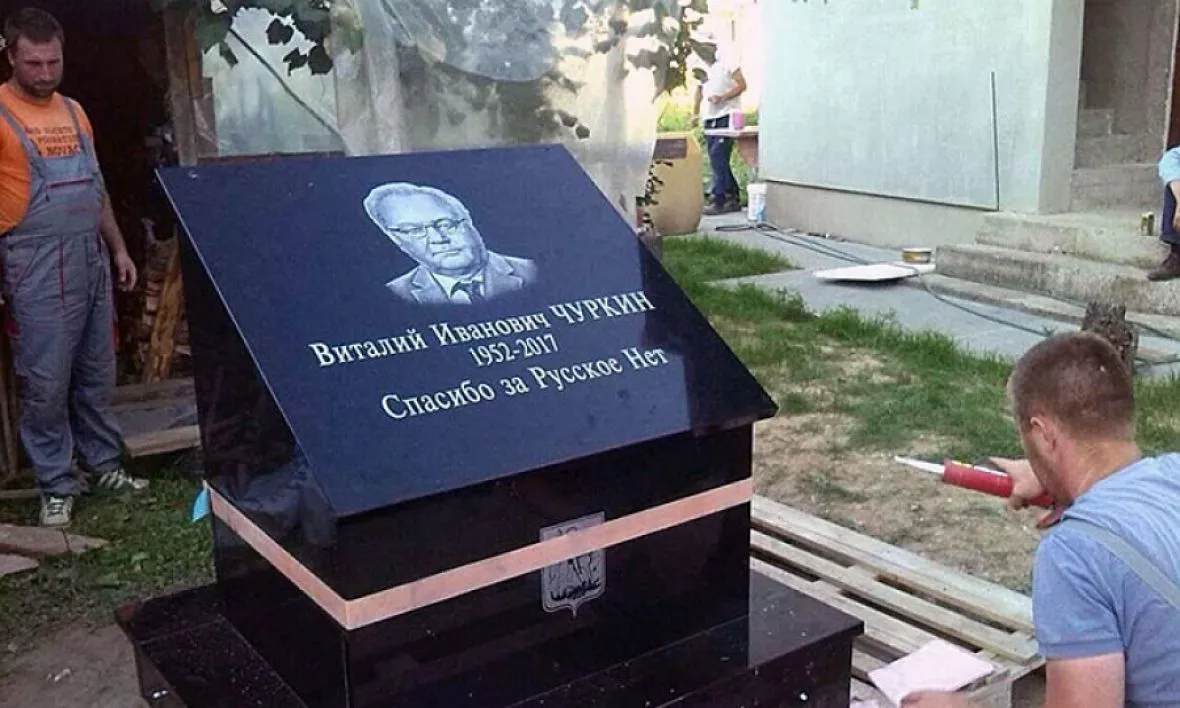
Tomorrow, February 20th, marks one year since the death of Vitaly Churkin, a distinguished Russian diplomat who died of a heart attack. He died in New York, just one day before his 65th birthday, while serving as the head of the Russian Federation Mission to the UN. He began his diplomatic career back in 1974. In his rich career, he served as ambassador to Chile, Canada, Belgium, and even as Russia's representative to the NATO alliance.
He is interesting to us as the special envoy of Russian President Boris Yeltsin for the former Yugoslavia. When Belgrade media write about Churkin, they mostly cover his speeches at the UN, where he emphasized the disenfranchisement of Serbs in Kosovo. Serbian leader Aleksandar Vučić has thanked him several times for the veto on the British Resolution on the genocide in Srebrenica.
When speaking about the monument to Vitaly Churkin in Srebrenica, numerous facts should be cited that do not portray Churkin in a one-sided manner, as suits Milorad Dodik, who would squeeze support for his remaining in power even from dry dogwood.
As deputy Russian Foreign Minister to Andrei Kozyrev from 1992 to 1994, Vitaly Churkin practically shaped Russian policy in the Balkans. Both he and Kozyrev were well acquainted with the details of the agreements between Tuđman and Milošević. Probably because the Russians organized a meeting between the two in Moscow in the autumn of 1991, when their agreements on the partition of Bosnia and Herzegovina culminated. Churkin and Kozyrev told international negotiators Cyrus Vance and David Owen back in 1993 that they were “too convinced of the possibility that the Serbs would commit to their sacred cows – Kosovo and Krajina”. This also revealed the essence of Milošević's, as well as Tuđman's, policy.
When Milošević supported the coup plotters against President Boris Yeltsin in August 1991, Yeltsin was particularly angered by this.
It was Vitaly Churkin who repeatedly warned Western diplomats about the danger of Serbs entering Srebrenica.
Things were clear to the Russians at the time, and they distanced themselves from their Orthodox allies. On February 13th, the Sunday Times published an article: „US boosts fleet as Russia agrees to 'protective' strikes”. The Independent on April 28, 1993, published: „Victorious Yeltsin joins anti-Serb chorus”, then in the same April „Russia joins West in condemning Serbs”, „Kremlin decides to abandon Serbian ally”, and in The Observer: „Russia turns a deaf ear to the cries of Serbian nationalism”... These are just some of the articles in Western media stating that Russia was tired of being the „permanent servant of a crazy policy”, as one American diplomat quoted Churkin.
When the US Congress voted in July 1995 to lift the arms embargo on the Bosnian government, Russia only “expressed regret”. There was not even a hint of Moscow's intention to violate Western sanctions imposed on Serbia in any way.
In his book “The Most Shameful Moment”, probably the best work on the war in Bosnia and Herzegovina, British publicist Brendan Simms writes that Yeltsin had neither interest nor sympathy for the Serbian cause. He told the Serbs to accept the Vance-Owen plan, otherwise they would face “the danger of decisive measures to end the conflict... The Russian Federation will not protect those who resist the will of the world community... Serbian nationalists and other participants in the conflict who resort to force will face a strong blow at the UN”, Yeltsin said in the spring of 1993.
Brendan Simms confirms: “And indeed, his special envoy to the former Yugoslavia, Vitaly Churkin, supported the airstrikes on April 19, 1994, with the words: 'The time has come for Russia to end all discussions with the Bosnian Serbs. The time for talks is over', recorded Churkin's statement by Independent journalists Andrew Marshall and Tony Barber. At one point, Churkin said that the Russian side was ‘sick of the madness of war’. He later also said that ‘the Serbs have pulled Russia and the entire international community by the nose enough’.
‘The Bosnian Serbs must understand that in Russia they are dealing with a superpower, not a banana republic’, Churkin stated.
That was 1994, when the Russians were clear about who Milošević and Karadžić were. However, Churkin admitted that ‘the Russians, more or less from an anti-Serb position, were returned to an initial pro-Serb position by British and French policy’, specifically the policy of John Major and François Mitterrand.
Thus, Russia's policy in the Balkans was not the only one against Bosnian Muslims, Bosniaks. ‘The most useful Russian contribution’, Simms quotes a confidential Foreign Office memorandum from 1993, ‘is their firm opposition to US demands to lift the arms embargo on the Muslims. It is comforting to know that at the decisive moment, the Russian veto will be ready to help’.
After all, the gratitude of the Serbian side to Churkin for the veto on the British Resolution on the genocide in Srebrenica should also be viewed in light of the fact that the International Court of Justice (ICJ) is the supreme court of the UN. To whom and why was such a British proposal and Russian veto needed? It is unworthy even of the worst democracies for, say, the parliament of one country to vote on the ruling of its supreme court, as the UN Security Council voted on the ruling of its supreme world court of justice. Perhaps this will one day be revealed in confidential Foreign Office correspondence.
Russian expert Anatol Lieven said: ‘If Russia did not exist, Britain and France would have to invent it as an excuse for their own cowardice and indecision’.
Vitaly Churkin announced in the Daily Telegraph on April 18, 1993: ‘If Srebrenica falls, all sorts of horrors will happen... We will certainly cast our vote in the UN Security Council ‘FOR’ (for imposing stricter sanctions on Serbia to prevent crimes).
The one who erected a monument to Vitaly Churkin in Srebrenica, and then bowed to him today, knows neither enough about diplomacy nor about the late diplomat Vitaly Churkin. /Sead Omeragić/
Komentari (0)
Prijavite se za komentiranje
PrijavaJos nema komentara. Budite prvi!
Minuta
Sve →Iz drugih kategorija

High Representative Not Elected: Germans, French and British Sabotaged Americans, New Attempt at End of June

ČOVIĆ WITHOUT MERCY: How Those Who Brought Ademović to Office Created a Political Hell for Him



Sunny Saturday, quite warm



Tragedy in Albanian resort: Two minors drown












