
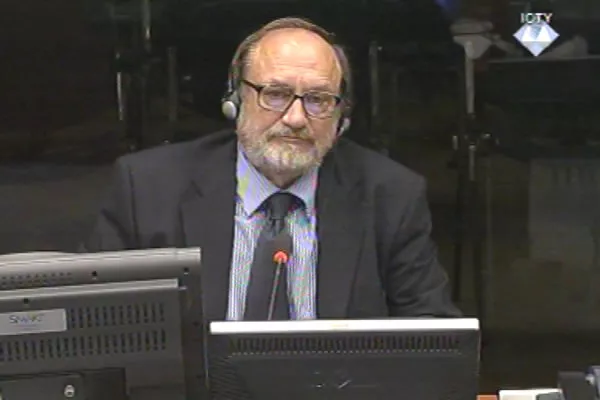
At the trial of Radovan Karadžić before the Hague Tribunal, in November 2013, defense witness Nikola Poplašen stated that during the war in BiH the accused was not an advocate of the expulsion of Bošnjaks and Croats from Serbian territories, reports the Patria news agency.
Poplašen, who in 1992 was the commissioner of the Republika Srpska authorities in the Sarajevo settlement of Vogošća, and after the war was elected president of Republika Srpska, said he never heard that Karadžić insisted on ethnic persecution.
Asked by Karadžić what his stance was on crimes against Bošnjaks and Croats, Poplašen said that Karadžić “demanded that legal procedures be followed and that perpetrators be punished.” He added that the judiciary of Republika Srpska did not have sufficient capacity for that, although there were “many such trials.”
Poplašen confirmed that in Vogošća in 1992 there were “detention centers” for non-Serbs, but emphasized that as soon as he learned of them, he asked the Ministry of Justice of Republika Srpska that those detentions “be included in the system.”
-Incidents occurred, but they were not systematic policy, nor were they approved by the leadership of Republika Srpska, said Poplašen.
Karadžić, the wartime president of Republika Srpska and supreme commander of its armed forces, is charged with the persecution of the non-Serb population throughout BiH, which in seven municipalities had the proportions of genocide. He is also charged with genocide in Srebrenica, terror against civilians in Sarajevo, and taking UNPROFOR members hostage.
In cross-examination, prosecutor Caroline Edgerton presented to the witness that Bošnjaks and Croats from detention in Vogošća were taken to forced labor on the front line, where they were also used “as human shields,” with some being killed and wounded.
-Do you agree that this would be a crime? the prosecutor asked.
-It is so throughout the world, including Libya, Afghanistan, Poplašen retorted.
-Do you agree? Edgerton repeated. “Yes,” the witness replied.
Poplašen, however, suggested that taking civilians to the battle line was part of “lawful mobilization, regardless of ethnicity.” “They were mostly Bošnjaks, but Serbs also had military obligations,” Poplašen added.
Reminded by prosecutor Edgerton that in a 2006 statement he confirmed that the illegal detention of non-Serb civilians in Vogošća was a “crime,” Poplašen said that referred to facilities he had not seen.
-I asked the Ministry of Justice to integrate that into the legal system, because otherwise it would indeed be criminal, Poplašen explained.
To the witness's statement that the SDS leadership and its leader Karadžić had no authority over municipal crisis staffs and the Territorial Defense (TO), the prosecution representative countered with a speech by Karadžić to the assembly in 1995 in which he said that “the SDS formed the army... the TO and Serbian brigades.”
Poplašen interpreted this as “the obligation of civilian authorities to mobilize the TO in a crisis,” which was stipulated “in the BiH Constitution.”
To the witness's claim that there was no ethnic cleansing in Vogošća or elsewhere, only voluntary departure of people caused by “chaos,” the prosecution representative presented evidence of the expulsion of Bošnjaks and Croats in Bijeljina and Banja Luka in 1994, when, as she said, “there was no chaos.”
-Sarajevo was thus left by 100,000 Serbs, Poplašen retorted.
Komentari (0)
Prijavite se za komentiranje
PrijavaJos nema komentara. Budite prvi!
Minuta
Sve →Iz drugih kategorija

High Representative Not Elected: Germans, French and British Sabotaged Americans, New Attempt at End of June

ČOVIĆ WITHOUT MERCY: How Those Who Brought Ademović to Office Created a Political Hell for Him



Sunny Saturday, quite warm



Tragedy in Albanian resort: Two minors drown












