
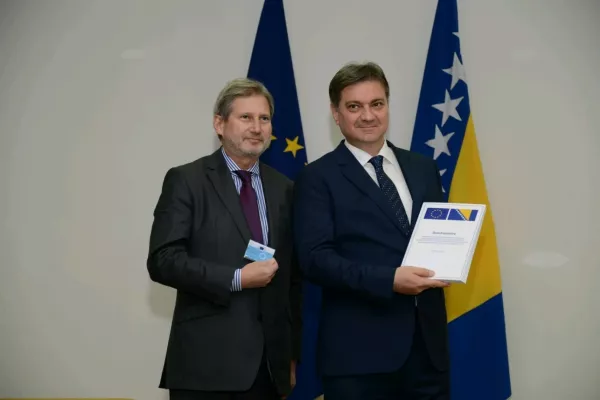
The finalization of answers to the European Commission's Questionnaire, submitted by institutions of BiH, entities, and Brčko District, is underway, after which the translation process into English should follow, writes the BiH news agency Patria.
What no one is talking about, and which will turn out to be a problem, are the different answers from RS institutions and BiH institutions on the same questions. These are the questions where data from the 2013 Census was supposed to be used in the answers. Thus, the Agency for Statistics of BiH used data from the 2013 Census in its answers to the EC Questionnaire, while the Institute of Statistics of RS used data from the results they published in December 2016, which differ from the already published and recognized ones. When the answers go through the Coordination Mechanism, it will be clear that there are discrepancies.
If there is no political agreement and a way to reach a consensus on the disputed answers is not found, the European Commission may return the Questionnaire for revision after identifying irregularities. The European Union and the EU Delegation in BiH exclusively use the verified results of the 2013 population census in BiH in their official documents.
The International Monitoring Mission (IMO) confirmed that the results of the 2013 population census, publicly released at the end of June 2016, are valid and that the Census was conducted in accordance with international standards.
The Agency for Statistics of BiH is unsuccessfully trying to reach an agreement with the management of the RS Institute so that the implementation, i.e., planning and application of data, can finally begin. This would also pave the way for the use of this data in all institutions, instead of the 1991 data.
According to the results of the population census in BiH, a total of 3,531,159 inhabitants live there. In the FBiH entity, 2,219,220 inhabitants live, in Republika Srpska, 1,228,423 inhabitants live, while Brčko District has 83,516 inhabitants. By ethnicity, in Bosnia and Herzegovina, 50.11% are Bosniaks, 30.78% are Serbs, 15.43% are Croats, and 0.77% of the population did not declare their ethnicity.
According to the data published by the Institute of Statistics of RS, a total of 1,170,342 inhabitants live in the territory of this entity. Compared to the recognized Census, this is 58,081 fewer inhabitants. Of these, 82.95 percent are Serbs, 12.69 percent are Bosniaks, and 1.25 percent are Croats.
What further complicates the entire situation is the attitude of the Council of Ministers of BiH towards the Agency for Statistics of BiH, whose work plan has not yet been adopted, and the end of the year is approaching.
BiH is the only country in the region that does not have an agricultural census or updated labor force surveys; they are based on outdated data.
Given that we are aspiring for membership in the European Union, any further economic development is blocked in this way. There are no surveys, strategies, or projections based on current data that we should have as a serious country seeking candidate status.
The greatest disagreement among political representatives and the blockade from the BiH entity of RS is due to the fact that the application of the Census results would lead to a change in the national structure of managers in BiH institutions. The structure from 1991 is still in force, although according to current data, even that is not being respected.
In March 2017, BiH Prime Minister Denis Zvizdić presented data showing that out of 205 officeholders in BiH institutions, 70 are Serbs, 68 are Bosniaks, 61 are Croats, and six identify as Others. According to the 1991 census, there were 1,902,956 Bosniaks, or 43.47%, 1,366,104 Serbs, or 31.21%, and 760,852 Croats, or 17.38%.
If the data from the 2013 Census were to be officially used, the distribution of managers in BiH institutions would have to change drastically in favor of Bosniaks. On the other hand, the number of personnel from the Serb and Croat nations, who already claim to be "endangered in BiH, especially in Sarajevo," would decrease.
Komentari (0)
Prijavite se za komentiranje
PrijavaJos nema komentara. Budite prvi!
Minuta
Sve →Iz drugih kategorija

High Representative Not Elected: Germans, French and British Sabotaged Americans, New Attempt at End of June

ČOVIĆ WITHOUT MERCY: How Those Who Brought Ademović to Office Created a Political Hell for Him



Sunny Saturday, quite warm



Tragedy in Albanian resort: Two minors drown












